

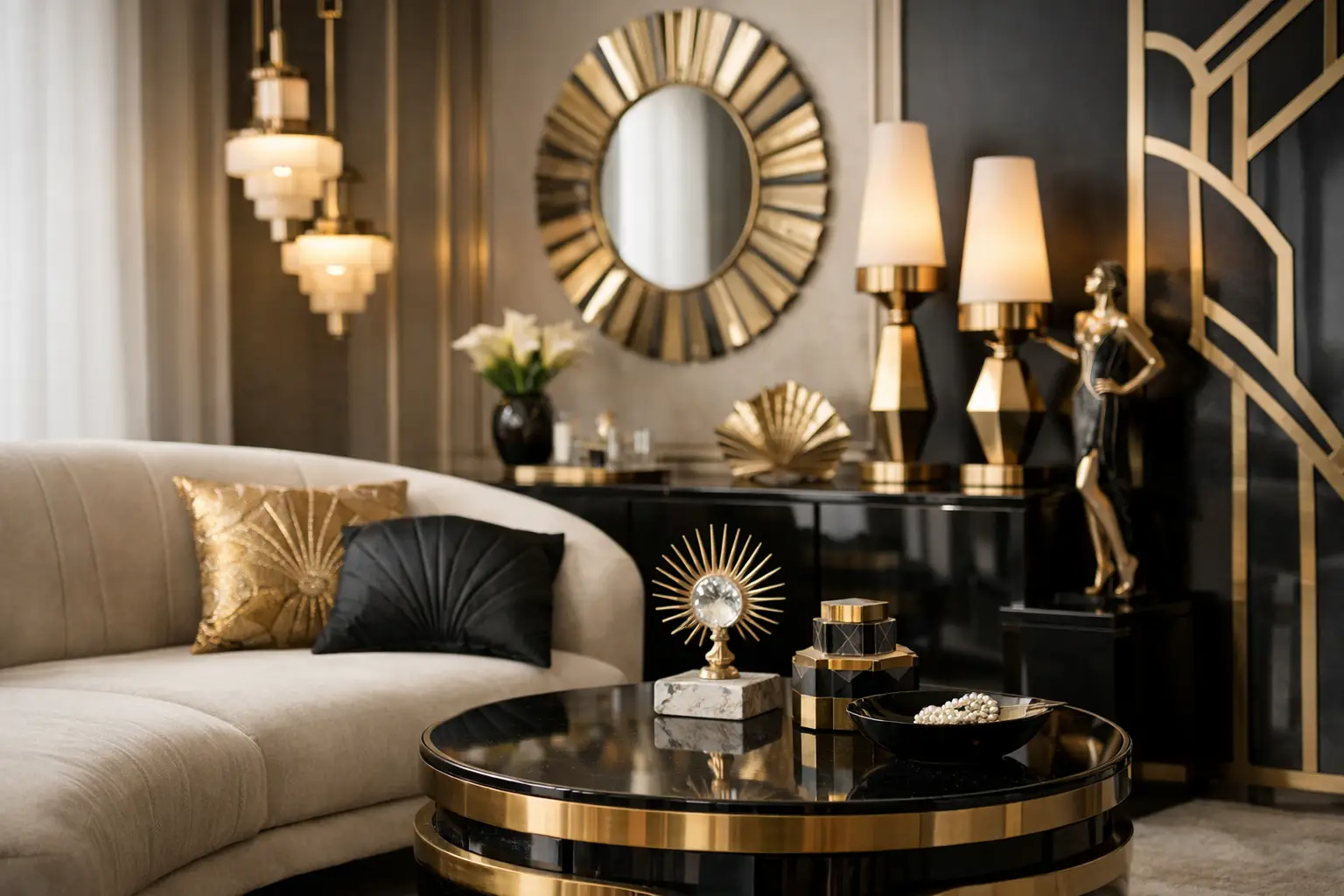
A room rarely needs more objects. It needs better presence. That is where an Art Deco home decor guide becomes useful – not as a formula, but as a way to recognize the visual codes that give an interior precision, glamour, and architectural clarity.
Art Deco remains one of the few historic styles that can still feel visibly luxurious without appearing fragile or nostalgic. Its appeal lies in balance: bold geometry tempered by disciplined composition, rich materials held within clean silhouettes, ornament used with intent rather than excess. For collectors, decorators, and homeowners drawn to vintage character, it offers a language that is immediately legible and surprisingly adaptable.
What defines an Art Deco interior
Art Deco emerged between the 1920s and 1930s, shaped by modernity, craftsmanship, and a fascination with streamlined elegance. In interiors, that translates into symmetry, contrast, and a strong sense of finish. Curves and angles often coexist. A cabinet may have a softened profile, but its veneers, hardware, and proportions remain exacting.
The style is often associated with luxury, and correctly so. Yet the real distinction is not opulence alone. It is control. Art Deco rooms tend to look composed, with furniture and decorative objects chosen for contour, material presence, and visual rhythm. Even a dramatic piece should feel placed, not scattered.
An authentic Deco atmosphere usually depends on several elements working together: lacquered or polished wood, brass or chrome accents, mirrored surfaces, sculptural lighting, marble, glass, and textiles with tactile depth. These materials create the reflective quality that gives the style its signature elegance.
Art Deco home decor guide: the essential visual codes
If you want to build a Deco interior with conviction, it helps to focus less on motifs in isolation and more on the broader composition. Sunbursts, zigzags, stepped forms, fan patterns, and fluted details are all part of the vocabulary, but they should not become costume.
The stronger approach is to begin with silhouette. Look for club chairs with rounded backs, consoles with geometric bases, substantial mirrors, tiered chandeliers, and occasional tables that feel architectural rather than rustic. In Deco rooms, line matters as much as ornament.
Color should follow the same principle. Black, ivory, deep green, oxblood, navy, taupe, and warm metallics are classic choices because they create contrast without visual confusion. Jewel tones work beautifully, especially when balanced by neutral walls or restrained flooring. A room entirely in high-gloss black and gold can be striking, but in a domestic setting it often benefits from softer counterpoints – parchment tones, cream upholstery, smoked glass, or walnut.
Scale also deserves attention. Art Deco has presence, and small decorative items alone rarely carry it. One large mirror, a pair of weighted sconces, or a sculptural table lamp can establish more character than a shelf crowded with theme-based accessories.
Start with lighting, not accessories
In many interiors, lighting is the fastest way to make the style visible. That is particularly true in Art Deco spaces, where chandeliers, sconces, and table lamps act almost like jewelry for the architecture.
A stepped chandelier in brass and glass can define a dining room instantly. Wall sconces with frosted shades and geometric mounts add structure to a hallway or bedroom. A table lamp with a polished metal base, opaque globe, or faceted detail introduces Deco character even in a relatively minimal room.
Vintage lighting has an advantage over reproduction because it carries the material authority the style depends on. The weight of the metal, the tone of aged brass, the cut of the glass, the subtle irregularities of manufacture – these qualities are difficult to imitate convincingly. For a curated interior, they matter.
Murano glass can also work in this context, particularly when chosen for form rather than ornament. Pieces with smoky tones, clear sculptural volume, or controlled gilded accents can enrich a Deco room without disrupting its composure. The key is restraint. If the glass is exuberant, keep the surrounding furniture quieter.
Furniture that gives the room structure
Furniture in an Art Deco interior should anchor the room before it decorates it. Think of sideboards with rounded corners, console tables with symmetrical bases, vanity tables with mirrored inserts, and armchairs with enveloping forms. The effect should feel intentional and substantial.
Wood tones deserve careful consideration. Macassar-style drama, walnut warmth, and ebonized finishes all have a place, but they produce different moods. Dark high-contrast veneers feel urbane and formal. Walnut tends to be more livable and easier to blend with contemporary interiors. Lacquered surfaces create the most overt Deco expression, although they also reveal wear more quickly and may require more deliberate styling.
This is one of the style’s useful trade-offs. A highly theatrical Deco room can be visually memorable, but not every home benefits from full intensity. In apartments, mixed-use living spaces, or interiors with strong natural light, a moderated approach often lasts longer. One striking cabinet, a pair of refined occasional chairs, and polished lighting can suggest Deco without making the room feel staged.
Materials that make the style credible
An Art Deco scheme succeeds when materials carry visual weight. That is why surface quality matters more here than in many other styles. Veneer, marble, brass, chrome, mirror, shagreen-inspired textures, velvet, and glass all contribute to the layered sophistication associated with the period.
However, mixing them requires discipline. Mirror multiplies light beautifully, but too much can flatten the room into effect. Brass adds warmth, but if every accent turns gold, refinement gives way to uniformity. Velvet introduces richness, though it can become heavy if paired with dark woods, blackout drapery, and low lighting in the same space.
The best interiors use contrast intelligently. Pair polished wood with matte upholstery. Set a chrome or brass lamp against a quiet plaster wall. Introduce marble through a side table or console top instead of covering every horizontal surface. Deco is glamorous, but its glamour is strongest when edited.
How to mix Art Deco with contemporary interiors
Many collectors admire the style but hesitate because they fear a period-set result. In practice, Art Deco mixes exceptionally well with contemporary rooms when the focus stays on proportion and finish.
A modern sofa can sit comfortably beside a Deco coffee table if their visual weight is comparable. A clean-lined bedroom can absorb a pair of vintage sconces and a mirrored nightstand without losing its modern identity. Even minimalist architecture benefits from Deco accents because the style brings shine, contour, and a sense of ceremony.
What usually fails is superficial mixing. A room filled with generic modern furniture and a few obvious Deco-pattern cushions will not feel resolved. Instead, choose one or two authentic anchors – a sculptural lamp, a substantial mirror, a cabinet with real material presence – then let the rest of the room support them.
For those buying selectively, this is often the most intelligent path. A boutique curation such as Sound Of Vintage Italy speaks to this approach: fewer pieces, stronger identity, and a clear preference for objects that hold a room on their own.
What to avoid when decorating in Art Deco style
The most common mistake is confusing Deco with excess. The style is decorative, but it is not indiscriminate. Too many metallic finishes, too many mirrored surfaces, or too many pattern references can push the room toward theatrical pastiche.
Another issue is inconsistency in quality. Because Deco depends on material sophistication, a weak reproduction beside an authentic vintage piece is often immediately visible. If budget is a concern, it is better to buy fewer pieces and let each one matter.
It is also worth resisting the urge to over-theme every room. A bathroom or entryway can carry a stronger Deco gesture. A living room often needs more nuance, especially if it is used daily. Interiors last longer when they leave space for life, not only for style references.
Art Deco home decor guide for collecting with confidence
Collecting Art Deco is partly about taste and partly about recognition. Look closely at proportion, joinery, finish, and the relationship between decoration and form. The best pieces rarely rely on one dramatic motif. They hold interest through balance, craftsmanship, and material tension.
Condition matters, but so does patina. A small sign of age on brass or wood is not necessarily a flaw. In many cases, it is part of the object’s authority. Restoration should preserve line and substance, not erase history completely.
If you are building a room over time, begin with the pieces that establish architecture: lighting, mirrors, and one major furniture element. Accessories can come later. That order keeps the interior grounded and prevents decorative drift.
Art Deco still speaks clearly because it understands how objects command space. Choose pieces with that same clarity, and the room will never need to shout.
Sorry, the comment form is closed at this time.