
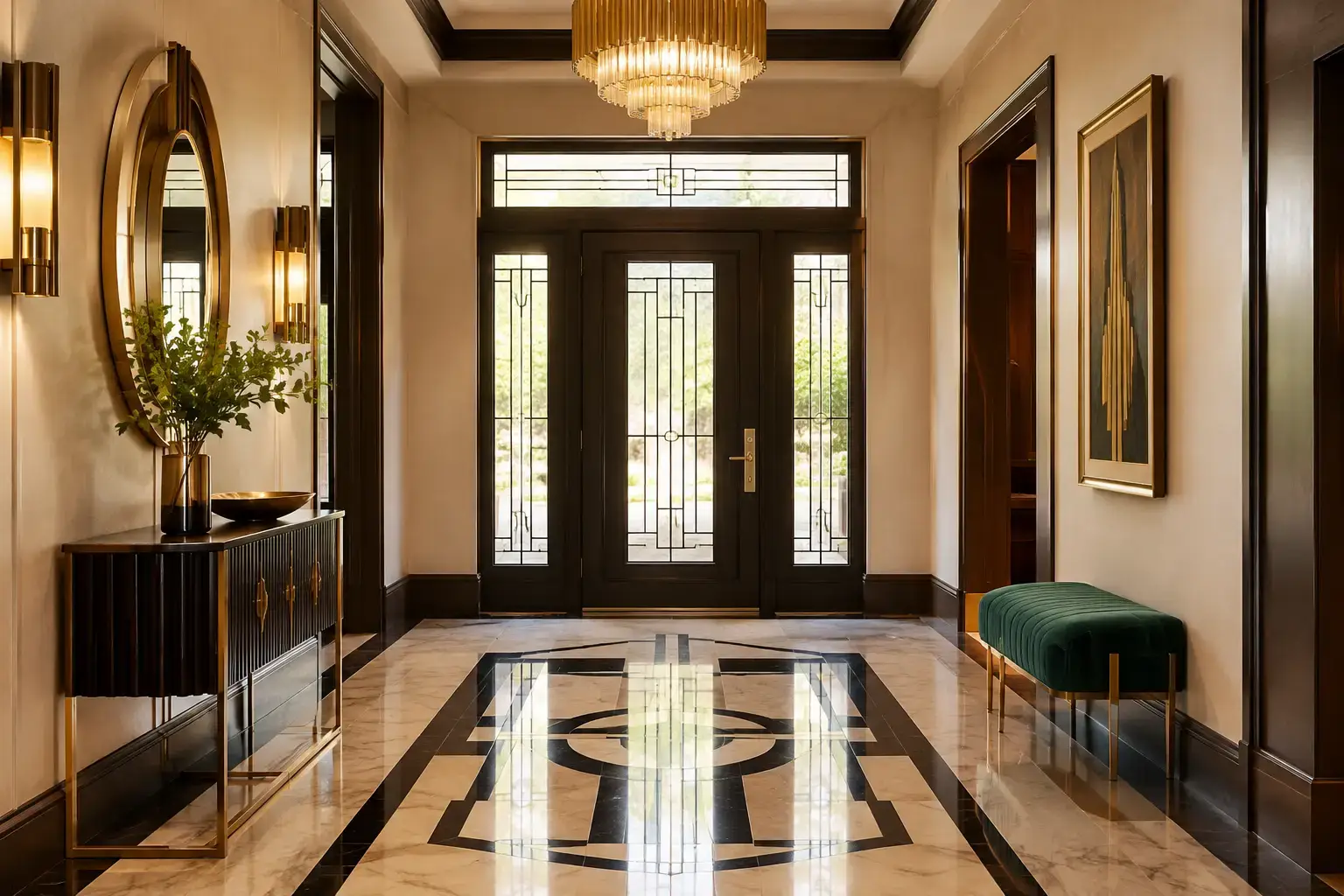
A foyer has only a few seconds to establish the mood of a home. An Art Deco foyer makeover gives that threshold a more deliberate role: not a corridor to pass through, but a composed scene of reflection, geometry, and material presence. The goal is not to recreate a 1920s film set. It is to select a small number of pieces whose silhouettes, finishes, and proportions create a persuasive sense of arrival.
Art Deco works especially well in an entry because it was always an expressive style. Its vocabulary is clear even in a compact space: stepped lines, fan motifs, fluting, black lacquer, warm brass, smoked glass, polished wood, and mirrors that multiply light. The distinction between an elegant foyer and a themed one lies in restraint. One exceptional mirror and a properly scaled light fixture will say more than a room filled with decorative references.
Start an Art Deco Foyer Makeover With the Architecture
Before choosing an object, look at what the foyer already offers. Ceiling height, natural light, floor finish, door profile, and circulation determine the kind of Deco language that will feel convincing. A narrow city entry may benefit from a vertical mirror, a shallow console, and a single dramatic wall sconce. A larger hall can support a low table, a sculptural chandelier, and a rug with an architectural border.
The period itself was not visually uniform. French Art Deco often favors refined curves, exotic veneers, ivory-toned surfaces, and elegant metalwork. Italian examples can feel more architectural and sculptural, with strong glass, marble, brass, and rational geometric forms. American Deco often brings greater graphic contrast, chrome, black, and more emphatic stepped profiles. Choosing one dominant interpretation gives the room a point of view.
For many homes, the existing architecture should lead. In a prewar apartment with original stone or terrazzo, a restrained Italian Art Deco composition can feel entirely natural. In a newer home with plain walls and broad openings, a more graphic Deco scheme may provide the definition the architecture lacks. Do not force dark walls into a foyer that has little daylight simply because black is associated with the period. Deep color needs light, reflection, and breathing room to remain luxurious rather than oppressive.
Build the Composition Around Light and Reflection
Lighting is the most consequential choice in a foyer because it is seen both from inside the home and at the moment of entry. An authentic or period-inspired chandelier with etched, frosted, or opaline glass softens the space while preserving the distinctive Deco silhouette. A pair of wall sconces creates a more formal composition, particularly when placed beside a mirror or above a console.
Brass offers warmth against stone, dark wood, and lacquered surfaces. Chrome has a crisper, more metropolitan effect and can be particularly effective with black glass or smoked mirror. Neither finish is automatically more luxurious. The better choice depends on the temperature of the surrounding materials and the provenance of the central piece.
A vintage fixture deserves careful consideration beyond appearance. Confirm the wiring is suitable for local installation, account for the ceiling box and fixture weight, and use a qualified electrician when required. These practical details protect both the object and the atmosphere you are trying to create. Harsh, exposed cool-white bulbs can flatten even a remarkable fixture. Warm illumination, ideally on a dimmer, allows glass, metal, and polished wood to reveal their depth after dark.
The mirror is lighting’s natural counterpart. A tall framed mirror with stepped edges, a scalloped crown, or a quietly geometric outline can establish the entire foyer. It should reflect something worth seeing: a pendant, a doorway, a piece of art, or the length of an adjacent room. A mirror aimed only at a blank wall is visually useful, but it misses the opportunity to build a layered interior view.
Choose One Anchor Piece With Provenance
The most successful foyer interiors tend to have an anchor: a Murano glass chandelier, a distinguished wall mirror, a walnut console, or a compact cabinet with a strong profile. This does not have to be the largest item, but it should be the piece that makes the room memorable.
Provenance and construction matter here. A vintage mirror with original patina, a carefully preserved Italian glass fixture, or a cabinet with a clearly legible period design brings visual authority that new decorative imitations rarely achieve. Minor wear is often part of that authority. Gentle oxidation on brass, small variations in old glass, and softened edges in wood communicate age without compromising elegance.
Condition should still be assessed honestly. Structural stability, glass chips, veneer lifting, and electrical safety are not romantic details to overlook. In an entry, furniture receives daily contact from bags, keys, pets, and visitors. A delicate original surface may need to be placed where it will be admired rather than constantly handled. If practical storage is essential, pair a collectible focal object with a more discreet, durable cabinet instead of asking one rare piece to solve every problem.
Sound Of Vintage Italy’s approach to selected lighting, mirrors, Murano glass, and decorative antiques is particularly relevant to this kind of room. A foyer benefits from objects chosen for identity, not from a matching set purchased to fill space.
Use Color and Materials With Discipline
A Deco palette does not need to begin with black and gold. Consider tobacco brown with antique brass, cream with deep oxblood, soft gray with chrome, or forest green with walnut and frosted glass. The important relationship is contrast: a dark note against a luminous surface, matte plaster against polished metal, clear geometry against a softer textile.
Keep the largest planes relatively calm. Walls in warm ivory, pale stone, mushroom, or muted putty allow vintage objects to retain their presence. If the foyer can carry more drama, use a saturated color on a single wall behind a mirror or console. A high-gloss finish can be beautiful, but it reveals imperfections and requires a level of upkeep that may not suit a busy entrance.
Flooring often determines whether the scheme feels grounded. Original marble, terrazzo, parquet, and encaustic tile already carry the weight of a Deco-inspired room. Where the floor is plain, a runner can introduce pattern without permanent renovation. Look for a border, a repeated fan, a broken stripe, or an abstract geometric field rather than an overly literal sunburst. The rug should clarify the route into the home, not become an obstacle under the front door.
Edit Accessories Until the Room Can Breathe
A foyer is not a display cabinet, even when it contains collectible objects. A low bowl for keys, a single sculptural vase, or a pair of bookends may be enough. If a console is visually complex, keep its surface nearly empty. If the furniture is simple, one expressive accessory can provide the necessary tension.
Avoid the common temptation to repeat every Deco motif at once. A fan-shaped mirror, a sunburst clock, a geometric runner, palm-leaf wallpaper, and a brass chandelier compete for the same attention. Let one or two gestures carry the historical reference, then introduce quieter elements with excellent material quality.
Function should remain visible in the plan. A place for keys, a discreet tray for mail, adequate light at the lock, and room to set down a bag make the design livable. If coats and shoes must be stored in the foyer, choose closed storage or a tailored wall solution. Visual clutter is especially disruptive in Art Deco interiors because the style relies on clean outlines and intentional symmetry.
Let the Entry Suggest, Not Explain
The finest Art Deco foyer does not announce every influence. It creates a particular sensation through a considered play of glass, metal, shadow, and silhouette. It may hold only three meaningful elements, but each should feel chosen rather than merely decorative.
Give the room time before adding another object. Live with the mirror’s reflection at night, notice how the fixture shapes the ceiling, and see whether the console actually serves the rhythm of daily arrival. A foyer becomes memorable when its materials gather presence over time, offering a small but unmistakable promise of what waits beyond the door.