
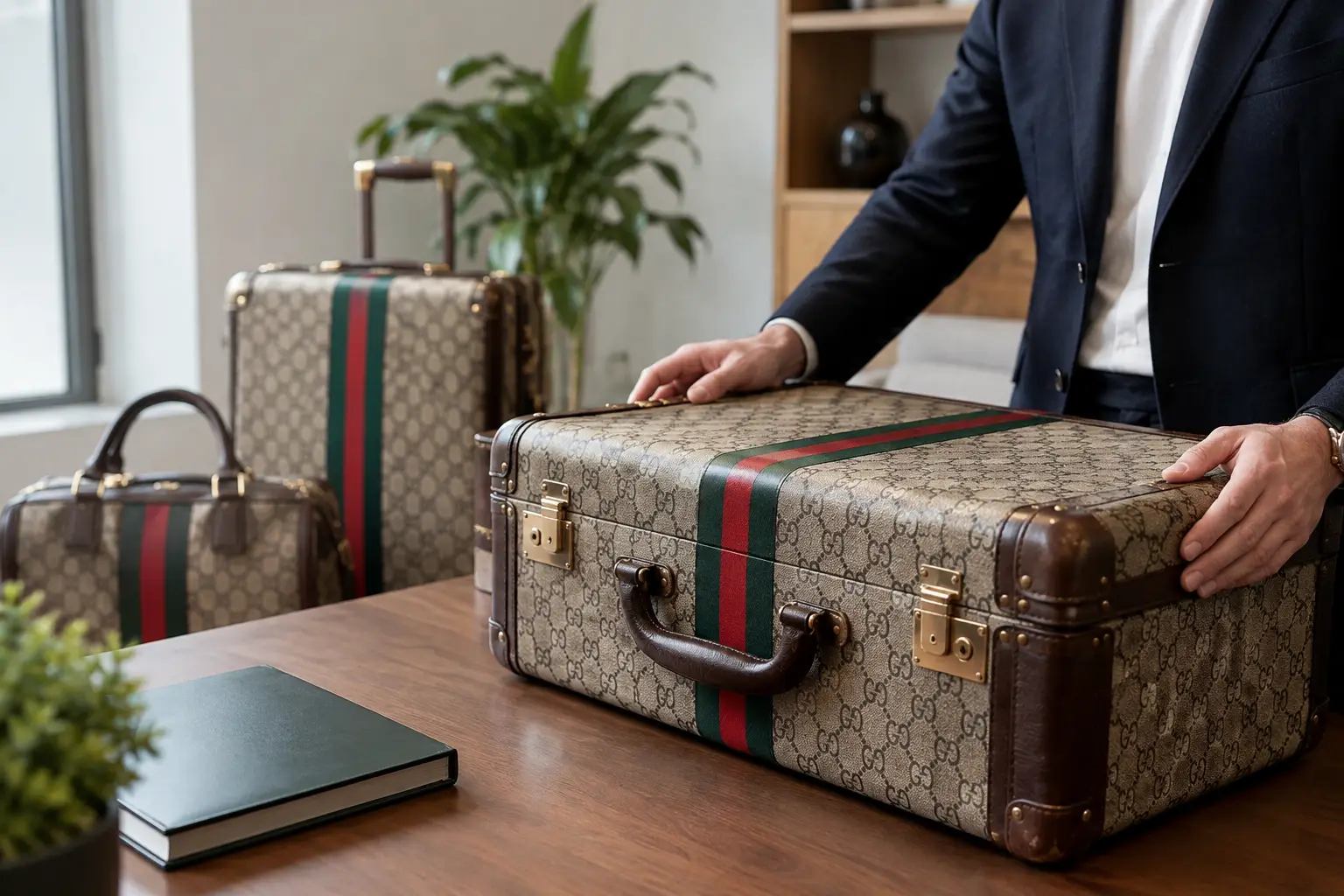
A vintage Gucci suitcase can hold more than the memory of travel. Its patinated leather corners, brass hardware, interior lining, and monogram canvas record a particular idea of movement: polished, personal, and made to last. This Gucci luggage collector case study considers how a discerning collector builds a focused group of pieces, evaluates their integrity, and gives them a meaningful place in a contemporary interior.
For collectors, vintage Gucci luggage occupies an intriguing space between fashion accessory and decorative object. It is recognizable without being anonymous, luxurious without requiring a display case, and often more expressive when its history remains visible. The appeal is not simply the double-G motif. It is the proportion of a 1970s trunk, the weight of a well-made frame, the quiet contrast between canvas and aged leather.
Gucci Luggage Collector Case Study: Building a Focused Collection
Consider the profile of a collector who begins with one medium-sized Gucci suitcase in coated monogram canvas, finished with chestnut leather trim and brass locks. The piece is not pristine. It has light rubbing on its corners, a few travel labels, and a softened leather handle. Yet its structure is sound, its lining is clean, and its details are consistent with its period.
Rather than pursuing every available format, the collector develops the collection around visual dialogue. A soft-sided weekender follows, then a small hard case with a more architectural silhouette. The final acquisition is a vanity case, chosen less for utility than for its compact geometry and presence on a dressing table. Together, the group creates variation in scale and function while retaining a coherent material language.
This restraint matters. A collection of three or four well-chosen pieces often has more decorative authority than a crowded accumulation of similar bags. Different forms allow the eye to register construction: the rigid edge of a suitcase, the relaxed volume of a duffel, the contained elegance of a beauty case. Each object contributes a distinct note.
The collector’s objective is not to recreate a boutique display or to chase a complete brand chronology. It is to assemble objects that feel convincing together in a home with vintage lighting, Murano glass, lacquered wood, or Italian modernist furniture. In that setting, Gucci luggage becomes part of a larger visual vocabulary of craftsmanship and travel.
What Makes Vintage Gucci Luggage Collectible
Age alone does not establish desirability. The strongest examples balance recognizable design with material integrity and a clear sense of period. Early and mid-period pieces can vary considerably in construction, trims, linings, labels, and hardware, so a collector should resist the assumption that every monogrammed case carries equal interest.
Condition is particularly nuanced in luggage. Unlike a handbag, a suitcase was made to be handled, placed on floors, loaded into cars, and taken through airports. Gentle wear can be persuasive: darkened leather, minor surface marks, and a handle softened by use may reinforce authenticity and character. Structural damage is different. Severe canvas cracking, compromised stitching, powdery or sticky linings, strong odors, and failing hardware can limit both use and display value.
Scale also influences collectibility. Large trunks make a dramatic statement but demand space, careful shipping, and a strong interior context. Smaller cases are more flexible. They can sit beneath a console, anchor a bedroom vignette, or hold letters, textiles, and personal objects. A collector with a city apartment may find that a single exceptional vanity case offers more pleasure than an oversized trunk that remains in storage.
Provenance can add interest when it is credible and documented, but it should not replace close observation. Original receipts, period photographs, travel labels, or a clear ownership history may enrich the narrative of a piece. They are supporting evidence, not permission to overlook condition or construction.
Reading the Details Before Buying
Authentication is not a single test. It is a process of comparing details and asking whether they belong together. Examine the quality and placement of the logo, the canvas pattern, leather finish, stitching, zipper or lock markings, interior labels, and the overall execution. A discrepancy may be explainable by a repair or a production variation, but several inconsistencies deserve caution.
The most useful approach is slow looking. Does the hardware have the expected weight and finish? Do the leather components show wear in a way that matches the age of the rest of the case? Is the lining appropriate to the format and era? Are replacement parts disclosed, and are they sympathetic to the object? A restored handle may be entirely acceptable when it preserves a usable case, provided the work is understood and reflected in the price.
Photographs should show corners, seams, interiors, locks, handles, tags, and any areas of loss or repair. A collector should be wary of listings that rely on a single flattering exterior image. For a luxury vintage object, transparency is part of the value.
The Condition Question: Patina or Compromise?
The distinction between desirable wear and material fatigue is where experienced collecting begins. A rubbed leather edge can be beautiful. A dry, splitting edge needs attention. Tarnished brass can offer warmth and depth. A lock that no longer functions changes the practical and, sometimes, decorative equation.
In this case study, the collector chooses the suitcase with visible travel marks over a shinier example with an altered lining and recent, poorly matched leather replacement. The choice reflects a preference for coherence. Originality, even with honest signs of age, can be more compelling than surface perfection achieved through indiscriminate restoration.
That said, there is no universal rule against restoration. If a suitcase will be used occasionally, a professionally reinforced handle or repaired seam may be sensible. If it is intended as a sculptural object, preserving its original state may be the priority. The right decision depends on intended use, rarity, cost, and the quality of the intervention.
Avoid aggressive cleaning. Harsh products can strip leather, alter the appearance of coated canvas, and remove the subtle evidence that makes an older piece convincing. Dust with a soft dry cloth, keep the case away from direct sunlight and excessive humidity, and avoid overfilling it. When storing luggage, use acid-free tissue to support its shape rather than forcing the case into a rigid fullness.
From Travel Object to Interior Accent
Vintage luggage has a natural affinity with interiors because it introduces narrative without needing explanation. A single Gucci case at the foot of a bed can soften a minimalist room. A stack of two complementary pieces beside a low lounge chair can bring depth to a Mid-Century setting. On a wide console, a small vanity case can act as a refined container for correspondence, scarves, or photographs.
Placement should feel intentional rather than theatrical. A suitcase displayed open, overflowing with props, can easily become costume-like. Closed cases tend to read more elegantly, especially when paired with objects of different material character: a Murano lamp, a ceramic vessel, a framed black-and-white photograph, or a polished metal tray.
Color is equally important. The warm beige and brown of classic monogram luggage works especially well against walnut, tobacco leather, cream plaster, deep green, burgundy, and black lacquer. In a more contemporary space, the graphic repeat of the canvas can create welcome tension against stone, chrome, or glass.
At Sound Of Vintage Italy, this approach aligns with a broader idea of collecting: objects should retain their individuality while participating in a composed room. Luxury luggage earns its place not through a logo alone, but through material presence, proportion, and the story suggested by use.
A More Considered Way to Assess Value
Price should be evaluated through a combination of rarity, condition, scale, completeness, and visual appeal. A common model in excellent condition may be more suitable for a first purchase than a rarer piece with extensive damage. Conversely, an unusual trunk with intact original fittings may justify patience and a more substantial budget, especially if it can define an interior.
Collectors should also account for the less glamorous realities: shipping costs, insurance, restoration, storage, and the physical dimensions of the object. Large luggage can be expensive to transport and difficult to return. A careful request for measurements, weight, and detailed condition information is not excessive. It is part of buying well.
The most enduring collection is not built from urgency. It develops through comparison, repetition of trained observation, and the confidence to leave behind a piece that is merely acceptable. When the right Gucci case appears, it will offer more than recognizable luxury. It will have a silhouette, surface, and history that continue to reward attention long after it has found its place in the room.