
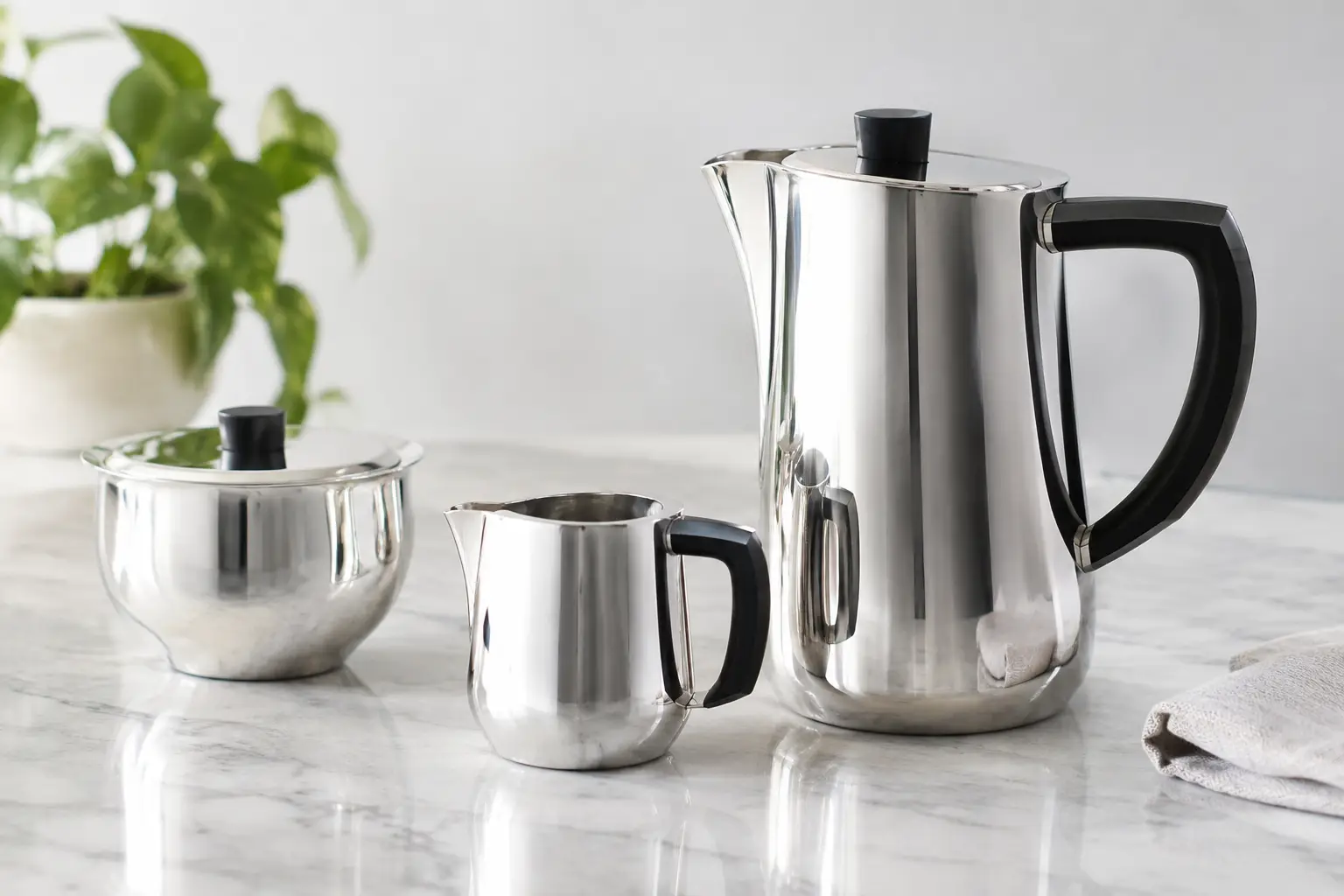
A Lino Sabattini silver object can make an entire table setting feel deliberate. A low bowl catches light without demanding attention; a tall candlestick introduces a sculptural vertical line; an ice bucket becomes a small piece of Italian design history. This Lino Sabattini silver review considers what separates a memorable example from a merely attractive one, and why the designer’s work continues to appeal to collectors and interiors with a modern point of view.
Sabattini did not treat silver as a conventional luxury material destined for ornate display. His language was cleaner, more architectural, and often surprisingly sensuous. The best pieces make metal seem almost soft, with stretched curves, tapered edges, or reflective surfaces that change character as the room changes around them.
Why Lino Sabattini Silver Still Feels Current
Lino Sabattini belongs to the generation of Italian designers who gave everyday objects a new visual authority in the postwar decades. Working across tableware, decorative objects, and functional accessories, he brought the formal clarity of modern Italian design to a material long associated with tradition and ceremony.
That tension is central to his appeal. A Sabattini tray or vase can sit convincingly beside Murano glass, a Mid-Century credenza, or a more austere contemporary interior because it does not rely on period decoration. Its presence comes from proportion, volume, and the disciplined use of negative space.
The finest examples have an immediate silhouette. Some are fluid and biomorphic, with forms that seem shaped by movement; others are geometric, reduced to a strong oval, cylinder, disc, or elongated curve. This is not silver chosen only for its surface value. It is silver selected for its ability to hold light, reflect color, and make a functional object feel quietly ceremonial.
For a collector, that distinction matters. Decorative silver without a recognizable design vocabulary can be difficult to place in a modern room. Sabattini’s work usually offers a more precise answer: it adds luminosity and material richness without introducing visual noise.
A Lino Sabattini Silver Review Starts With Material
The word “silver” requires attention. Not every object attributed to Sabattini is solid silver, and this is neither unusual nor necessarily a drawback. Much of his production was made in silver plate, stainless steel, pewter, brass, or other metals, depending on the edition, manufacturer, and intended function.
Silver plate is often the right choice for a large tray, centerpiece, or bar accessory. It gives the visual depth and cool reflection associated with silver while allowing more generous scale. Solid silver has a different appeal: weight, intrinsic material value, and, in many cases, the presence of formal Italian assay marks. Yet a solid silver object is not automatically more compelling than a plated one. Rarity, design quality, condition, and provenance may matter just as much.
A buyer should be wary of vague descriptions. “Silver tone” only describes color. “Silver plated” indicates a layer of silver over a base metal. “Sterling” has a specific meaning in American terminology, while Italian silver is commonly identified through purity numbers and maker or assay marks rather than the word itself. A careful listing should state what is known, show the relevant marks where possible, and avoid presenting plated metal as solid silver.
The surface also deserves close reading. Sabattini pieces may be polished to a mirror finish, satin-finished, hammered, or deliberately textured. Each finish has a different relationship with wear. Mirror-polished silver reveals fine scratches quickly but can often be professionally refreshed. A textured or hammered surface can conceal light signs of use more gracefully, though severe polishing may flatten the original character.
Hallmarks, Signatures, and Attribution
Marks are useful, but they should not be treated as the only evidence of authenticity. Depending on the piece and period, one may find an engraved or stamped Lino Sabattini signature, workshop mark, retailer mark, manufacturer mark, or Italian silver hallmarks. Some objects were produced in collaboration with established companies, so the maker’s identity can be part of the object’s story rather than a reason for doubt.
What matters is consistency. The construction, finish, proportion, and marking should support one another. A signature alone is less persuasive if the design is poorly resolved, the quality of the metalwork is weak, or the mark looks newly added. Conversely, an unsigned item with a documented model, convincing construction, and reliable provenance can still be a serious design object.
Photographs should include the underside, interior, edges, and any inscriptions. This is where a buyer can assess not only markings but also fabrication. Look for clean joins, balanced feet, even plating, and a form that sits correctly on a flat surface. A well-made Sabattini object has an economy of line that is difficult to imitate convincingly.
When examining a rare or expensive work, it is reasonable to ask for measurements, weight, close images of the marks, and details about prior ownership or restoration. Serious vintage buying is not about suspicion for its own sake. It is about understanding the object before assigning it a place, and a price, in a collection.
Condition: Patina or a Problem?
Silver acquires history visibly. Light tarnish can deepen contours and make a polished object feel less clinical. Many collectors prefer this restrained patina, especially on sculptural pieces where bright polishing would make every plane appear too sharp. It can also suit rooms with wood, leather, stone, and older glass, where a completely mirrored finish might feel overly new.
There is a clear difference, however, between patina and damage. Dark oxidation is generally reversible. Plate loss, deep dents, distorted rims, loose components, heavy pitting, and aggressive machine polishing are more consequential. A tray may still be decorative with small surface marks, but a dent on a highly resolved curve can interrupt the exact quality that makes a Sabattini design desirable.
Function should guide the standard of condition. A small bowl used as a catchall can tolerate minor wear. A formal cocktail service, a pair of candlesticks, or a centerpiece intended for close viewing benefits from cleaner surfaces and complete elements. If an object is described as restored, ask what was done. Gentle hand polishing is very different from replating, reshaping, or removing original patina.
Which Pieces Offer the Strongest Decorative Return?
For interiors, the most effective Sabattini objects are often not the most elaborate. A single sculptural bowl on a marble console, a polished ice bucket on a bar cart, or a pair of candlesticks on a dining table can carry more presence than an overcrowded group of small accessories.
Trays are especially versatile because they frame objects while remaining useful. They can organize decanters, perfume bottles, or collected Murano pieces, and their reflective plane gives color and glass additional intensity. Vases and centerpieces are more sculptural, particularly when left empty or paired with sparse branches rather than full floral arrangements.
Table services offer a different kind of value. They reward use and are best chosen with completeness in mind. A partial set may still be interesting if the form is exceptional, but matching components, original boxes, and clearly documented editions tend to matter more to collectors. Scale also changes the equation: a small desk object may be easy to place, while a monumental centerpiece needs room around it to read properly.
Value Depends on More Than Metal
A practical Lino Sabattini silver review cannot reduce value to silver content or age. The market responds to several intersecting factors: the importance of the model, its date, rarity, size, material, condition, signature, and whether it belongs to a recognized production line or collaboration. Provenance and original packaging can add confidence, although neither should substitute for a convincing object.
There is also a difference between buying for resale and buying for a room. An unusual piece with minor, honest wear may offer excellent decorative value, even if it is not the most investment-oriented choice. A pristine, documented example may command more, but it may also be better suited to a collection where condition and completeness are the central criteria.
The most satisfying acquisitions tend to be those where design and purpose align. Choose a reflective bowl because it will hold its own on a long dining table. Choose a lidded box because its compact geometry will bring order to a desk. Choose a candlestick because the flicker of candlelight will activate its form. At Sound Of Vintage Italy, that is the lasting appeal of selected modern Italian objects: they are not simply displayed, but allowed to become part of the visual rhythm of a home.
A Sabattini piece earns its place when it is given air, light, and a setting that respects its line. Whether softly tarnished or brightly polished, its value is ultimately felt in that encounter between hand, object, and room.