
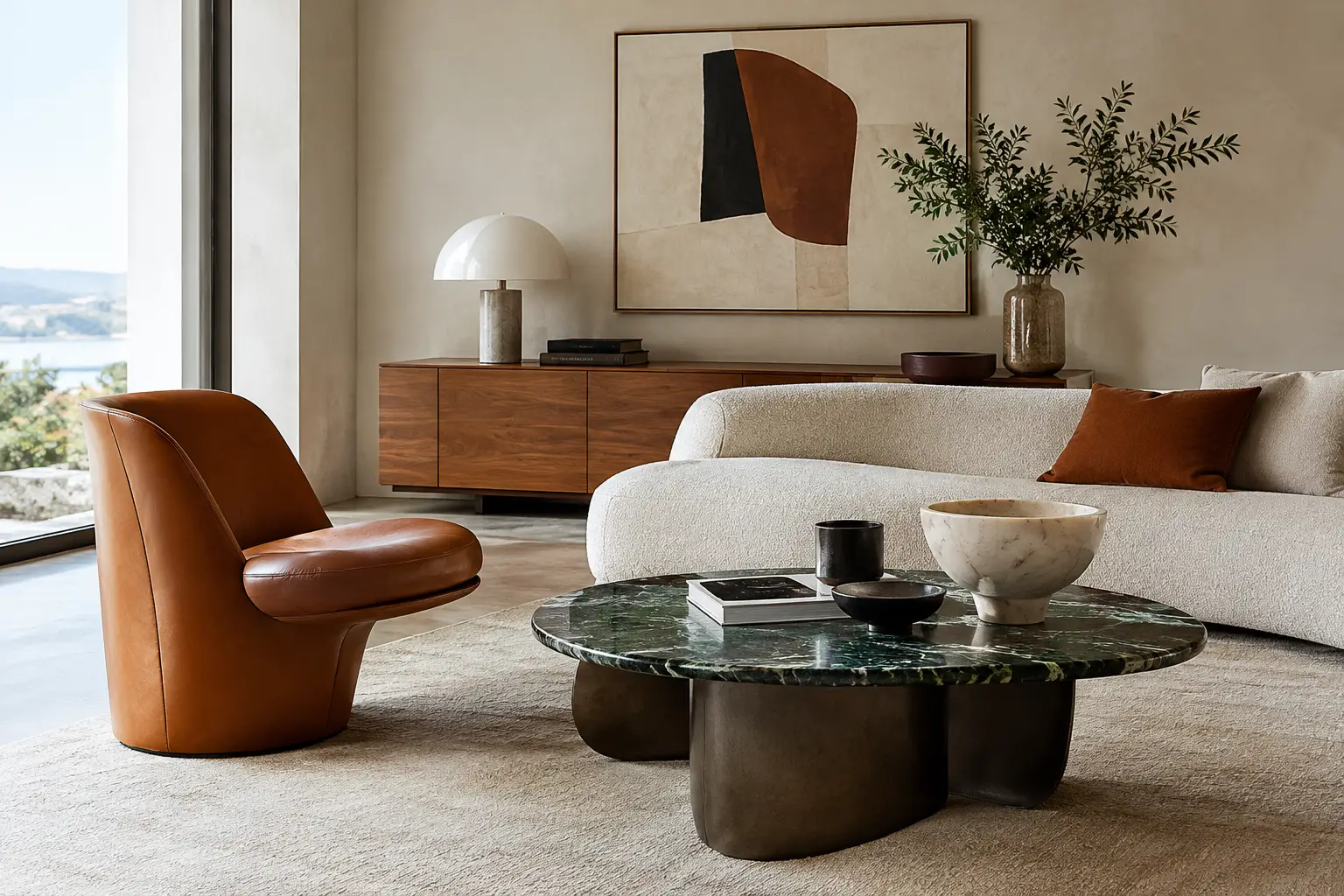
A room becomes memorable when it resists the logic of the showroom. The most compelling Italian design trends are moving away from coordinated perfection and toward interiors assembled with knowledge, contrast, and a clear point of view. A Murano glass lamp beside a severe walnut credenza, an Art Deco mirror above a contemporary console, or a Sicilian ceramic object placed against quiet plaster walls can create more presence than a room furnished entirely at once.
This is not a rejection of contemporary design. It is a recalibration of what makes an interior feel finished. Italian design has long understood that quality is not only a matter of newness or expense. It is found in proportion, material, craft, and the subtle tension between pieces from different eras. For collectors and design-conscious homeowners, the object with a past is increasingly the element that gives a space its identity.
Italian Design Trends Favor the Singular Object
The defining direction is not a single decorative style. It is the return of the singular object: a piece selected for its silhouette, provenance, or material intelligence rather than its ability to match everything around it. This approach rewards restraint. One exceptional chandelier can do more for a dining room than a ceiling full of generic recessed lighting; one original mirror can establish a wall more decisively than a grid of decorative prints.
The appeal lies partly in visual relief. Many interiors produced over the last decade leaned heavily on soft neutrals, pale wood, and broadly interchangeable forms. Those elements can still be useful, particularly in small or light-starved rooms, but they need counterweight. Vintage Italian design introduces density without necessarily adding clutter. A brass floor lamp, a sculptural smoked-glass vase, or a lacquered side table contributes depth through surface, scale, and history.
For this reason, the most successful rooms do not attempt to recreate a period set. A strict 1950s interior can be beautiful, but it requires discipline and a suitable architectural setting. A collected interior is more forgiving. It allows a mid-century armchair, a 1970s Italian lamp, and an older carved frame to coexist, provided there is a shared visual language: repeated metal finishes, related wood tones, or a consistent approach to scale.
Sculptural Lighting Takes Center Stage
Lighting remains one of the strongest expressions of Italian design. It is also one of the most practical places to introduce a collectible piece, because a lamp serves both the atmosphere of a room and its daily function. Current preferences favor forms that read as objects even when switched off: pleated or ribbed glass, articulated metal arms, generous domes, smoked shades, and finely worked brass details.
Murano glass is particularly resonant in this context. Its value is not simply its association with Venice, though provenance matters greatly. The best examples possess a complexity that machine-made glass struggles to imitate: irregularity in the right places, nuanced color, weight, and an almost liquid response to light. A hand-blown pendant in amber, opaline white, or soft pink can make an otherwise restrained room feel deliberate rather than sparse.
Scale deserves careful attention. An oversized chandelier can bring grandeur to a tall entryway or dining room, but it may overpower a low-ceilinged apartment. In more compact spaces, a pair of wall sconces or a substantial table lamp often has greater effect. The goal is not to fill every dark corner. It is to create pools of light that reveal texture: the grain of a wood cabinet, the patina of bronze, the transparency of glass.
Why Patina Matters
A pristine object is not always the most interesting one. In vintage lighting and furniture, a gentle patina can confirm material authenticity and give a piece visual warmth. Light oxidation on brass, small variations in lacquer, or minor wear consistent with age should not automatically be treated as defects.
There is, however, a distinction between character and compromise. Structural damage, unstable wiring, significant cracks, or an alteration that erases the integrity of the design deserves closer scrutiny. For functional vintage lighting, professional rewiring may be necessary, especially when the piece is intended for regular use in a US home. Restoration should preserve the original character while making the object safe and usable.
Rich Materials Replace Flat Neutrality
Color is returning to interiors, though not necessarily in loud or highly saturated form. The palette is becoming more mineral, burnished, and dimensional: tobacco brown, oxblood, moss green, deep blue, cream, amber, black, and muted terracotta. These shades work especially well with the materials central to Italian decorative history, including walnut, travertine, marble, brass, lacquer, velvet, and hand-worked glass.
This does not mean every room needs dramatic marble or dark walls. A pale interior can gain richness from a small number of concentrated elements. Consider a clear or colored Murano vessel on a limestone surface, an ebonized frame against warm white paint, or a single velvet-covered chair in a room of linen and oak. The material contrast creates the composition.
Travertine continues to hold attention because it is at once architectural and tactile. It can feel monumental in a coffee table or quiet in a small accessory. Yet it is not the right choice for every household. Its porosity and weight require care, and a large stone piece can make a room feel static if all other furnishings are similarly heavy. Balancing it with glass, slender metal, or upholstery keeps the arrangement responsive.
The Revival of Decorative Eras Without Imitation
Art Deco, Art Nouveau, and Italian mid-century design are reappearing not as costumes but as reference points. Their influence is visible in curved forms, graphic geometry, decorative metalwork, fluted surfaces, and a renewed appreciation for glamour. The difference is that contemporary rooms tend to use these cues selectively.
An Art Deco mirror can sharpen the lines of a modern living room. A sinuous Art Nouveau object can soften the strict geometry of a contemporary kitchen. Mid-century Italian furniture, with its elegant joinery and confident proportions, often provides the anchor between these worlds. The result should feel edited rather than theatrical.
This is where provenance becomes more than a label. Knowing whether an object belongs to a particular period, workshop, or design language helps determine how it should be placed. A piece does not need to be famous to be significant, but it should have a legible identity. An anonymous vintage lamp with extraordinary glass and construction may offer more decorative value than a recognizable name in poor condition.
A Collected Room Needs Negative Space
The risk of the collected approach is accumulation without hierarchy. Italian design trends reward expressive objects, but expression depends on breathing room. A cabinet crowded with glass, silver, ceramics, and framed photographs can lose the distinction of every individual piece.
Allow important objects a measure of solitude. Place a sculptural lamp where its outline can be read from across the room. Let a mirror reflect a considered view, not visual noise. Group smaller accessories by material or color, then leave part of the surface unfilled. This restraint gives even ornate pieces a contemporary clarity.
Sicilian Character and Regional Craft
Italy is not a single aesthetic language. The cool rationality associated with northern modernism differs from the ornament, color, and Mediterranean energy of Sicily. Bringing regional character into an interior prevents the generic version of Italian style, the one reduced to a few predictable references.
Sicilian decorative pieces can introduce this specificity through painted ceramic, volcanic stone, baroque-inspired forms, or vivid handcrafted detail. Used with care, they add a human, almost narrative quality to a room. A single regional object on a modern shelf can feel more sophisticated than an entire arrangement of vaguely Mediterranean décor.
The same principle applies to vintage fashion accessories. A well-chosen bag, jewelry box, or small decorative object can bridge personal style and interior style, particularly in a dressing room, entry, or study. These are not secondary details. They show that the home has been shaped by a collector rather than styled from a checklist.
The strongest interiors are built slowly. Choose the piece that changes the room first, whether it is a Murano pendant, a substantial mirror, or a sculptural table. Then let the next choice answer it. That rhythm of looking, waiting, and selecting is where a house begins to acquire its own design memory.