
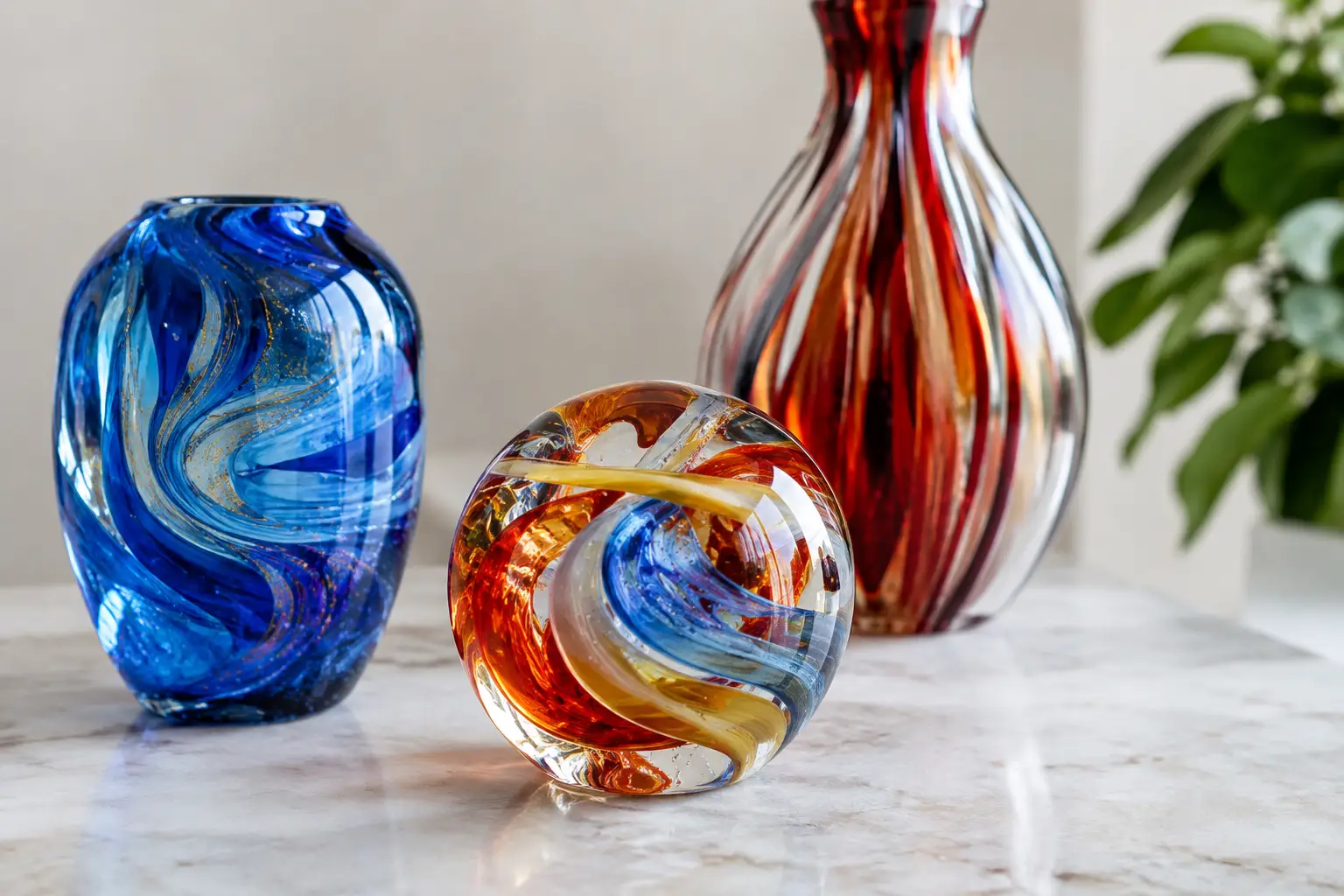
A signature at the base of a Murano vase can feel like the final word: a name, a place, a promise of authenticity. In reality, Murano glass signatures are one part of a larger and more revealing conversation. They can confirm a workshop, support an attribution, or point toward a period of production. They can also be misleading when read without attention to form, technique, labels, and the object itself.
For collectors and design-minded buyers, this distinction matters. A remarkable Murano lamp, sculpture, bowl, or chandelier is not defined by a name alone. Its quality rests in the coherence between its glassmaking, its design language, its condition, and its documented history. The signature is evidence, not a shortcut.
Why Murano Glass Signatures Matter
Murano has long been a center of technical invention and artistic collaboration. From the postwar years onward, celebrated designers, master glassmakers, family-run furnaces, and international studios produced objects that now occupy a central place in modern Italian decorative arts. Their names carry weight because they can connect a piece to a particular creative vocabulary, manufacturing tradition, and market history.
A properly understood signature may help distinguish an anonymous decorative object from a documented work by a recognized maker. It can clarify whether a piece belongs to a known production line or whether it is likely later. In some cases, it also affects value, particularly for work associated with major firms and designers such as Venini, Barovier & Toso, Seguso, Salviati, Cenedese, or Alfredo Barbini.
Yet the presence of a name should never replace judgment. Some authentic Murano pieces were never signed. Others originally carried paper labels that have disappeared over decades of handling, cleaning, and relocation. Conversely, a signature added later, a copied label, or a vague claim of Murano origin does not establish authorship.
The Main Types of Murano Signatures
A signature may appear in several forms, and each should be read differently. The most familiar is an engraved inscription, often found beneath the base or in an unobtrusive area of the glass. It may have been etched with a diamond point, acid-etched, sandblasted, or engraved by hand. The quality of the lettering, its placement, and its relationship to the surface can all offer useful clues.
Paper labels are equally significant. Historic labels vary widely: foil stickers, printed labels, circular marks, and branded labels with model or export information. They are fragile and therefore uncommon on older pieces, but when original and consistent with the object, they can be especially persuasive.
Some works bear engraved company names, while others include the name of a designer, an edition number, an artist’s signature, or a date. These are not interchangeable. A firm’s mark may identify the producer but not necessarily the designer. A designer’s name may indicate an authorized model, a collaboration, or an artist-made object, depending on the period and the studio.
The wording matters, too. “Murano” alone is not the same as a full workshop signature. It indicates a geographic association more than a precise attribution. A name followed by “Murano” can be stronger evidence, but it still deserves comparison with known examples from the same maker and era.
Hand-Etched Signatures and Their Variations
Hand-etched marks often show slight irregularities in pressure, spacing, and letter shape. That is not a defect. On the contrary, these small variations may be entirely consistent with hand-finishing. A signature can also differ across decades as a company changes its branding, uses different engravers, or produces work for export.
This is why a signature should not be judged against a single image found elsewhere. It needs context. Is the glass consistent with the known methods of the workshop? Does the form belong to the stated period? Does the mark sit naturally on the object, without looking freshly cut or unusually shallow? The answers carry more weight than perfect lettering alone.
When an Unsigned Piece Can Still Be Authentic
Many of the most compelling Murano objects on the vintage market are unsigned. A missing signature may result from normal wear, the loss of a label, or a production practice in which objects were simply not marked. This is particularly common among tableware, decorative vessels, and lighting components, where labels were often more practical than permanent engraving.
Attribution then relies on a close reading of material and construction. The rhythm of a hand-blown form, the density of sommerso layers, the controlled irregularity of pulegoso bubbles, the placement of gold leaf, or the quality of a sculptural applied element can reveal a great deal. So can the hardware of a chandelier, the shape of a lamp’s fittings, and the way individual elements were assembled.
Design references are also valuable. A distinctive silhouette may correspond to a documented model, a catalog image, or a well-known series. Still, “in the style of” is not the same as “by.” Responsible attribution uses language proportionate to the available evidence: signed, labeled, attributed to, probably by, or inspired by. Those distinctions protect both the object’s integrity and the buyer’s confidence.
Reading a Signature Alongside the Glass
The most reliable approach is cumulative. Begin with the signature or label, then look closely at the object’s making. A genuine attribution should make visual sense.
For example, an etched name associated with a refined postwar Venetian firm should be accompanied by the expected level of finish: balanced proportions, clean pontil treatment where relevant, controlled color transitions, and carefully resolved details. A large sculptural vase attributed to a master of thick, luminous sommerso glass should display depth and clarity that support the claim. A signature cannot compensate for weak workmanship or a form that belongs to another period altogether.
Condition also influences how a mark is interpreted. Wear on the base, faint scratches, oxidation to metal components, and age-consistent patina can support a vintage reading, although they are never proof by themselves. Excessively pristine labels on a heavily worn object deserve a closer look. So do signatures that appear sharper or newer than the surrounding surface.
Photography can obscure these details. When considering a purchase, ask for views of the base, the signature, labels, fittings, and any areas of restoration or damage. Good documentation does not diminish the romance of a piece. It gives that romance a foundation.
Common Mistakes to Avoid
The first mistake is assuming every Murano object must be signed. It does not. Dismissing an unsigned piece too quickly may mean overlooking an excellent example of Venetian glassmaking.
The second is treating every visible name as definitive. Decorative glass has been widely reproduced, and famous names are frequently invoked in descriptions with more confidence than evidence warrants. A buyer should be wary of language that makes a major attribution without showing the mark, explaining the provenance, or acknowledging uncertainty.
The third is focusing only on resale value. A signature can increase collectibility, but a piece should first earn its place through visual distinction. An unsigned 1960s Murano table lamp with superb form and exceptional handblown glass may bring more character to an interior than a mediocre signed object from a better-known name.
Finally, do not underestimate scale and intended use. A dramatic chandelier may have no visible signature after installation, yet its glass components, frame, and construction can be highly informative. Smaller objects may retain labels but have limited decorative presence. The best choice depends on whether the goal is collecting, furnishing, or both.
A More Considered Way to Buy Murano
The strongest Murano collection is rarely built by pursuing signatures alone. It is built by recognizing quality: glass with depth, color with intention, forms that hold their presence in a room, and pieces whose history is supported rather than overstated.
At Sound Of Vintage Italy, this is the value of a selective approach to vintage Murano. The most memorable objects are not merely named. They show why a particular furnace, designer, technique, or decade still matters.
Let a signature invite further attention, not end it. When the mark, the material, and the design tell the same story, the object becomes more than a beautiful fragment of Venetian glassmaking. It becomes a piece with a credible past and a lasting place in the present.