
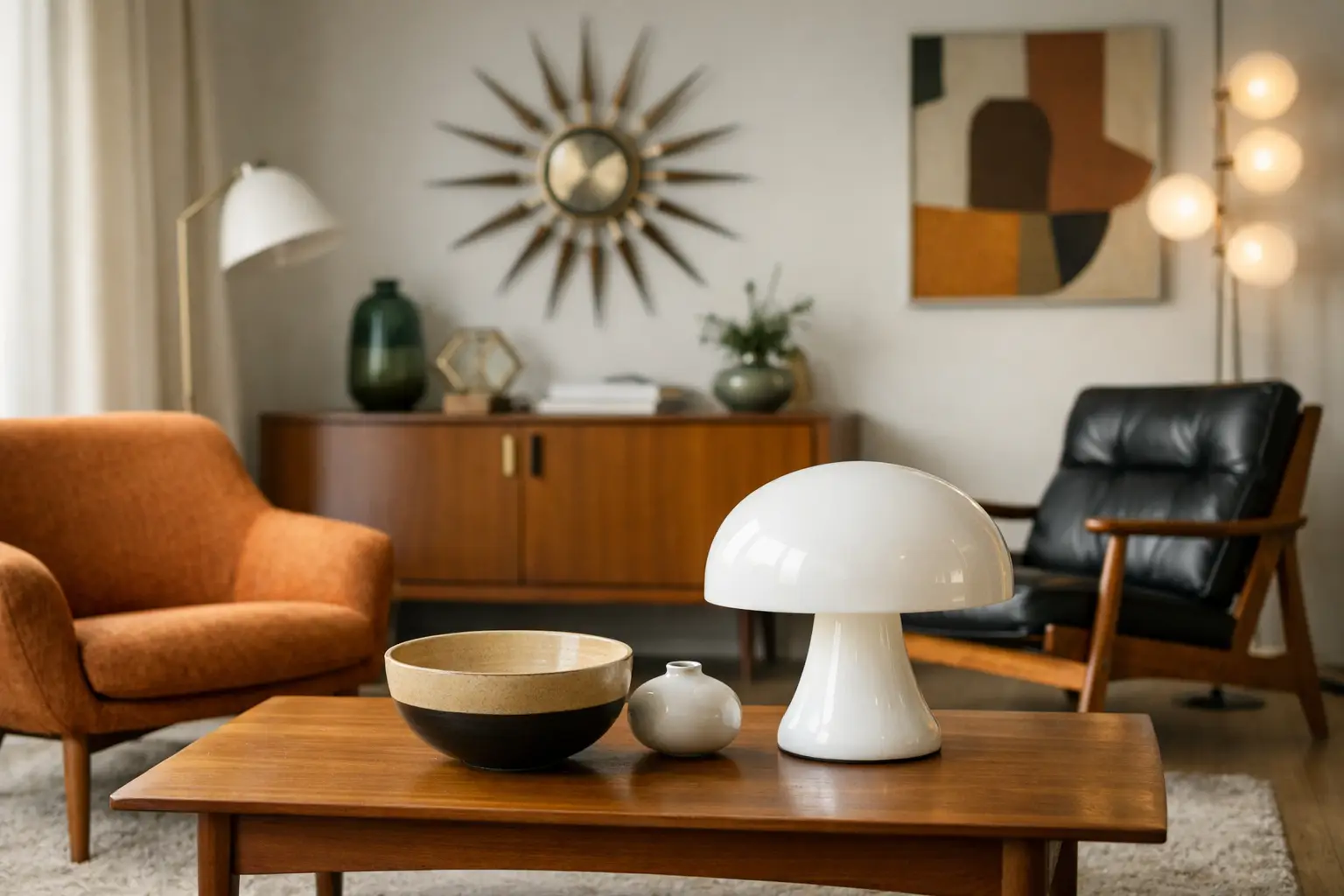
A 1970s chrome lamp, a Murano glass chandelier with an organic silhouette, a sculptural Italian sideboard in walnut: these are not simply old objects. They belong to a visual language shaped by experimentation, exceptional materials, and designers who treated domestic life as a field for new ideas. What is modernariato design? In Italy, the term identifies collectible design and decorative objects from the 20th century, especially pieces made from roughly the 1930s through the 1980s.
Modernariato is valued not because it imitates the past, but because it captures a period when form, technology, craftsmanship, and everyday living were being reconsidered. It brings an interior a sense of authorship that newly manufactured furniture often struggles to create.
What Is Modernariato Design?
The word modernariato is used in Italy to describe objects from the modern era that have acquired historical, aesthetic, and collectible relevance. It sits between antique furniture and contemporary design. While there is no single official date range, the category commonly includes Art Deco, rationalist, mid-century, Space Age, and postmodern pieces produced throughout the 20th century.
The distinction from antiques matters. In the conventional trade, an antique is generally associated with an earlier period and a longer historical distance. Modernariato is newer, yet it is not merely secondhand or vintage in the casual sense. A piece becomes significant through its design quality, manufacturer, condition, rarity, materials, documented origin, or its ability to represent a recognizable moment in design history.
A 1960s Italian floor lamp can be modernariato even if it was originally made for an ordinary home. If its proportions, engineering, maker, and visual presence speak clearly of its era, it carries more than utility. It becomes a document of taste.
A Broad Category With a Strong Italian Identity
Italian modernariato is particularly rich because postwar Italy produced an extraordinary dialogue between industry and craft. Factories introduced new methods for metal, plastics, glass, and upholstery, while artisans retained a close relationship with hand-finishing and expressive material choices. The result was design that could be technologically forward without becoming anonymous.
Lighting is one of the most compelling fields in the category. Murano glass, brass, lacquered metal, opaline shades, and architectural structures gave Italian lamps a theatrical yet refined presence. A pendant light can function as illumination, sculpture, and focal point at once. In a dining room or entryway, this layered role is often more valuable than visual minimalism alone.
Furniture follows the same principle. Modernariato may include rosewood or teak credenzas, curved lounge chairs, modular shelving, marble tables, mirrored consoles, and compact bar cabinets. Some pieces are restrained and rational; others are exuberant, colorful, or deliberately unconventional. What unites them is not one look, but a belief that an object should have a distinct point of view.
Decorative objects also belong to this world. Murano vases, ceramic tableware, sculptural mirrors, ashtrays, magazine racks, and small brass accessories can carry the signature of an era without demanding a complete room redesign. For collectors, these pieces offer an accessible way to build knowledge and visual coherence over time.
Modernariato, Vintage, and Mid-Century: The Difference
The terms are often used interchangeably, but they do not mean exactly the same thing. Vintage is the broadest label. It can describe an older garment, a 1990s chair, or a 1950s radio, whether or not the item has recognized design value.
Mid-century modern refers more specifically to the design language that developed from the 1940s through the 1960s, characterized by clean lines, functional forms, organic curves, and innovative materials. It is a major chapter within modernariato, but it is not the entire category.
Modernariato has a wider historical and stylistic reach. It can include the geometric luxury of Art Deco, the disciplined clarity of Italian rationalism, the optimistic plastics of the 1960s, and the radical forms of the 1970s and 1980s. A Memphis-era object and a 1940s glass sconce may look entirely different, yet both can be understood as modernariato when their provenance and design relevance are established.
For this reason, buying by label alone is rarely enough. The most interesting interiors do not attempt to reproduce a museum period room. They select objects with compatible materiality, scale, and atmosphere.
How to Recognize a Worthwhile Piece
A strong modernariato object usually reveals its quality before its label is known. Look at the relationship between line and proportion. Is the lamp balanced when viewed from different angles? Does the chair feel resolved in its structure? Are the details – the joints, hardware, glasswork, veneer, or patina – consistent with careful production?
Provenance adds another level of confidence. Designer attribution, manufacturer marks, original labels, period documentation, and a known production history can affect both cultural interest and market value. Yet an unsigned piece should not be dismissed automatically. Many objects made by skilled workshops or smaller Italian manufacturers have considerable decorative and material value even when a famous name is absent.
Condition requires judgment rather than perfectionism. Light wear, aged brass, small signs of use, and the soft patina of original surfaces can be part of an object’s appeal. Structural damage, poorly executed repairs, altered wiring, missing components, and aggressive refinishing are different matters. They may affect safety, usability, and value.
With lighting, electrical adaptation deserves particular attention. A lamp can retain its original character while being rewired for safe use. The objective is not to freeze an object in time, but to preserve what makes it visually and historically persuasive.
Why Modernariato Changes an Interior
Modernariato works best when it is treated as a presence, not as decoration to be scattered across every available surface. One important chandelier can define the mood of a room. A pair of Italian wall sconces can give depth to a hallway. A sculptural mirror can create tension against plain walls and contemporary architecture.
The appeal lies partly in contrast. A restrained new sofa gains personality beside a 1960s glass coffee table. Clean kitchen cabinetry can feel warmer with an expressive Murano pendant. A contemporary office becomes less generic when a vintage desk lamp introduces color, texture, and a visible sense of design history.
There is a trade-off. Period pieces may have dimensions that differ from current standards, and rare materials can require more thoughtful care than mass-market furnishings. A low Italian lounge chair may be visually perfect but unsuitable for every daily use. A delicate glass chandelier may demand professional installation. Collecting well means balancing desire, function, and the realities of the space.
Building a Personal Collection
The most convincing collections begin with a point of view rather than a checklist. Some people are drawn to the glow and irregularity of Murano glass. Others prefer the precision of chrome, black metal, and smoked glass. A home can accommodate both, but a recurring material or color palette helps the selection feel intentional.
Start with the object that can carry the room: a chandelier, floor lamp, credenza, mirror, or table. Then introduce smaller pieces that echo its character without repeating it too literally. A brass lamp may relate to a gilt-frame mirror; a smoked-glass table may be balanced by a dark ceramic vessel. The room should feel collected, not staged.
At Sound Of Vintage Italy, this approach is reflected in a selection that places lighting, Murano glass, furniture, decorative antiques, and distinctive Italian objects in conversation. The value is not only in finding a rare piece, but in recognizing how it can become part of a lasting domestic landscape.
Modernariato design rewards a slower eye. Choose the object whose materials, proportions, and history continue to hold your attention after the first impression – that is usually the piece that will give a room its most enduring character.