
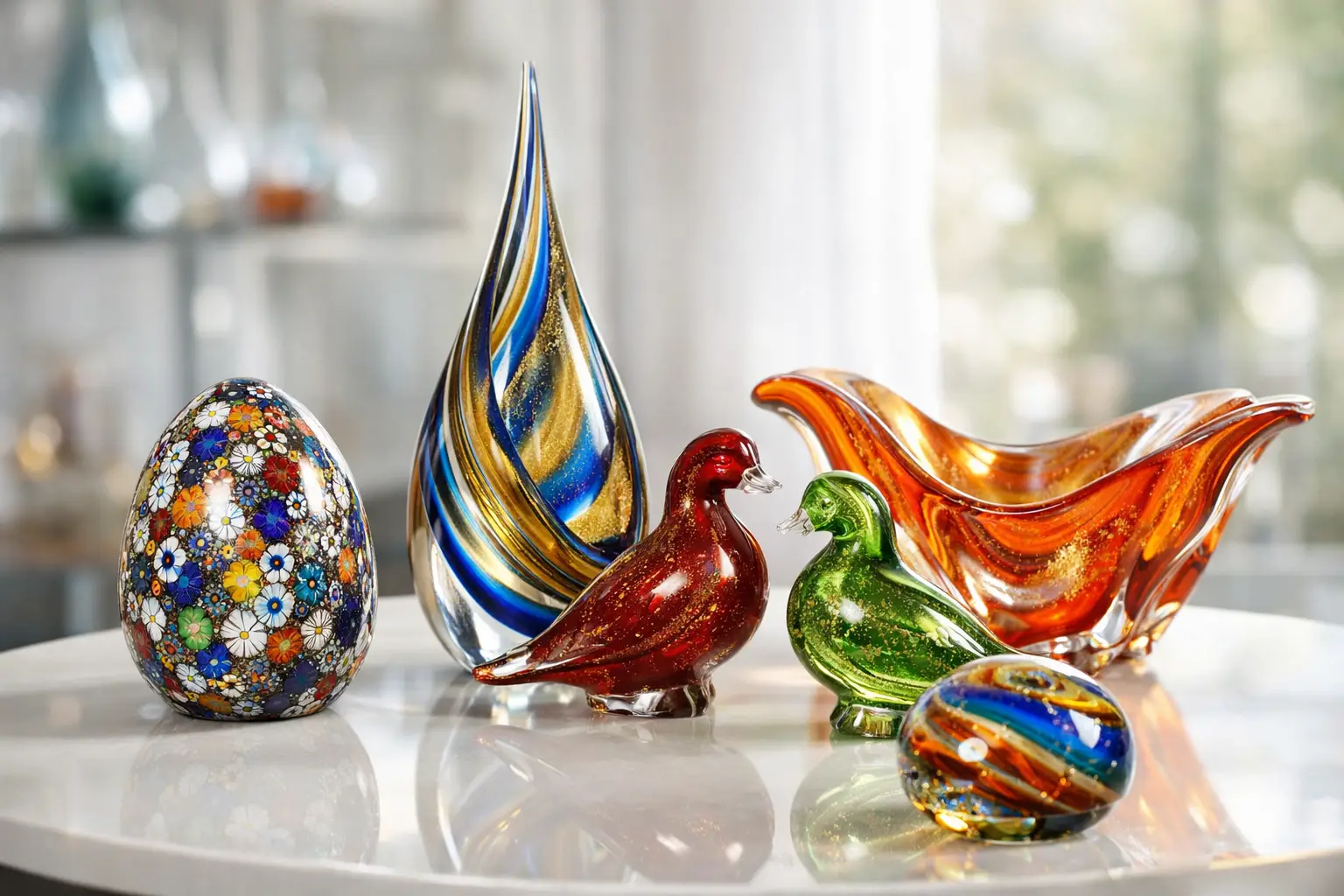
A handblown Murano vase can change the temperature of a room before it holds a single flower. Its surface catches light differently through the day, its color carries depth rather than decoration, and its irregularities make the work unmistakably human. That is why collectible Murano glass trends are not simply about buying more glassware. They reflect a return to objects with presence, technical intelligence, and a visible connection to Italian design history.
For collectors and interiors with a point of view, Murano is moving beyond the familiar idea of a souvenir or a pretty accent. The most compelling pieces now operate as sculptural statements: a heavy Sommerso bowl on a travertine table, a 1970s lamp with a textured glass shade, a group of slender Venetian vessels arranged as a deliberate composition. Value still rests on quality, condition, authorship, and rarity, but the way Murano is being chosen has become more personal and more design-led.
Collectible Murano Glass Trends: Sculpture Before Ornament
The strongest current preference is for forms that stand on their own. Collectors are drawn to vessels with exaggerated lips, substantial bases, asymmetrical profiles, and silhouettes that feel almost architectural. A good Murano object does not need to be crowded with decoration to command attention. Its volume, weight, and relationship to light are often enough.
This shift favors mid-century and postwar production, particularly pieces that balance Venetian craft with the visual language of Italian modernism. Low, wide centerpieces in cased glass, teardrop vases, biomorphic bowls, and tall bottle forms sit naturally beside vintage Italian furniture, polished steel, walnut, or stone. They also bring softness to more severe contemporary interiors.
Scale matters. A small piece with an exceptional technique can be highly collectible, but larger works tend to make a stronger decorative gesture and are increasingly selected as focal points. The trade-off is practical: large Murano glass requires space, careful placement, and thoughtful handling. A well-chosen medium-scale vase may be more versatile in a city apartment than a monumental centerpiece, while retaining the same sense of material richness.
The renewed appeal of expressive color
Color is central to the current market, although not every saturated object is equally desirable. The most interesting palettes are complex rather than merely bright: amber layered with deep blue, smoky amethyst, petrol green, coral, tobacco, and opaque white paired with clear crystal. These tones have the ability to look both distinctly vintage and surprisingly current.
Sommerso glass remains especially relevant because its submerged layers create visual depth. Seen from above, at eye level, or in changing daylight, the colors shift in proportion and intensity. This makes each piece feel active within an interior. Works with clean, confident color blocking often suit modern spaces, while softer blends and clouded effects can add warmth to rooms built around antiques, Art Deco details, or natural materials.
There is also renewed interest in clear and nearly colorless glass when the technique is strong. Pulegoso surfaces filled with controlled bubbles, thick faceted forms, and finely ribbed bodies offer texture without demanding a dominant palette. In a room already rich in color or pattern, this quieter kind of Murano can be the more considered choice.
Provenance Is Becoming Part of the Decoration
A beautiful object should be beautiful first. Yet provenance increasingly shapes how collectors assess it. Original labels, etched signatures, archival attributions, known workshop histories, and a credible date all help place a work within the wider story of Murano production. They can also make the difference between an attractive vintage object and a piece with enduring collector interest.
Names such as Venini, Barovier & Toso, Seguso, Salviati, and Cenedese carry weight for good reason, but a label alone should not end the conversation. Labels can be lost, added later, or associated with a retailer rather than a designer. Form, technique, workmanship, wear, dimensions, and the quality of the color remain essential evidence. For an unsigned object, an informed attribution can still be meaningful when the design language and construction support it.
This does not mean every purchase needs museum-level documentation. Many collectors acquire Murano because they respond to a specific form, color, or period. But it is wise to distinguish between a decorative piece and one purchased partly for rarity or investment potential. The latter calls for closer attention to condition, authenticity, and a clear description of what is known rather than what is assumed.
Design signatures collectors recognize
Certain techniques and formal languages continue to attract discerning attention. Sommerso remains a favorite, as does pulegoso glass with its lively bubble texture. Filigree, latticino canes, aventurine inclusions, and murrine patterns can be exceptional when the execution is precise and the design does not become overly busy.
The most sought-after examples often show restraint. A single spiraling cane inside a clear vessel, a compact field of gold aventurine, or a strongly proportioned pulegoso lamp can feel more contemporary than an object overloaded with motifs. Murano’s technical range is immense, but the pieces that remain visually persuasive are those where technique serves the form.
Lighting deserves special attention. Vintage Murano chandeliers, sconces, and table lamps bring a different kind of collectibility because their beauty is activated. Opaline shades diffuse a warm glow, textured glass creates shadow, and colored elements become more theatrical after dark. Electrical components, however, need practical scrutiny. Rewiring may be advisable for safety and compatibility, particularly with older European fixtures. Professional intervention should preserve original glass elements and hardware wherever possible.
The New Collector Mixes Periods, Not Sets
Complete matched sets still have appeal, particularly for dining tables or formal interiors, but the more current approach is selective grouping. A pair of related vases might sit with a single contrasting bowl. A 1960s amber vessel can be placed beside a contemporary ceramic work and an early 20th-century bronze. The point is not to create a display case. It is to let each object retain its identity.
This is especially useful for those beginning a collection. Instead of acquiring several ordinary pieces in the same style, it is often better to wait for one object with excellent color, proportion, and condition. A collection gains character through distinctions: a delicate filigree vase beside a dense Sommerso form, or a transparent sculptural bowl balanced by an opaque lamp.
Murano also works particularly well in unexpected rooms. A small vase on a bedside table brings color to a quiet space. A large centerpiece can give a dining room an immediate Italian note without making the entire room feel themed. In an office or hospitality setting, a pair of vintage glass sconces can establish atmosphere more effectively than generic decorative art.
Condition, Rarity, and the Value of Patina
Murano glass should be examined closely. Chips, cracks, rim nicks, internal fractures, repairs, and cloudiness can materially affect value. Minor shelf wear on the base is common and may be entirely appropriate for a vintage object, especially when it confirms age without disrupting the overall presentation. The difference lies in whether wear reads as honest use or as damage that compromises the piece.
For lamps and chandeliers, completeness is equally important. Replacements are sometimes necessary, but original leaves, flowers, pendants, arms, and shades contribute substantially to both visual coherence and collector value. Before buying, consider where the object will live and whether it can be safely installed, displayed, and maintained.
Rarity is not always about a limited edition. It may be found in an unusual colorway, an uncommon scale, a discontinued form, an early production detail, or a particularly successful example of a known model. The best collecting decisions often come from recognizing quality before consensus makes it obvious.
The most lasting Murano acquisitions are not chosen to follow a passing look. Choose the piece whose color changes your room, whose workmanship holds up under close inspection, and whose form still feels alive after the first excitement has passed. That is where a decorative object begins to become part of a collection.