
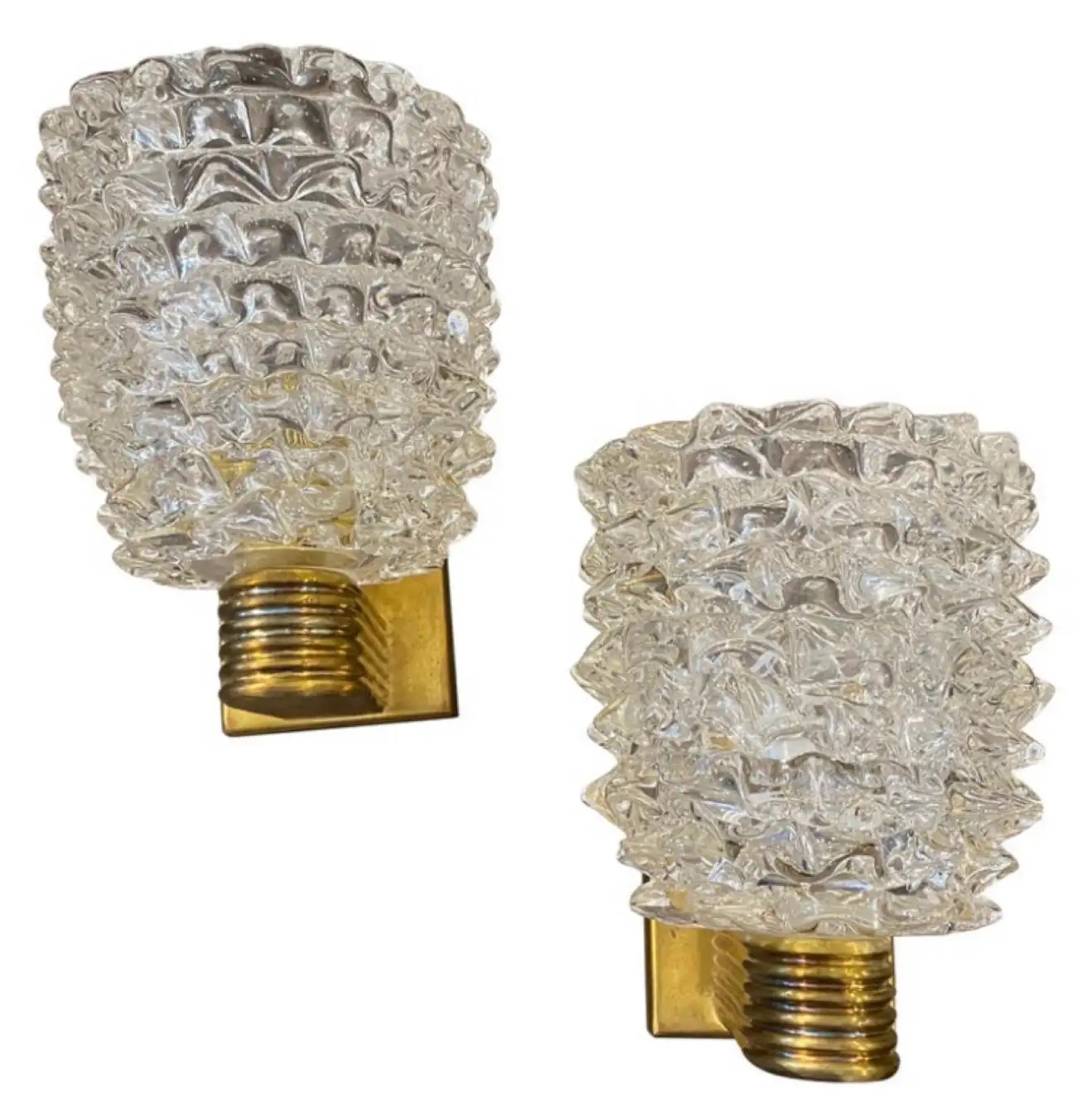
A hallway can feel resolved or forgettable because of one detail on the wall. Vintage Murano wall sconces have that effect. They do more than provide light – they introduce relief, texture, and the unmistakable presence of Italian glassmaking into a room that may already be well furnished but still lacks a focal point.
For collectors and design-led homeowners, this category sits in a particularly interesting place. It belongs to lighting, but it is also decorative art. It speaks to architecture, yet it carries the intimacy of an object made by hand. That is why Murano sconces continue to hold attention across very different interiors, from restrained Mid-Century spaces to layered apartments with Art Deco or eclectic references.
Why vintage Murano wall sconces still matter
The value of vintage Murano glass has never been limited to nostalgia. These pieces remain relevant because they solve a contemporary design problem: how to add character without resorting to visual noise. A well-chosen sconce can animate a blank wall, soften a passageway, or frame a mirror with far more distinction than standard contemporary lighting.
Murano wall sconces are especially compelling because glass changes with light. During the day, the material reads as sculpture. In the evening, it becomes atmospheric. Frosted, pulegoso, ribbed, smoked, or translucent glass all respond differently once illuminated, and that variation is exactly what makes vintage examples so desirable.
There is also the question of individuality. Many current fixtures borrow the silhouette of Italian modernism, but vintage Murano carries the irregularities, proportions, and material depth that reproduction rarely captures. Even when a model was produced in series, the hand-finished nature of the glass often gives each example a slightly different presence.
What defines a true Murano sconce
Not every Italian glass wall light belongs in the same conversation. When discussing vintage Murano wall sconces, the distinction lies in origin, workmanship, and design language. Murano refers to the Venetian island historically associated with exceptional glass production, and the best vintage pieces show a confident relationship between technique and form.
Some sconces are built around thick textured glass panels mounted on brass or chrome backplates. Others use triedri prisms, curved glass leaves, or floral forms that move closer to Art Nouveau or Hollywood Regency. Mid-century examples may be more architectural, with geometric lines and a stronger emphasis on material contrast.
The frame matters as much as the glass. Patinated brass, lacquered metal, gilded details, and carefully scaled mounts all influence the final effect. A Murano sconce that feels refined usually has balance – the hardware supports the glass without overpowering it, and the silhouette remains convincing whether lit or unlit.
Styles to know before you buy
Collectors often approach Murano through chandeliers, but sconces deserve the same attention. They appear in a wide range of styles, and understanding those families helps narrow the search.
Mid-century and modernist Murano
This is often the most versatile direction for current interiors. Think clean profiles, structured glass, and metal finishes that sit comfortably with vintage furniture, travertine, walnut, or polished plaster walls. These pieces work particularly well in living rooms, stair halls, and bedrooms where a sculptural accent is needed without excess ornament.
Floral and organic forms
Murano also produced highly expressive sconces with petals, leaves, shells, and flowing contours. These examples can be romantic, dramatic, or quietly lyrical depending on scale and glass treatment. In the right interior, they add movement and softness that boxier fixtures cannot offer.
Triedri and prism compositions
Sconces composed of angular prisms have a more architectural presence. They reflect light sharply and often suit entryways, formal dining areas, and projects that lean toward 1960s and 1970s Italian glamour. They can be striking in pairs, especially when installed symmetrically.
Deco-influenced and gilded models
Some pieces sit between decorative lighting and statement jewelry for the wall. These may include gilt mounts, curved silhouettes, and richly textured glass. They are ideal where the room already embraces a layered visual vocabulary rather than strict minimalism.
Where vintage Murano wall sconces work best
The strongest placements are usually the most intentional ones. A pair flanking a fireplace creates symmetry without feeling predictable if the glass has enough presence. In a bedroom, Murano sconces can replace bedside lamps and free up surface space while making the room feel more tailored. In a powder room or dressing area, they provide a flattering, diffused light that standard vanity fixtures often lack.
Hallways are another natural setting. Transitional spaces are frequently underdesigned, yet they benefit enormously from decorative lighting. A single exceptional Murano sconce at the end of a corridor can give the eye a destination. A sequence of matching sconces can turn a passage into an architectural gesture.
Scale should guide placement. Larger, heavier models need visual breathing room and often suit taller walls. More delicate sconces can work beautifully beside mirrors, in niches, or in compact entry zones where a chandelier would be too assertive.
What to look for when evaluating a piece
Condition is always part of the conversation with vintage lighting, but with Murano it requires a trained eye. Minor wear to the metal can be acceptable, even desirable, because it supports the age and authenticity of the piece. The more significant issue is the glass. Chips, cracks, poor restorations, or mismatched elements change not only value but also the integrity of the object.
Originality matters as well. Ask whether the glass elements are period-correct to the frame and whether the hardware appears consistent with the era. Rewired electrical components are often necessary and practical, particularly for use in the US, but structural alterations are a different matter. A professionally rewired sconce can preserve function. A heavily modified one may lose much of its collectible appeal.
Provenance, attributed maker, and period all influence desirability, but not every outstanding piece needs a famous name. Some unlabelled Murano sconces are compelling because of proportion, quality of glass, and decorative impact. For many interiors, the visual authority of the object is more relevant than a signature alone.
Styling Murano without making the room feel staged
One of the most common mistakes with vintage lighting is treating it like a museum object. Murano performs best when it is allowed to participate in the room rather than stand apart from it. That might mean pairing a textured glass sconce with matte wall finishes, or using a more ornate model in a room anchored by simpler furniture.
Contrast often works better than perfect matching. A 1950s Murano sconce can look extraordinary above a contemporary console. A more elaborate Venetian glass form can sharpen a restrained interior by adding one note of ornament. What matters is rhythm and hierarchy. If every object in the room is trying to be memorable, nothing is.
Metal finishes deserve attention. Brass-based sconces usually pair well with warm woods, parchment tones, and stone. Chrome or nickel mounts can feel more graphic and cooler, especially in interiors that favor black, white, gray, or smoked glass. The wall color changes everything. Murano against deep plaster, off-white limewash, or soft taupe can read very differently than against bright gallery white.
Why collectors return to Murano again and again
There are categories in vintage design that people buy once. Murano is rarely one of them. The appeal deepens with familiarity because the more examples you see, the more clearly you recognize the differences in hand, period, and atmosphere. One pair may be quietly architectural. Another may be theatrical. Both can be right, depending on the room and the eye selecting them.
That is also why a curated selection matters. In a market crowded with decorative lighting, discernment saves time. A boutique approach like Sound Of Vintage Italy is valuable precisely because it filters by aesthetic intelligence, not just by category label. For buyers who already know the language of vintage, that kind of editing is often the difference between browsing and finding a piece worth living with.
Vintage Murano wall sconces reward patience. They are not filler objects and they should not be chosen as afterthoughts. When the scale is right, the glass is convincing, and the placement is considered, they do something rare – they light a room while giving it memory.