
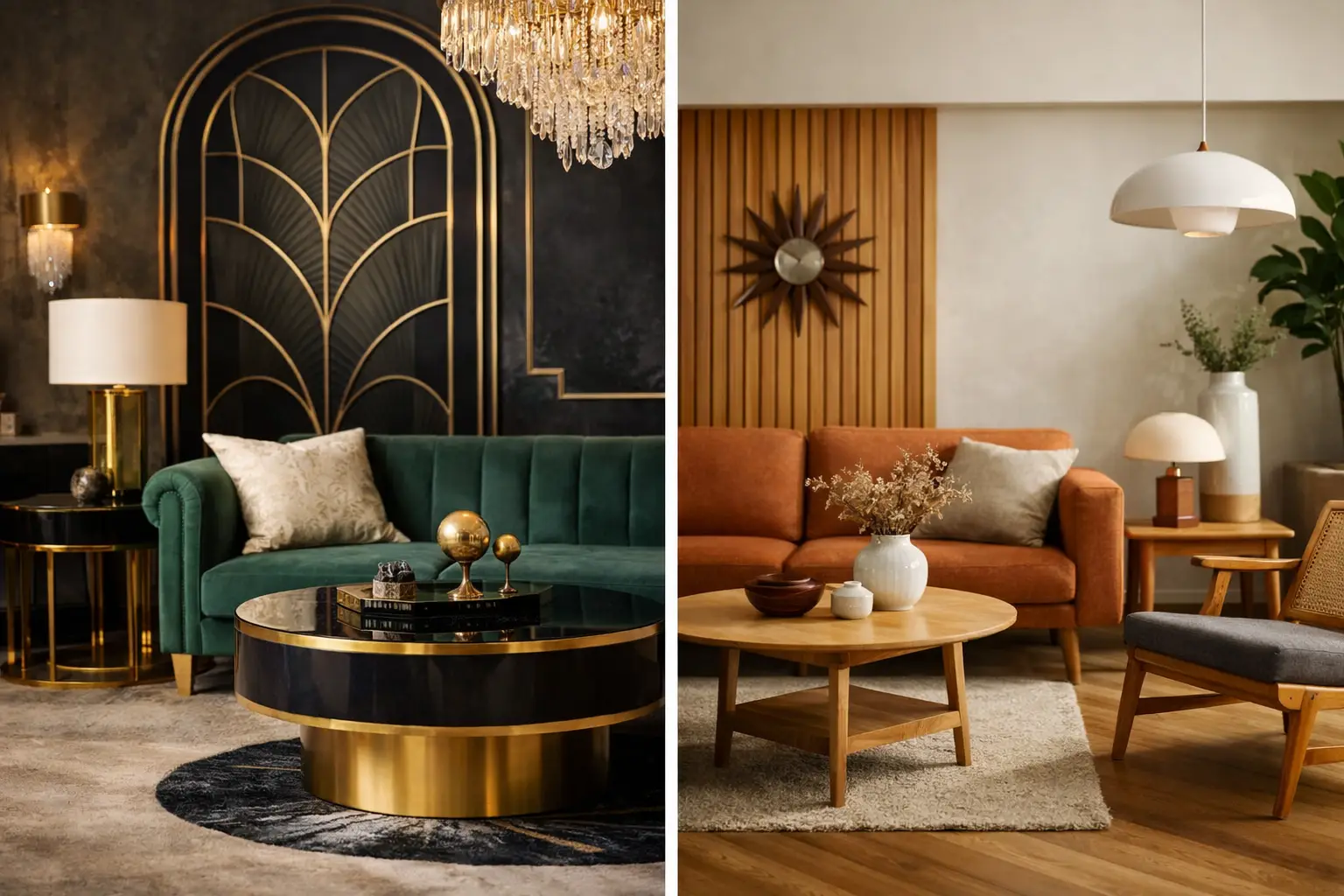
A mirrored console with a stepped silhouette can make an entrance feel immediately composed. A low walnut sideboard with tapered legs creates a different kind of confidence: quieter, warmer, and closer to daily life. In the conversation around Art Deco vs Mid Century, the distinction is not simply a matter of dates. It is a choice between two visual languages with very different ideas of luxury, function, and atmosphere.
Both styles remain highly collectible because they offer more than decoration. They bring a precise historical character to contemporary interiors, whether through a sculptural Murano glass lamp, a lacquered cabinet, a brass-framed mirror, or a carefully proportioned lounge chair. Knowing how to read their details makes it easier to select pieces with genuine presence rather than assemble a room from vague stylistic references.
Art Deco vs Mid Century: The Essential Difference
Art Deco emerged in the 1920s and 1930s, at a moment when modernity was associated with speed, glamour, travel, and technological progress. Its vocabulary is theatrical and polished. Geometric symmetry, sunbursts, stepped forms, bold contrast, and rich surfaces define the style. An Art Deco interior often feels formal, even when it is intimate.
Mid-Century design developed mainly from the mid-1940s through the 1960s. It inherited modernism’s interest in clean forms but made it more relaxed and practical for postwar homes. The emphasis shifted toward usability, lighter visual weight, organic curves, and materials suited to modern production. Where Art Deco often presents itself as an occasion, Mid-Century feels designed for living.
The simplest way to frame the difference is this: Art Deco seeks drama through composition and finish. Mid-Century seeks ease through proportion and function. Of course, exceptional pieces from both periods can be highly refined, richly made, and visually striking. The distinction lies in how they achieve their effect.
The Shapes That Define Each Style
Art Deco favors strong geometry. Look for fan motifs, chevrons, zigzags, fluting, octagons, and the repeated vertical lines of skyscraper architecture. Furniture frequently has a substantial, grounded profile. A cabinet may feature a curved front, a stepped base, or highly symmetrical veneer patterns. Lighting can be compact and architectural, with frosted glass shades, chrome details, or sharply articulated metalwork.
Mid-Century form is often more open and aerodynamic. Chairs are lifted on slender legs. Case pieces sit low and long. A table may have a kidney-shaped top, a gently tapered edge, or a sculptural base that seems to float below it. The geometry is still deliberate, but it is softened by curves and by the influence of Scandinavian design, American industrial design, and new manufacturing methods.
This difference matters when choosing a focal point. An Art Deco chandelier tends to command a room from above, creating a clear axis and a sense of ceremony. A Mid-Century floor lamp often works more conversationally, defining a reading corner or balancing a sofa without dominating the entire composition.
Symmetry or movement?
Art Deco is usually organized around symmetry. Even decorative details feel carefully arranged, often reinforcing a central line or a formal rhythm. It suits rooms where architecture is already expressive: a dramatic entry, a dining room with generous ceiling height, or a bedroom where a statement headboard can establish the scene.
Mid-Century is more comfortable with asymmetry and movement. A low credenza paired with an offset lamp, a modular seating arrangement, or a cluster of differently shaped ceramics can feel entirely natural. It is particularly effective in open-plan spaces, apartments with abundant daylight, and interiors that need visual rhythm without excessive ornament.
Materials: Polish Versus Warmth
Art Deco materials are chosen for impact. High-gloss lacquer, figured wood veneers, ebony or ebonized finishes, chrome, brass, mirrored glass, marble, shagreen, and ivory-tone details all belong to its historic palette. Contrast is central: dark wood against pale parchment, black lacquer against brass, or a dense marble surface against polished metal.
The best Art Deco pieces demonstrate restraint within their opulence. A small detail in patinated brass, an inlaid geometric motif, or the quality of a veneered surface can be more compelling than a room filled with shine. This is one reason original objects remain desirable: their materials have depth, and their craftsmanship is visible at close range.
Mid-Century design is often warmer to the touch and more candid about construction. Teak, walnut, oak, rosewood, molded plywood, rattan, leather, chrome, and textured upholstery are recurring materials. Wood grain is typically celebrated rather than disguised under lacquer. Metal is used sparingly, often as a clean structural accent.
A Mid-Century piece can be luxurious, but its luxury is rarely ceremonial. Consider a beautifully made walnut credenza, a leather lounge chair, or an Italian glass table lamp with a softly rounded silhouette. The appeal comes from balance, tactility, and the confidence of a well-resolved form.
Color and Light Set the Mood
Art Deco is associated with black, cream, deep green, burgundy, cobalt, and metallic accents. These colors can create a striking room, especially when layered with reflective surfaces and directional lighting. A pair of wall sconces, for example, can frame a mirror or artwork with the composed symmetry the style favors.
That said, Art Deco does not require a dark, cinematic palette. Pale lacquer, ivory upholstery, smoked glass, and champagne-toned brass can produce a lighter interpretation while preserving the style’s sophistication. The essential element is contrast and definition, not any single color.
Mid-Century palettes tend toward earthy, optimistic, and occasionally playful tones: walnut brown, olive, ochre, rust, warm white, charcoal, and selected notes of turquoise or orange. Natural light is part of the aesthetic. The style was shaped by interiors that looked outward to gardens, terraces, and wide windows, so it benefits from breathing room around furniture.
For lighting, the contrast is especially telling. Art Deco often favors a jewel-like glow through frosted, etched, or colored glass. Mid-Century lighting may use an adjustable arm, a perforated shade, or a large opaline globe to direct light with efficiency and sculptural clarity. Italian Murano glass can belong beautifully to either setting, depending on its form: a bold geometric fixture leans Deco, while an organic or biomorphic lamp often speaks more naturally to Mid-Century sensibilities.
How to Choose for a Contemporary Interior
Choose Art Deco when the room needs definition, glamour, or a stronger sense of occasion. It is ideal for an entryway, bar area, powder room, formal dining room, or hospitality setting where an immediate visual impression matters. One important Art Deco piece can do considerable work: a monumental mirror, a pair of sconces, a lacquered occasional table, or a faceted glass chandelier.
Choose Mid-Century when you want the room to feel collected but easy to inhabit. It works especially well in living rooms, studies, dining areas, and spaces where furniture must perform daily tasks. The lower profiles and practical proportions of Mid-Century pieces can also make compact rooms feel less crowded.
Scale should guide the decision more than labels. A large Art Deco cabinet with dark veneer may overwhelm a narrow apartment, while a delicate Mid-Century occasional chair can disappear in a room with ornate architectural details. Study the height of the ceilings, the natural light, the existing flooring, and the visual weight of major furniture before introducing a period piece.
Authenticity also deserves attention. Original vintage furniture may show age in the form of patina, minor wear, or subtle variations in finish. These are not automatically defects. They can be evidence of material quality and a lived history, provided the structure is sound and any restoration respects the original design. A carefully curated selection, such as the one associated with Sound Of Vintage Italy, makes it possible to focus on character and provenance rather than search through generic reproductions.
Can Art Deco and Mid-Century Work Together?
Yes, but the room needs a clear hierarchy. The most successful mix does not try to make the two styles indistinguishable. Instead, it lets one establish the architecture of the space while the other provides contrast.
A Mid-Century walnut sideboard can ground an Art Deco mirror because both value strong materials and disciplined form. An Art Deco brass lamp can bring a more tailored note to a relaxed Mid-Century armchair. The connection is strongest when there is a shared element, such as warm wood tones, black accents, opaline glass, or repeated brass details.
Avoid combining too many competing signatures at once. A sunburst mirror, geometric rug, tulip table, sculptural lounge chair, and highly patterned wallpaper may each be attractive individually, yet together they can flatten the room into a period collage. Give significant pieces space, and allow the eye to understand why each object is there.
The most memorable interiors rarely follow one era with total obedience. They are built around objects that hold their own: a lamp with exceptional glass, a chair with an unmistakable line, a cabinet whose veneer has real depth. Choose Art Deco if you want the room to arrive with a flourish. Choose Mid-Century if you want it to reveal its character gradually, through proportion, texture, and the quiet authority of well-chosen design.