
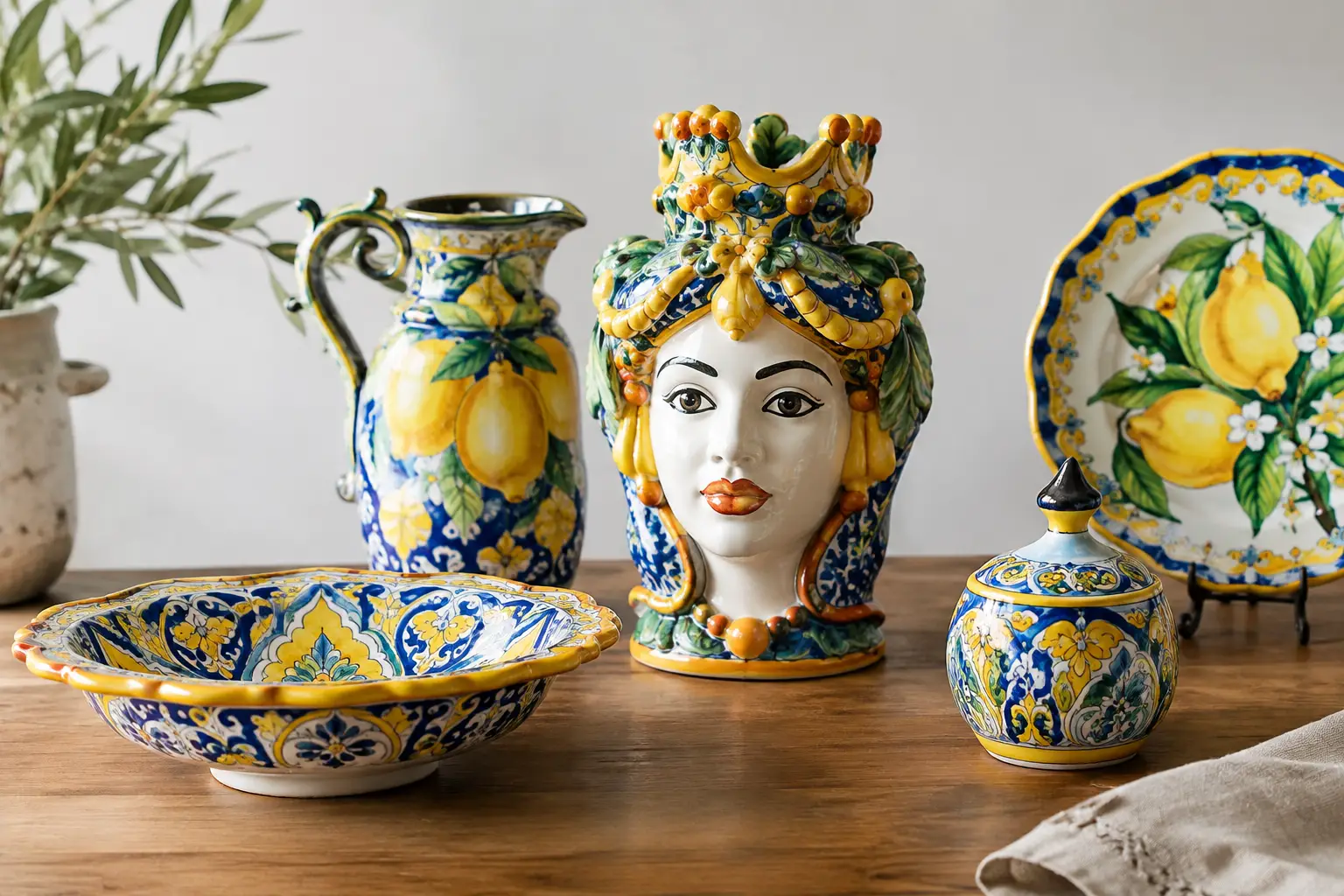
A hand-painted Sicilian plate can hold far more than color. Its dense cobalt blue, saffron yellow, or manganese green may carry the memory of a town, a workshop, a domestic ritual, and the hand of the decorator who brought its surface to life. This Sicilian ceramics collecting guide is for those who see pottery not as a souvenir, but as an expressive object with cultural presence – one that can hold its own beside Murano glass, Italian modernist lighting, or an antique walnut console.
Sicilian ceramics are immediately recognizable, but collecting them well requires a more considered eye. The island has never been stylistically uniform. Its ceramic traditions reflect Arab, Spanish, Greek, Norman, and Baroque influences, while individual towns developed their own palettes, motifs, clay bodies, and methods of decoration. The best collection is not necessarily the largest. It is built around pieces whose origin, condition, and visual force are all convincing.
Sicilian Ceramics Collecting Guide: Start With Place
For a collector, place is the first useful distinction. Caltagirone is the name most closely associated with Sicilian ceramics, and for good reason. Its workshops are known for richly painted maiolica, architectural forms, ornamental heads, pharmacy jars, chargers, and vessels animated by bold figuration. The town’s long ceramic history has produced both exceptional antiques and a vast contemporary market, making attribution and quality especially relevant.
Sciacca offers another essential chapter. Its historical ceramics are often admired for their luminous, iridescent luster decoration, a difficult technique that gives surfaces a metallic, shifting quality. Antique Sciacca lusterware can be particularly desirable because the effect is subtle and technically sophisticated: colors appear to change with the light rather than simply sit on the glaze.
Burgio, Santo Stefano di Camastra, Palermo, and other Sicilian centers each contribute distinct visual languages. Some favor restrained geometric decoration; others lean into theatrical flowers, birds, fruit, or folkloric figures. A collector does not need to specialize in one town, but should know when a piece is presented as coming from one. Geographic attribution is part of an object’s identity, not decorative background information.
Learn to Read Maiolica
Maiolica is tin-glazed earthenware, valued for its opaque white ground and painted decoration. The glaze creates a receptive surface for vivid pigments, which is why Sicilian maiolica can feel so graphic and immediate. On an older piece, look beyond the motif itself. Examine the relationship between glaze, clay, paint, and wear.
A convincing handmade object is rarely mechanically perfect. The foot ring may be uneven, the thrown body may have a slight asymmetry, and the painted line may reveal a confident variation of pressure. These details do not automatically prove age, but they distinguish workshop character from industrial repetition. Conversely, perfect uniformity, overly glossy glaze, and rigidly identical motifs across multiple objects may indicate recent commercial production.
This is not an argument against contemporary ceramics. A modern Caltagirone vase, made by a skilled workshop and chosen for its form or decoration, can be a strong design purchase. The key is to buy it for what it is. Antique, vintage, and contemporary pieces should not be judged by the same criteria or priced as though they were interchangeable.
Motifs That Carry Meaning
Sicilian ceramic decoration is full of symbolism, often delivered with a joyful lack of restraint. Lemons, prickly pears, pomegranates, fish, roosters, palmettes, and stylized flowers all appear frequently. The most iconic forms are the teste di moro – sculptural heads traditionally associated with a Sicilian legend of love, jealousy, and revenge. These heads are now produced in countless variations, from theatrical Baroque interpretations to simplified contemporary editions.
The value of a motif depends less on popularity than on execution. A beautifully modeled testa di moro with expressive features, strong proportions, and nuanced glaze can command attention in a room. A generic version with flat modeling and synthetic color may still be decorative, but it belongs to a different category. Collectors should resist buying a form merely because it is emblematic of Sicily. Look for visual authority.
Figural pieces also deserve close scrutiny. On antique or early twentieth-century examples, painted faces, animals, and foliage often have a spontaneity that cannot be reproduced by a printed transfer. Brushwork may be loose, but it should feel intentional. Charming irregularity is part of the language; careless execution is not.
Condition: Accept Patina, Question Damage
Ceramics are fragile by nature, and age leaves evidence. Fine glaze crazing, small kiln marks, slight rubbing at raised decoration, and wear to the foot can be entirely appropriate on an older object. In fact, a surface with credible, even wear often has greater presence than one that appears unnaturally pristine.
Structural damage requires more caution. Hairline cracks, chips along rims, restored handles, drilled holes, and overpainting can affect both value and long-term stability. Restoration is not always a reason to reject a piece. A rare seventeenth- or eighteenth-century vessel with a discreet professional repair may be more compelling than a common example in perfect condition. But the repair should be disclosed, and its effect on price should be clear.
Ask to see the underside. The base can reveal the clay color, age-related wear, old collection labels, workshop marks, and signs of restoration. It is also where a signature or town name may appear. Marks are helpful, though absence of a mark is not proof that an object lacks merit. Many handmade pieces were unsigned, while marks themselves can be copied or added later.
Provenance Adds Confidence, Not Decoration
Provenance can range from a documented workshop attribution to a simple but credible history of ownership. Original labels, old invoices, collection records, or a clear dealer description all strengthen confidence. For higher-value pieces, especially antique lusterware or uncommon large-scale forms, provenance becomes more than a pleasant detail. It is part of the object’s market position.
Be wary of overly precise claims with no support. A seller who describes a piece as “eighteenth-century Caltagirone” should be able to explain the basis for that attribution, whether through form, glaze, decoration, comparison, or documented origin. An honest “Sicilian, circa mid-twentieth century” is often more valuable than a grander but vague statement.
For collectors building across categories, this approach will feel familiar. The same discernment applied to Murano glass, vintage lighting, or Art Deco objects applies here: authenticity is not a single feature. It emerges from materials, construction, condition, context, and a seller’s ability to describe the object accurately.
Collect by Conversation, Not by Matching Set
Sicilian ceramics are at their most interesting when they are allowed to create tension with their setting. A pair of painted candlesticks can bring warmth to the disciplined geometry of a mid-century dining table. A large charger can become a wall-mounted focal point above an understated Italian console. Small apothecary jars may give a bookshelf more character than a row of decorative objects chosen only for color.
Matching sets can be beautiful, particularly when they retain their original coherence. Yet an assembled collection often has more depth. Combine a restrained blue-and-white vessel with one confident figural object, then leave enough space around them for each piece to register. Too many saturated patterns crowded together can turn even fine ceramics into visual noise.
Scale matters as much as palette. A single monumental vase may be more effective than six smaller pieces. In a quiet interior, use one object with a strong silhouette. In a room already layered with vintage furniture, textiles, and lighting, choose ceramics with a limited color range or a simpler painted field. The goal is not to make Sicily into a theme. It is to give its visual richness a deliberate place.
Buying With a Collector’s Eye
Before acquiring a piece, consider four questions: Is the form distinctive? Is the decoration well executed? Is the condition appropriate to its age and rarity? Is the attribution credible? These questions create a useful discipline, particularly when an object is emotionally persuasive – and Sicilian ceramics often are.
At Sound Of Vintage Italy, the appeal of a selected Sicilian object lies in precisely this balance of decorative impact and material identity. The right piece should not disappear into an interior. It should introduce a note of place, craftsmanship, and collected confidence.
Let your collection develop slowly. A ceramic object chosen for its presence will remain compelling long after the first pleasure of its color has become familiar.