
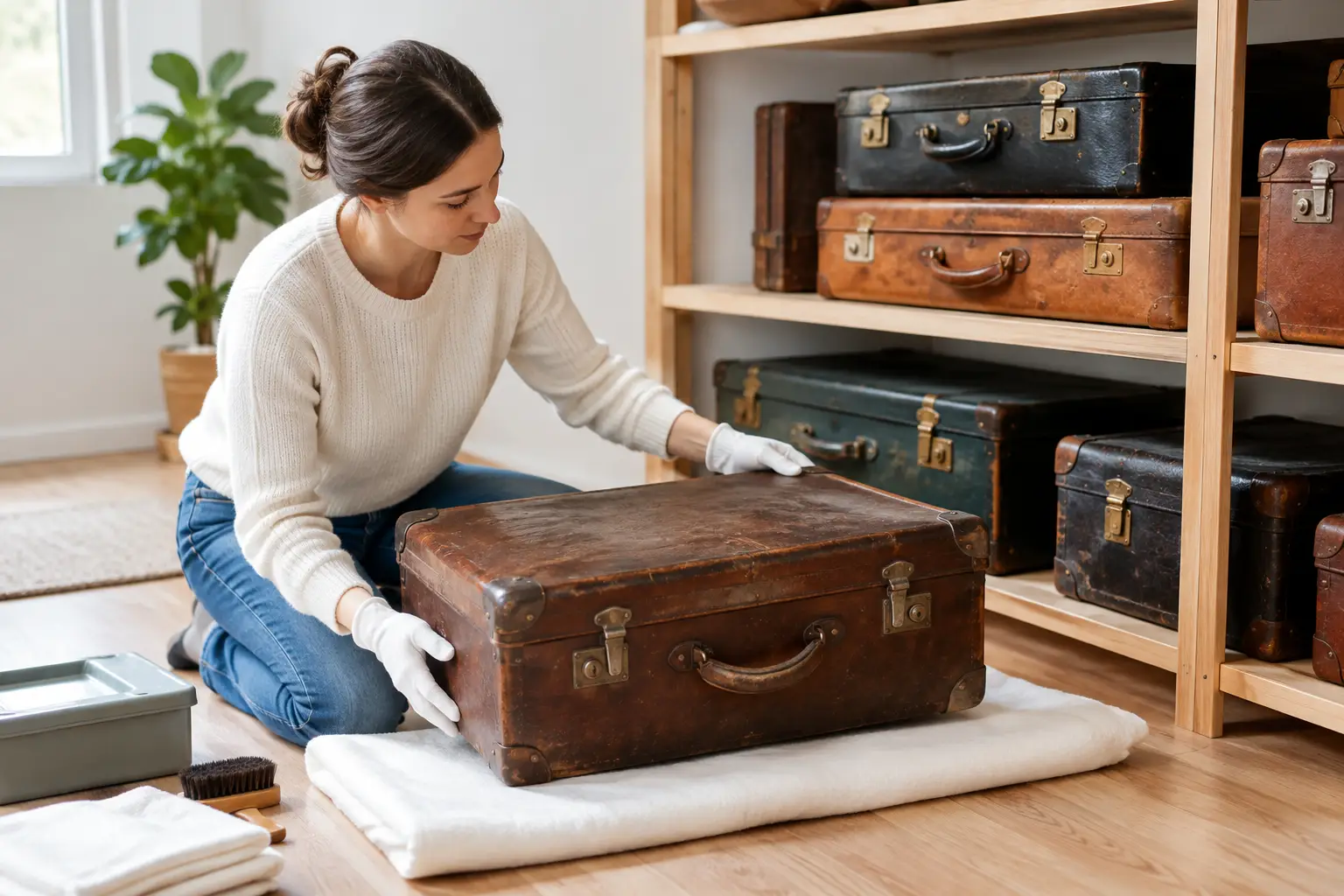
A 1950s leather suitcase can look perfectly at home beneath a Mid-Century console or beside a Murano lamp, but its beauty depends on what happens when it is not on display. Vintage luggage was made to travel, often in harsher conditions than a modern home, yet age changes the equation. Leather dries, canvas attracts dust, metal hardware oxidizes, and fragile linings retain odors and moisture.
Knowing how to store vintage luggage is therefore less about hiding it away than giving it the stable conditions a decorative object and collectible deserve. The aim is to preserve its original materials, patina, labels, and hardware without flattening the form or over-restoring the story it carries.
Start With the Material, Not the Age
“Vintage luggage” covers a remarkably broad family of objects. A structured vulcanized-fiber train case, a leather steamer trunk, a canvas suitcase with leather trim, and a hard-sided 1960s vanity case should not be treated identically. Before choosing a location, identify the materials and their most vulnerable points.
Leather reacts badly to heat, very dry air, and direct sunlight. It can become stiff, crack at folds, or develop a pale, powdery surface if it has been poorly stored for years. Canvas and fabric-covered cases are more susceptible to dust, staining, and mildew. Wood-framed trunks can warp in unstable humidity, while plated metal clasps and brass corners can tarnish or corrode in damp conditions.
Original paper labels, travel stickers, and interior textiles deserve particular restraint. They are often among the most evocative details of a piece, but also the least replaceable. Do not use aggressive cleaners in an effort to make luggage look newer. A small darkened area or softened corner is often honest patina, not damage to erase.
How to Store Vintage Luggage in the Right Environment
The ideal storage space is clean, dry, dark, and reasonably stable. A climate-controlled interior closet, guest room, or dedicated storage cabinet is usually far safer than an attic, basement, garage, or outdoor storage unit. The latter spaces are prone to sharp temperature shifts, dampness, pests, and prolonged heat – all conditions that can quietly compromise old materials.
Avoid placing luggage directly on a concrete floor, even in a dry-looking basement. Concrete can hold and release moisture, creating a microclimate that encourages mold and stains. If a lower-level room is the only available option, raise each piece on a shelf, wood slats, or a stable platform, leaving room for air to circulate beneath it.
Light matters even when the luggage is displayed rather than packed away. Sunlight can fade canvas, dry leather, and make old adhesives brittle. A case displayed in a bright room should sit away from direct windows or be protected by UV-filtering shades. Soft ambient light will allow the shape and surface to remain visible without sacrificing the finish.
Humidity calls for balance. Very damp air invites mildew and corrosion; overly dry air can dehydrate leather and wood. For most collections, a consistently moderate indoor environment is preferable to any attempt at extreme control. If a room has a history of moisture problems, solve that issue before introducing vintage pieces. Silica gel packets may be useful inside a case in a humid climate, but they should be checked and replaced regularly rather than forgotten for years.
Clean Gently Before Putting It Away
Never store vintage luggage while it is dusty, damp, or carrying residue from a recent move. Begin with the least invasive method: a soft, dry microfiber cloth or a natural-bristle brush. Work around seams, handles, corners, and hardware where dust tends to settle.
For leather, use a dry cloth first. If there is surface grime, a slightly damp cloth can be appropriate, followed immediately by air-drying away from heat. Use leather conditioner sparingly and only after testing it on an inconspicuous area. Some vintage leathers darken noticeably with conditioners, and over-conditioning may leave a tacky surface that attracts dust. Luggage with flaking finishes, unstable dye, or mold should be assessed by a conservator rather than treated at home.
Metal hardware benefits from a restrained approach as well. A dry polish cloth can lift superficial tarnish, but avoid abrasive polishes around stitched leather, painted surfaces, or plated corners. The goal is not mirror-bright hardware. Gentle age and tonal variation often belong to the object’s visual character.
Open the case and inspect the interior. Vacuum loose debris with a low-suction brush attachment held slightly above fragile linings. If the interior smells musty, leave it open in a shaded, dry room for several days. Do not mask the odor with perfume, scented sachets, or fabric sprays. They can stain linings and create a more difficult problem later.
Support the Shape Without Overpacking It
An empty case can sag, especially if it is made of softer leather or canvas. At the same time, packing it tightly can distort seams, stress hinges, and imprint the lining. The best approach is light, breathable support.
Use unprinted acid-free tissue paper or washed, undyed cotton fabric to softly fill the interior. This helps a case retain its silhouette without adding pressure. Avoid newspaper, colored tissue, plastic grocery bags, and bubble wrap. Ink can transfer, plastic can trap moisture, and synthetic packing materials may leave creases or odors over time.
For trunks and larger suitcases, support the lid if weak hinges make it difficult to keep open. Do not force a warped closure or pull hard on a fragile handle. A piece that no longer closes properly may be better stored slightly ajar, with a clean cotton barrier protecting the interior, than compressed into its original position.
As a rule, store vintage luggage flat on its base rather than upright on narrow edges. This distributes weight through the structure as intended. A large trunk may safely support a lighter suitcase if the surfaces are stable and padded with a layer of clean cotton or archival tissue. Do not create a tall tower. Excess weight can deform lids and leave permanent marks on leather.
Protect Hardware, Handles, and Interiors
The details that make a suitcase compelling are frequently the first to fail. Leather handles dry out from repeated stress. Brass latches can scratch adjacent cases. Interior straps, pockets, and mirror panels may become brittle long before the exterior shows obvious wear.
Wrap exposed buckles or sharp metal corners with a small piece of acid-free tissue when nesting luggage. If you place one case inside another to save space, make sure there is enough padding between them and that the outer case is strong enough to bear the slight outward pressure. Nesting is efficient for a set of small, sturdy hard cases, but it is not ideal for delicate vanity cases, trunks with original trays, or luggage with unstable leather.
Keep locks unlocked whenever possible. Old keys are easily misplaced, and an antique lock can seize after a season in storage. Store the key in a labeled envelope or fabric pouch near, but not loose inside, the case. If the luggage has a working combination lock, record the combination in a secure collection inventory.
Display Storage Can Be the Best Storage
For a particularly sculptural case, storage can become part of the room. A matched pair of 1960s suitcases can function as a low bedside table; a handsome leather trunk can anchor a dressing room or study; a compact vanity case can add a personal note to a shelf of design books and objects. This approach keeps a collection visible while avoiding the neglect that often comes with deep storage.
The trade-off is exposure. Displayed luggage needs periodic dusting and protection from sun, pets, food spills, and high-traffic corners. Keep it away from radiators, fireplaces, and air-conditioning vents. If it is used as a table, place a tray or protective surface on top rather than setting drinks, candles, or plants directly on the lid.
A trunk that is structurally sound may hold lightweight textiles, letters, or seasonal accessories. Do not treat an old trunk as a heavy-duty storage bin simply because it once crossed an ocean. Its decorative value may now exceed its practical load-bearing capacity.
Inspect Your Collection Seasonally
Vintage luggage benefits from quiet attention. Every few months, open each stored piece and look for changes in smell, moisture, mold spotting, insect activity, leather stiffness, or corrosion around hardware. Move it gently rather than dragging it by the handle, and check whether shelf surfaces remain clean and dry.
Photographing each item and noting its condition is worthwhile for valuable luggage, especially pieces with maker’s marks, original labels, or exceptional provenance. Documentation helps you notice gradual changes and preserves useful information for insurance, resale, or future stewardship.
A vintage suitcase should never be reduced to an empty container. Stored with care, it remains what it has become over time: a functional object transformed into a record of travel, craftsmanship, and personal style. Give it a stable place, a little room to breathe, and the chance to keep its character intact.