

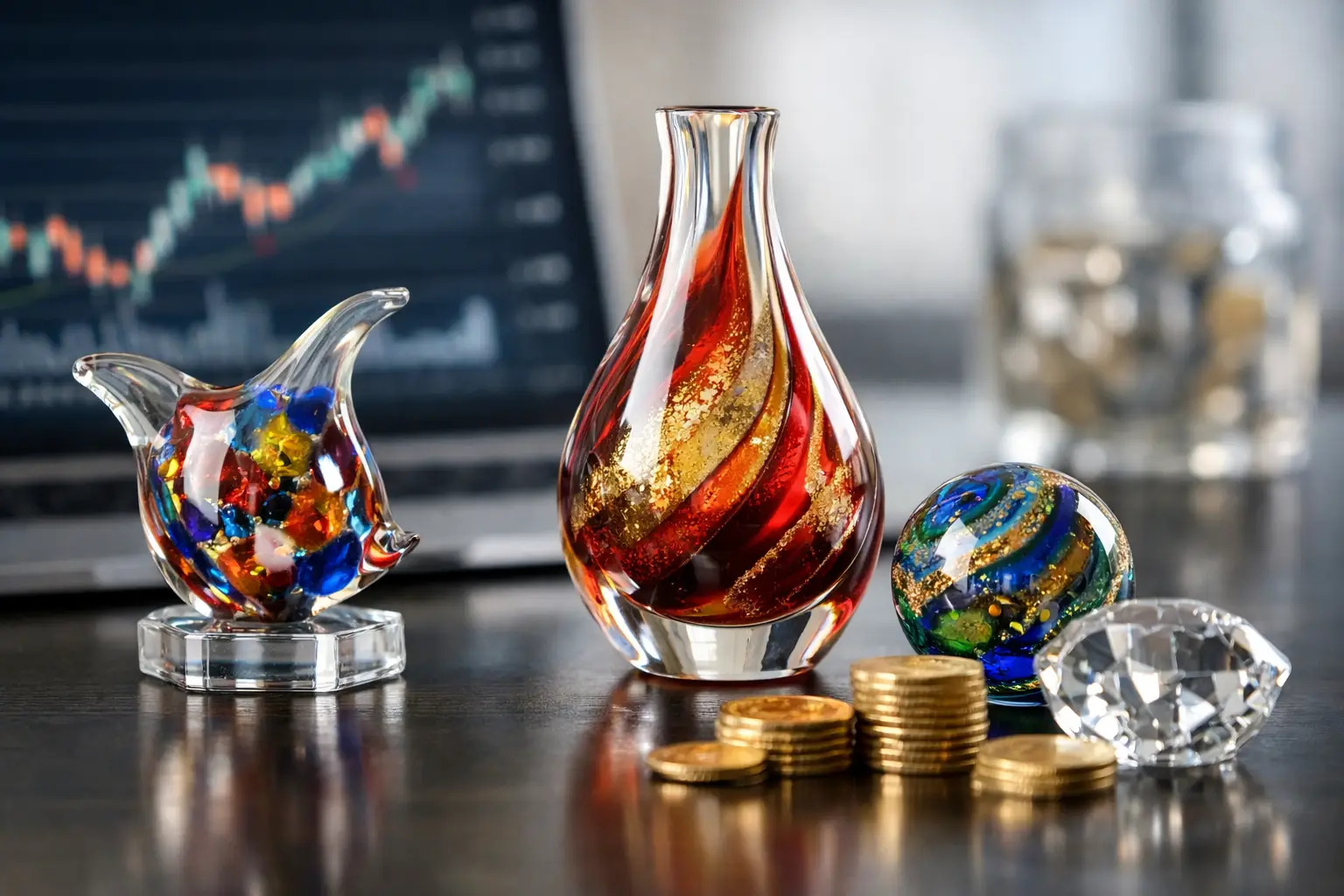
A hand-blown Murano vase can sit in a room like sculpture, catch light like jewelry, and still raise a practical question: is Murano glass a good investment? The honest answer is yes – sometimes very much so – but not in the simplistic way people often hope. Murano is not a guaranteed upward market. It is a category where quality, authorship, rarity, condition, and timing matter more than the label alone.
For collectors and design-led buyers, that distinction is everything. The best Murano pieces tend to reward a trained eye, not impulsive speculation.
Is Murano glass a good investment or just a beautiful purchase?
Murano glass occupies an unusual position. It belongs at once to decorative art, collectible design, and Italian cultural production. That overlap gives it resilience. A strong piece can appeal to a design collector, an interior designer sourcing a statement object, or a buyer who simply wants an interior with more identity.
That broad desirability is one reason the category has remained relevant. Unlike highly specialized collectibles that depend on a narrow base of experts, Murano often has visual immediacy. People respond to form, color, scale, and craftsmanship before they even start evaluating signatures or provenance.
Still, beauty alone does not create investment value. Many Murano objects were produced in large numbers across decades. Some are attractive but common. Others are later decorative pieces with limited collector depth. If the only argument for value is that it is “Murano,” the case is thin.
Investment potential tends to be strongest where artistic identity and historical importance meet. Mid-century lighting, sculptural forms, rare colorways, documented works by known designers, and pieces tied to respected furnaces usually hold the most serious attention.
What actually drives value in Murano glass
The first driver is authorship. A work attributed to Venini, Barovier, Seguso, Toso, Cenedese, or a known designer associated with those houses enters the market differently from an anonymous decorative piece. Collectors pay for authorship because it places the object within a documented design history.
The second is period. Mid-century Murano remains especially strong because it sits at the crossroads of postwar Italian design, interior fashion, and serious collecting. Pieces from the 1940s through the 1970s often have the greatest market fluency, particularly when the design language is distinctive rather than generic.
Condition matters more than many first-time buyers expect. Glass is unforgiving. Chips on rims, polished repairs, cracks, bruising at the base, or replacement hardware on lamps and chandeliers can materially affect value. Even when a piece remains decorative, collector appetite may narrow quickly.
Rarity also needs nuance. A rare object is not automatically desirable. True value comes when rarity meets demand. An uncommon sculptural vase with a strong silhouette and known attribution has a different market from an obscure form that few buyers recognize.
Then there is scale and function. Large chandeliers, rare sconces, monumental vases, and table lamps often attract stronger prices because they combine collectible interest with practical placement in interiors. Buyers do not only want to own them. They want to live with them.
Which Murano pieces tend to perform best
If the question is whether Murano glass is a good investment, it helps to separate decorative purchases from collectible ones. The strongest performers are usually not the most generic examples of the category.
Lighting often stands out. Murano chandeliers and sconces sit in a premium segment because they operate as both design objects and architectural focal points. A well-preserved fixture with original elements, elegant proportions, and clear period character can remain highly desirable across private residences, hospitality projects, and designer-led interiors.
Signed or well-attributed vases and sculptures also do well, especially when they represent a recognizable technique or model. Pulegoso, sommerso, latticino, zanfirico, and figural or biomorphic forms all have collector followings, though not every example is equally sought after.
Limited-production pieces and works with documented provenance deserve special attention. Original labels, archival references, period catalog matches, or a credible chain of ownership can transform a nice object into a serious acquisition.
Jewelry and small decorative objects can be attractive entry points, but they tend to be more uneven as investments. They may offer style and accessibility, yet not always the same long-term price strength as exceptional lighting or museum-quality decorative forms.
Where buyers make mistakes
The most common mistake is buying the name of the island rather than the quality of the object. Murano has extraordinary artistic heritage, but it has also produced decades of commercial output at many levels. Not every piece carries the same cultural or market weight.
Another mistake is confusing age with significance. Older does not always mean more valuable. A well-designed mid-century piece with clear attribution can outperform an earlier but less remarkable example.
Condition is another blind spot. Buyers sometimes accept damage because glass still looks luminous at a distance. In the market, though, damage is rarely invisible. It affects confidence, resale, and comparability.
There is also the issue of misattribution. Murano has been widely imitated, and labels are not always present. Some pieces are correctly described as Murano but cannot be assigned to a specific furnace or designer with certainty. That does not make them undesirable, but it does place a limit on investment logic.
How to buy Murano with investment sense
A good purchase starts with selectivity. Buy fewer pieces, but buy better ones. This is almost always wiser than assembling a broad group of average examples.
Look closely at form. Strong Murano has conviction. The proportions are considered, the color is intentional, and the technique supports the design rather than substituting for it. Pieces that feel visually resolved tend to remain attractive even as market taste shifts.
Prioritize documentation whenever possible. Labels, signatures, invoices, old photographs, expert attribution, and catalog references all matter. They reduce ambiguity, which is one of the biggest obstacles to future resale.
Buy from a source with a clear curatorial point of view. In a category where variation in quality is dramatic, selection is not a minor detail. It is part of the value proposition. A specialized dealer or boutique platform such as Sound Of Vintage Italy can help narrow the field to pieces with stronger aesthetic and collector relevance.
It also helps to buy where your own taste is already engaged. If a piece has no decorative life for you beyond its supposed upside, that is usually a warning sign. The Murano market can reward patience, but patience is easier when the object genuinely earns its place in your interior.
Is Murano glass a good investment in today’s market?
The market is favorable to objects that combine authenticity, sculptural presence, and design credibility. That has benefited better Murano. Interiors have moved away from flat uniformity, and buyers increasingly want pieces with material richness and historical texture. Murano answers that desire beautifully.
At the same time, the market is more educated than it once was. Buyers compare examples more carefully. They ask harder questions about originality, restoration, and attribution. This tends to strengthen top-tier pieces while leaving weaker ones behind.
That split is healthy. It means Murano is not being treated as a trend label alone. The market is learning to distinguish between decorative glass and collectible design.
For this reason, Murano can be a good investment, but it is best approached as a selective design asset rather than a quick-flip opportunity. The upside tends to favor exceptional pieces, not average ones. If your expectations are measured and your standards are high, the category offers something rare: objects that can hold aesthetic power in a room while also preserving collector interest over time.
The most satisfying Murano purchases usually live in that intersection. They are not bought only to appreciate, and not only to decorate. They are chosen because they have presence, pedigree, and enough permanence to remain compelling long after the market mood has changed.
If you buy Murano glass with that standard in mind, you are not just chasing value. You are acquiring a piece with the capacity to keep giving it.
Sorry, the comment form is closed at this time.