
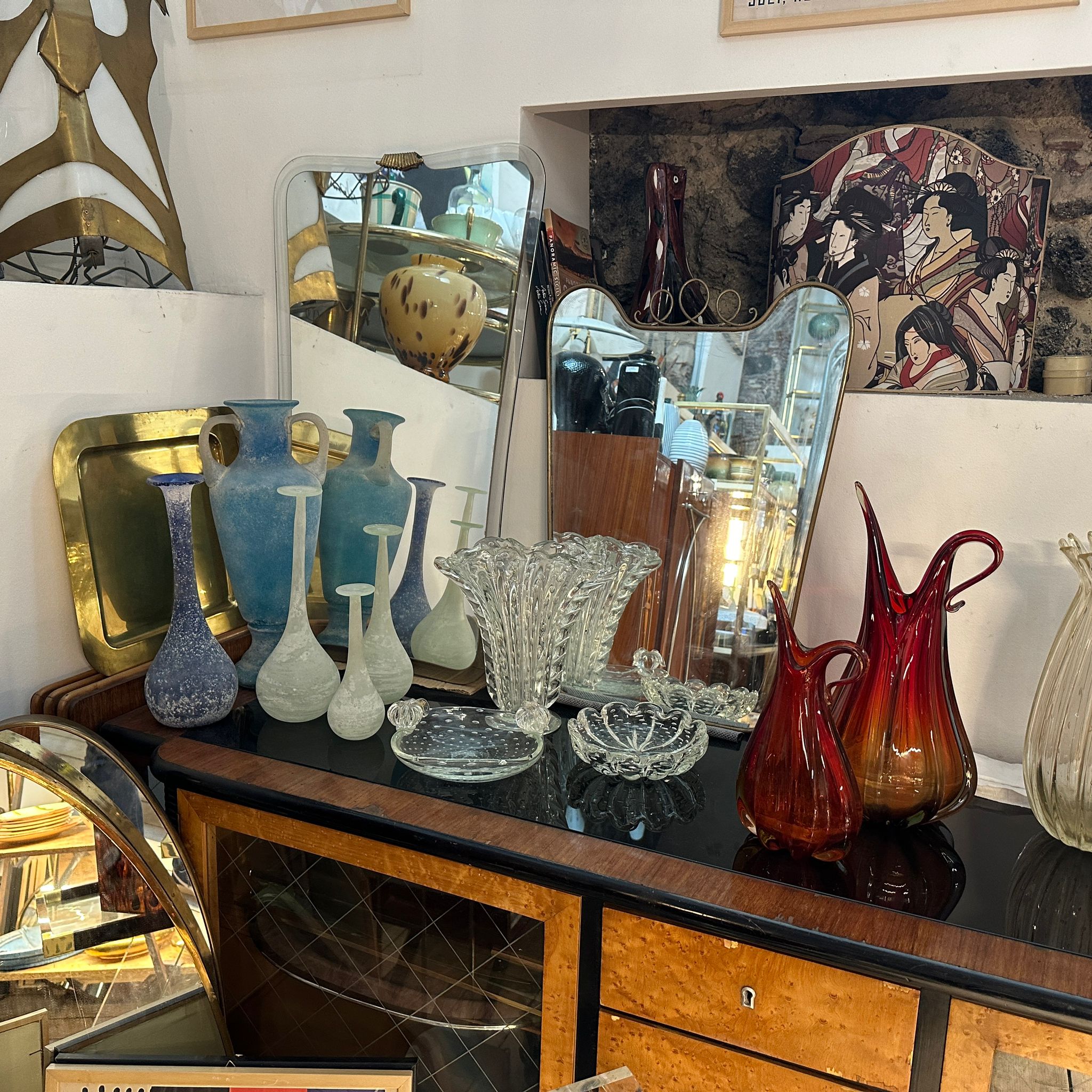
A Murano chandelier can fill a room before the light is even switched on. A small sommerso vase can do the same from a console table. That immediate presence is part of what makes Murano glass valuable, but it is never the whole story. Real value sits at the intersection of artistry, authorship, condition, rarity, and the cultural weight of an object made in one of Italy’s most important glassmaking traditions.
For collectors and design-led buyers, Murano is not a generic style category. It is a place, a method, and often a signature of quality. Yet not every piece carries the same relevance in the market. Some examples are decorative and accessible. Others are historically significant works tied to major furnaces, documented designers, or technically ambitious executions that are increasingly difficult to find.
What makes Murano glass valuable in the market
The first factor is authenticity. Murano glass refers to glass made on the Venetian island of Murano, where centuries of specialized craftsmanship shaped a language of forms and techniques now recognized worldwide. A piece that is genuinely Murano-made has a very different standing from glass merely inspired by Murano aesthetics.
That distinction matters because the market rewards origin. Collectors, decorators, and dealers are not only buying color and form. They are buying a tradition of furnace production, hand-finishing, and technical knowledge handed down through workshops and artistic collaborations. When provenance supports that origin, value tends to rise accordingly.
The second factor is design quality. Murano glass is broad – it includes lighting, sculptures, mirrors, vases, bowls, figurines, and furniture elements. Within that breadth, the market consistently favors pieces with strong silhouette, balanced proportions, refined color work, and a clear decorative identity. Objects that hold the eye from every angle tend to remain desirable, especially when they fit naturally into sophisticated interiors rather than feeling purely period-bound.
Technique is one of the clearest value drivers
Not all Murano glass requires the same level of mastery. Certain techniques signal time, skill, and risk in production, and that affects desirability.
Sommerso, for example, is prized for its layered depth of color. When executed well, it creates a sculptural effect that feels almost architectural. Filigrana and latticino require fine internal line work with remarkable control. Pulegoso introduces a dense field of bubbles that can look simple at first glance but depends on precise handling. Aventurine adds shimmering metallic inclusions that elevate surface complexity. Zanfirico twists and interlaces can move into truly virtuosic territory.
The more technically demanding the piece, the more likely it is to attract serious attention, especially if the result is clean and visually resolved rather than busy. Technique alone does not guarantee value, but exceptional technique often separates ordinary decorative glass from collectible design.
Why difficulty matters
A difficult piece carries a different kind of authorship. It reflects not just an attractive result but a higher threshold of execution. In Murano, where the finest works emerge from the choreography between designer and master glassmaker, that difficulty is part of the object’s identity.
Collectors notice details such as the sharpness of canes, the clarity of layers, the precision of applied elements, and the confidence of the overall finish. These are not minor refinements. They are often the reason one vase is modestly priced while another commands sustained market interest.
Age helps, but it is not enough on its own
There is a common assumption that older always means more valuable. In Murano glass, age can increase importance, but only when paired with quality, provenance, and condition.
Mid-century Murano remains especially strong because it combines exceptional furnace production with a period of adventurous Italian design. Pieces from the 1940s through the 1970s often appeal to both collectors and interior designers, which broadens demand. They work in period homes, contemporary spaces, hospitality projects, and curated retail environments.
Earlier examples can be highly valuable as well, particularly if they relate to historic Venetian techniques or notable decorative movements. But age without distinction is not enough. A later piece by a respected furnace or designer can be more valuable than an older but generic object.
Designer and furnace attribution can change everything
One of the strongest price factors is attribution. When a piece can be connected to a known designer, a major furnace, or both, its market position often shifts upward.
Names such as Venini, Barovier and Toso, Seguso, Salviati, Cenedese, Archimede Seguso, Carlo Scarpa, Fulvio Bianconi, Paolo Venini, Ercole Barovier, and Dino Martens are central to Murano’s collecting landscape. Their work carries not just decorative appeal but design history. A vase or lamp attributed convincingly to one of these names enters a different conversation from an anonymous example.
That said, attribution needs care. Labels may be missing, signatures may be absent, and old stickers can be damaged or removed over time. Serious evaluation often depends on shape, documented models, technique, archive references, and comparison with known pieces. In this category, confidence matters. Strong attribution supports value. Weak attribution creates hesitation.
Labels, signatures, and documented models
Original labels are helpful, but they are not the only proof. Many authentic Murano pieces have lost labels through use, cleaning, or rewiring in the case of lighting. Acid signatures, paper labels, foil labels, and etched marks can support identification, but design language and production traits are equally important.
Collectors tend to pay more when a piece corresponds to a documented model or catalog example. Documentation reduces uncertainty, and uncertainty is one of the fastest ways value softens.
Rarity is not just about low numbers
Rarity in Murano glass takes several forms. A piece may be rare because few were made, because few survived intact, because a technique was used for a short period, or because a specific colorway appears infrequently on the market.
Large-scale lighting is a good example. An impressive Murano chandelier with complete components, original decorative coherence, and strong visual scale can be far rarer than a small tabletop object, simply because these works were fragile, expensive to maintain, and often altered over time.
Unusual forms also matter. Experimental mid-century pieces, limited artistic productions, and sculptural works with daring asymmetry or uncommon internal effects tend to attract buyers who want more than a recognizable Murano look. They want a piece with edge, personality, and scarcity.
Condition has a direct effect on price
Murano glass is beautiful, but it is vulnerable. Chips, cracks, clouding, heavy scratches, losses to applied details, poor restorations, or later replacements can significantly affect value.
Lighting deserves particular scrutiny. Rewired chandeliers and sconces can still be highly desirable, but missing leaves, broken arms, replaced bobeches, or mixed parts change the integrity of the piece. With vases and decorative objects, small rim chips may seem minor, yet they can reduce collector confidence quickly, especially in high-end examples.
Condition is also a matter of proportion. A tiny wear mark on the base of a mid-century vase may be expected. A structural crack is not. The better and more original the condition, the stronger the pricing power.
Decorative presence matters more than many buyers realize
A truth of the Murano market is that beauty sells. Historical relevance is important, but decorative power often determines how wide the audience will be.
The most successful pieces balance scholarship and presence. They have enough pedigree to satisfy a knowledgeable buyer and enough visual clarity to anchor an interior. This is why Murano performs so well beyond strict collecting circles. It lives comfortably in design culture.
At Sound Of Vintage Italy, this is precisely where Murano becomes compelling as a category. The right piece does not need to justify itself through history alone. It holds space, reflects light, and brings an unmistakable Italian signature into a room.
What makes Murano glass valuable to collectors versus decorators
Collectors and decorators often overlap, but they do not always prize the same things in the same order.
Collectors may prioritize rarity, designer attribution, early production, and documentation. Decorators may put scale, color, visual impact, and compatibility with an interior first. A rare piece in an awkward palette may interest a specialist more than a design buyer. A large amber-and-clear chandelier with dramatic form may outperform a more scholarly object because it answers a strong decorative need.
This is why value is never fixed by one metric. Market value depends on who wants the piece, how often comparable examples appear, and whether the object speaks more strongly as a collectible, a furnishing statement, or both.
How to assess value with a more trained eye
If you are evaluating a Murano piece, start with five questions. Is it authentically Murano? Can it be attributed with confidence? Does the technique show real mastery? Is the condition honest and strong? Does the design have presence beyond trend?
Then look closer. Study the weight, the finish, the transitions between colors, the quality of any applied elements, and the coherence of the form. Murano worth buying rarely feels casual in the hand or unresolved in silhouette. Even playful pieces usually show discipline.
Price should follow substance. A modestly scaled but beautifully attributed vase may be more valuable than a larger anonymous one. A chandelier with original complexity may justify a premium over simpler examples. A rare sculptural object may command attention because there is simply nothing else like it in circulation.
The most rewarding Murano purchases tend to be the ones that hold up on every level – origin, craft, design, and presence. When those elements align, value stops being abstract. You can see it in the surface, in the light, and in the way the object changes the room around it.