
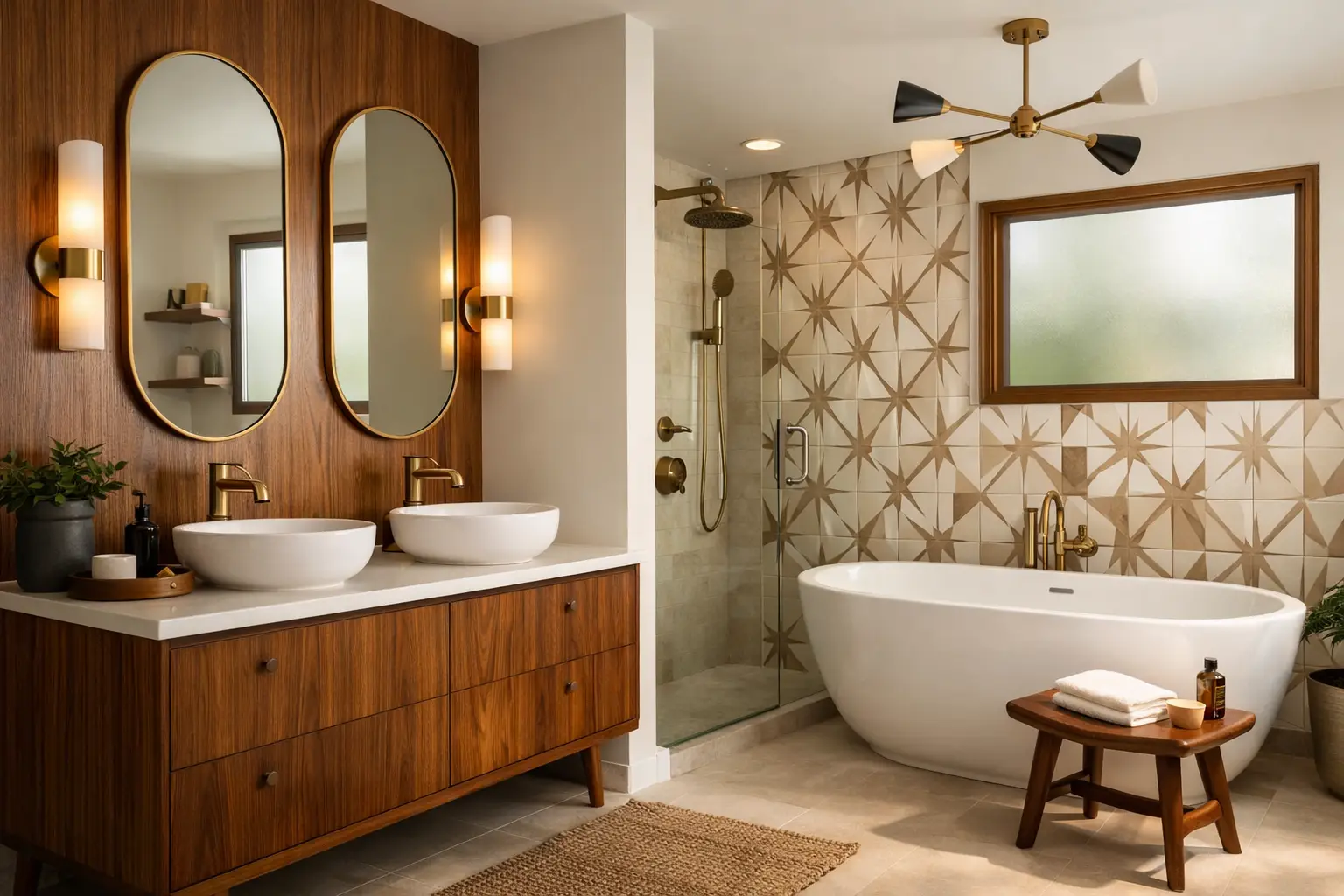
A convincing bathroom design mid century modern scheme rarely begins with the vanity. It begins with proportion. The best rooms in this style feel composed before they feel decorated – clean lines, warm materials, and a measured use of color that never slips into nostalgia for its own sake.
That balance is what makes mid-century modern bathrooms so enduring. They can feel architectural without becoming cold, decorative without becoming crowded. For those drawn to vintage interiors with presence, this is one of the few bathroom styles that can carry collectible character and daily practicality at the same time.
What defines bathroom design mid century modern
In a bathroom, mid-century modern design is less about reproducing a period set and more about preserving a visual language. Think horizontal lines, well-scaled cabinetry, honest materials, and a controlled palette where each element has a reason to exist. Walnut, teak, oak, terrazzo, ceramic tile, brass, smoked glass, and mirror all belong here, but not in equal measure.
The distinction matters. A room with a starburst mirror and a few retro accessories is not necessarily mid-century modern. A room with visual discipline is. That usually means a floating vanity or one with slender legs, integrated storage, geometric tile, and lighting chosen as an object rather than an afterthought.
There is also a particular warmth to the style. Unlike more austere modern bathrooms, a strong mid-century scheme allows wood grain, amber tones, olive, rust, matte white, and softened metallic finishes to live together. The result should feel collected, not staged.
Start with the architecture, not the accessories
If the room already has original features, they deserve attention first. A narrow window with a horizontal emphasis, an existing recessed niche, or old tile with good geometry can become the foundation of the design. Trying to cover every older detail often weakens the room. In many cases, editing is more effective than replacing.
For renovated spaces, the architectural shell should stay quiet. Walls, floor plane, and built-in elements need to support the furniture-like quality that defines the best mid-century bathrooms. This is why oversized decorative moldings, busy stone veining, and heavily embellished hardware tend to feel misplaced. They compete with the line of the room instead of clarifying it.
A practical guide here is simple: if an element looks too loud before the bathroom is furnished, it is probably too loud for the style.
Vanities with furniture presence
The vanity is often the strongest expression of the period. Mid-century modern bathrooms respond well to pieces that read like cabinetry rather than generic bath units. Flat-panel fronts, finger pulls, tapered legs, and a low horizontal profile are especially convincing. Walnut and teak are classic choices because they bring depth without visual heaviness.
That said, wood in a bathroom always comes with a trade-off. Natural veneers and solid timber need proper sealing and ventilation. In powder rooms this is less of a concern. In family bathrooms with daily steam, a carefully finished vanity or a high-quality wood-look alternative may be the smarter solution.
Countertop selection should support the silhouette rather than dominate it. White integrated sinks, pale quartz with restrained movement, or terrazzo surfaces work well because they keep the focus on shape and material balance.
Tile choices that stay true to the era
Tile can make a mid-century bathroom feel refined or theatrical. The better choice is usually restraint. Small-format square tile, elongated rectangles, stacked layouts, mosaic floors, and terrazzo all fit naturally. Colors can range from chalk white and soft gray to moss, dusty blue, ocher, or blush, but saturation should be handled carefully.
A common mistake is to combine too many period references at once – bold patterned floor tile, colorful shower walls, dramatic wallpaper, and statement fixtures in a single compact room. Mid-century design usually looks better when one surface leads and the others support.
If you want the room to feel quietly authentic, consider keeping wall tile simple and letting the floor carry more personality. Terrazzo, in particular, has the right mixture of graphic interest and material seriousness. It also ages well visually, which matters in a room that should outlast trends.
Color and finish in a mid-century bathroom
The palette of bathroom design mid century modern is warmer and more nuanced than many people expect. Pure black and white can work, but often feel sharper than the style requires unless balanced by wood or aged brass. More faithful combinations include walnut with ivory, sage with warm white, pale pink with tobacco wood, or soft gray with brushed brass.
Finish selection deserves the same care. Chrome is crisp and period-appropriate in some interpretations, especially if you want a cleaner, more architectural look. Brass and bronze introduce a softer, more decorative note. Neither is universally correct. It depends on whether the room leans toward California modernism, European restraint, or a slightly more glamorous vintage mix.
Consistency helps. Too many metals can make the room feel assembled from trends rather than curated through a point of view.
Lighting is where character enters
Bathrooms often suffer from technical lighting choices that erase the room’s identity. Mid-century spaces ask for more intention. The mirror area should be lit well, but the fixtures themselves should still have sculptural value. Globe sconces, brass wall lights, opaline glass, and disciplined geometric forms all work beautifully.
This is one of the rare rooms where a decorative light can shift the entire atmosphere. A carefully chosen wall sconce or ceiling fixture brings the bathroom out of the purely functional category and into the decorative life of the home. For collectors and design-focused homeowners, this is where vintage pieces can add real distinction.
Murano glass, if used with restraint, can be especially compelling in a powder room or guest bath. The key is placement. One memorable light is more effective than several competing gestures.
Mirrors, hardware, and the art of editing
Mid-century modern bathrooms benefit from mirrors with clear geometry. Round mirrors soften rectilinear cabinetry. Rectangular mirrors with thin frames reinforce the architectural line. What usually does not help is overly ornate framing or heavily distressed finishes meant to simulate age.
Hardware should feel deliberate and tactile. Knurled details can work in small doses, but simple pulls, integrated handles, and restrained faucet profiles are more aligned with the style. This is not minimalism for its own sake. It is visual discipline.
Accessories should be few and specific. A ceramic vessel, a lidded box, a small stool, a folded textile in a rich solid color – these are enough. Mid-century rooms lose force when every surface is activated.
Vintage authenticity versus reproduction
This is where taste becomes visible. An entirely reproduction-based room can be attractive, but it often lacks the tension that makes interiors memorable. One or two authentic vintage elements – a light fixture, mirror, stool, or decorative object – can give the bathroom a more grounded identity.
At the same time, bathrooms are hard-working spaces. Original cabinets may not meet current needs, and vintage lighting sometimes requires rewiring or adaptation for wet-area compliance. Purism is less useful here than judgment. The strongest rooms often combine a practical new framework with selective vintage accents that carry history.
For a curated result, prioritize pieces with clarity of form and material quality. Not every old object belongs in a mid-century bathroom, and not every mid-century object belongs in a humid room.
How to avoid a staged retro look
The difference between elegant and theme-driven often comes down to repetition. If every element announces the era, the room can start to feel costume-like. Better to let the style emerge through structure, material, and one or two decisive statements.
That might mean pairing a teak vanity with plain white tile and a striking vintage sconce. Or using terrazzo flooring with quiet cabinetry and a single sculptural mirror. The eye needs moments of rest. This is especially true in smaller bathrooms, where too much visual information quickly feels compressed.
A useful test is to remove the obvious retro accessories in your mind. If the room still reads mid-century modern through line, tone, and proportion, the design is strong.
Small bathrooms work especially well in this style
Mid-century modern is remarkably effective in compact spaces because it favors clean profiles and visual lightness. Floating vanities create floor visibility, large mirrors extend depth, and disciplined material choices keep the room coherent. Small does not have to mean plain.
In fact, powder rooms are often the ideal place to be slightly bolder. A deeper color, a more expressive light fixture, or a rarer mirror can make a compact room feel intentional rather than secondary. For those who collect design objects, the bathroom can become a precise stage for a single exceptional piece.
A thoughtfully composed mid-century bathroom does not need to imitate the past. It needs to understand why the period still matters – its confidence in line, its respect for materials, and its refusal to decorate without purpose. When those qualities are present, even a modest bathroom gains something rare: style with memory, and usefulness with character.