
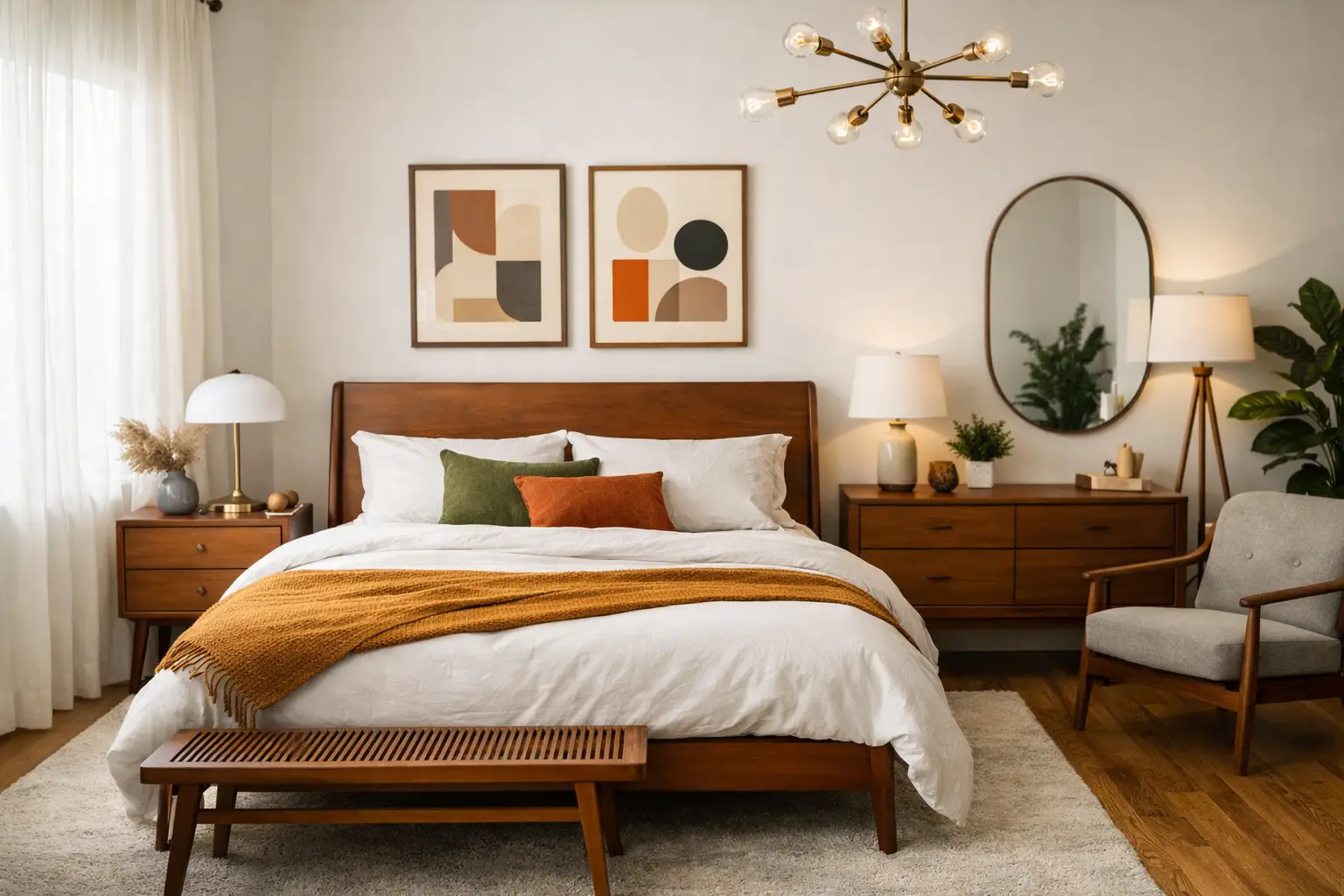
A mid-century modern bedroom should never feel staged. The best ones feel edited, calm, and quietly confident – a room where every line has purpose, every material adds warmth, and a single vintage piece can carry more presence than an entire matching set. That is exactly why bedroom design mid century modern continues to hold its place: it offers restraint without feeling cold, and character without visual excess.
For a design language so recognizable, it is also easy to flatten into cliché. Walnut bed, tapered legs, abstract print, done. But an authentic room has more nuance than a checklist. Mid-century modern bedrooms work when proportion, materiality, and atmosphere are considered together.
What defines bedroom design mid century modern
At its core, bedroom design mid century modern is built on clarity. Lines are clean but not severe. Surfaces are refined but not glossy for the sake of polish. Furniture sits lightly in the room, often raised on slim legs, which creates visual space and keeps the bedroom from feeling heavy.
Wood is usually the anchor. Walnut, teak, and rosewood bring the warmth that makes this style livable. Against those richer tones, upholstery, bedding, and rugs tend to stay restrained – ivory, oatmeal, camel, tobacco, olive, charcoal, and muted rust all sit naturally in the palette. Bright color can work, but usually as an accent rather than the main event.
Just as important is the balance between architecture and object. A mid-century bedroom is not crowded with decoration. It relies on a smaller number of strong elements: a bed with a clean silhouette, a pair of nightstands with good proportions, lighting with sculptural value, and one or two pieces that introduce depth through age, glass, brass, ceramic, or textile texture.
Start with the bed, but avoid the obvious set
The bed is the visual center, so its shape matters more than ornament. A low-profile frame with a solid wood headboard is the most direct expression of the style. Slatted detailing, gently rounded corners, and finely tapered legs all support the look without pushing it into reproduction territory.
What often weakens the room is the impulse to buy the full matching suite. In a truly convincing interior, the bed does not need identical companions. A pair of complementary nightstands is usually stronger than a complete set, especially if the wood tone is related rather than perfectly matched. Slight variation gives the room maturity.
If the bed is substantial, keep the surrounding forms lighter. If the bed is visually minimal, nightstands or lamps can take on more sculptural presence. This is where the room starts to feel collected rather than assembled from a single source.
Nightstands, dressers, and storage with real proportion
Mid-century modern furniture is often praised for its silhouette, but proportion is what separates elegant from generic. Nightstands should sit at a practical height relative to the mattress and should not overwhelm the bed width. Dressers, especially longer horizontal ones, work well because they echo the low, elongated geometry associated with the period.
Drawer fronts with integrated pulls or discreet hardware keep the elevation clean. Brass details can add warmth, but too much metallic finish can make the room look styled instead of lived in. If storage is visually dominant, reduce the number of secondary accessories nearby.
Vintage case pieces are especially effective here because they bring surface patina and construction quality that many newer pieces imitate but rarely equal. A dresser with softened edges, visible grain, and a sense of age immediately gives the bedroom more authority.
Lighting is where the room becomes memorable
In many bedrooms, lighting is treated as a necessity. In a mid-century modern bedroom, it is part of the composition. Bedside lamps, wall sconces, and overhead fixtures should all contribute shape, material contrast, and atmosphere.
This is where glass, brass, lacquered metal, and opaline finishes earn their place. A pair of vintage table lamps can sharpen the entire room. Wall-mounted sconces free the nightstands and create a cleaner profile. A ceiling fixture with sculptural form gives the room identity even during the day.
Warm light is essential. The style depends on softness across wood grain and textile texture. Cool white bulbs flatten everything and undermine the warmth that mid-century interiors need. If the room has one area where selection should feel especially considered, it is lighting.
For collectors and design-led buyers, Murano glass can be an exceptional way to introduce refinement into bedroom design mid century modern. Used with restraint, it adds luminosity and an unmistakably Italian sense of craftsmanship without interrupting the room’s graphic clarity.
Walls, color, and the case for restraint
White walls can work, but they are not the only answer. Mid-century bedrooms often benefit from off-whites, mushroom tones, pale taupe, muted olive, or warm greige. These colors hold light gently and support the richness of walnut and teak better than stark bright white.
A darker accent wall behind the bed can succeed, but only if the room has enough daylight and volume. In smaller bedrooms, deep color may compress the space unless furnishings remain minimal. The safer approach is tonal layering – subtle changes in shade through paint, curtains, bedding, and rug rather than one dramatic contrast.
Artwork should be selected with the same discipline. One large abstract piece or a small grouping with clean spacing is more effective than a busy gallery wall. The style prefers visual rhythm over accumulation.
Textiles should soften, not decorate too loudly
One of the common mistakes in mid-century bedrooms is leaving them too hard. Wood, metal, and angular lines need balancing. Bedding, curtains, and rugs are what make the room feel inhabited rather than museum-like.
Choose bedding with tactile quality and simple structure. Cotton percale, washed linen, wool blends, and quilted coverlets all work well. Patterns should stay controlled: subtle stripes, understated geometrics, or solid tonal layers. The focus is texture and depth, not print overload.
A rug is often the missing element. It should extend the warmth of the room rather than compete with the furniture. Flat weaves, restrained geometric patterns, or softly worn vintage rugs suit the style well. If the bedroom already contains statement lighting and richly grained furniture, the rug should be quieter.
Curtains should fall cleanly and generously. Even in a more architectural room, softness at the window is what keeps the atmosphere balanced.
Vintage pieces give the room credibility
A bedroom can reference the mid-century period without containing actual vintage, but it rarely feels as persuasive. One authentic piece changes the tone of the whole room. It may be a pair of bedside lamps, a mirror, a ceramic vessel, a bench, or a dresser with original character.
This matters because mid-century modern is often copied but not always understood. Rooms filled only with new reproductions can feel too perfect, too uniform, almost anonymous. Vintage introduces slight irregularity, and that irregularity is often what creates sophistication.
A curated approach is more convincing than quantity. One excellent mirror and one well-scaled lamp will often do more than six decorative objects with no historical or visual weight. For this reason, boutique selections such as those associated with Sound Of Vintage Italy speak directly to buyers who prefer distinction over volume.
What to avoid when styling the room
The most common error is turning the style into a formula. Too many tapered legs, too many atomic motifs, too many knowingly retro accessories, and the room slips from refined to themed. Mid-century modern should feel designed, not costumed.
Another issue is scale. Many period-inspired pieces are visually slight, which can be elegant, but a room full of undersized furniture feels insubstantial. There should be at least one element with grounding presence, whether that is the bed, a long dresser, a statement rug, or a ceiling fixture.
Material balance matters too. If everything is wood, the room can feel flat. If everything is metal and glass, it can feel cold. The pleasure of this style comes from contrast – smooth and textured, matte and reflective, structured and soft.
A bedroom that feels personal, not referential
The strongest mid-century modern bedrooms do not try to recreate a decade. They borrow its discipline, its respect for form, and its confidence with materials, then adapt those qualities to contemporary living. That may mean mixing a vintage walnut headboard with a more minimal upholstered bench, or pairing period lighting with bedding that feels fresher and less formal.
There is room for interpretation. Some bedrooms lean more architectural and sparse. Others introduce Italian glass, warmer brass notes, or a slightly more layered decorative sensibility. What matters is coherence. Every piece should feel chosen, and every omission should feel intentional.
When the room is done well, it does not ask for attention. It holds it. That is the quiet power of a mid-century modern bedroom – not nostalgia, but presence.