
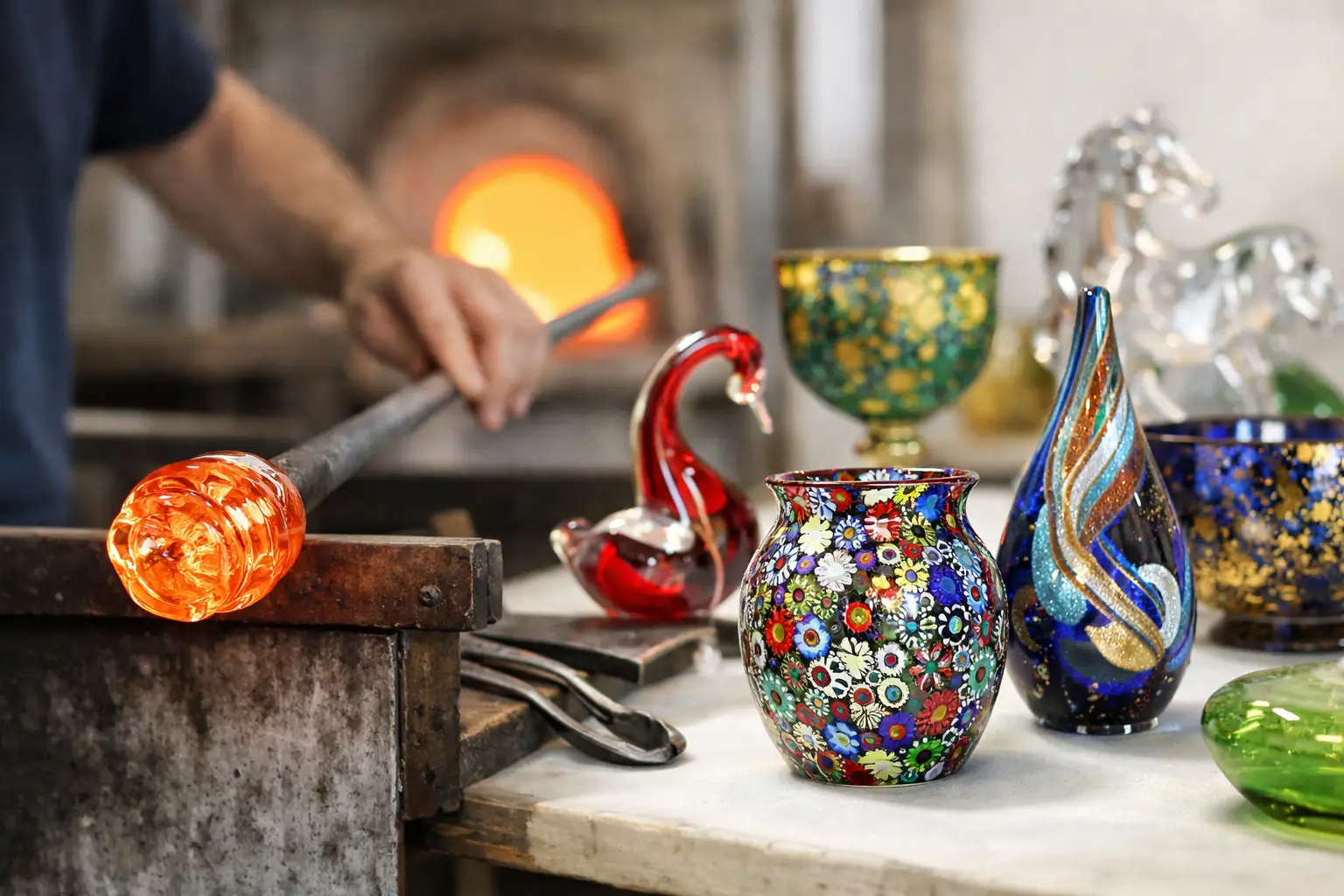
A Murano chandelier may look perfectly composed from across a room, yet its most persuasive details appear up close: a slight movement in a petal, a tiny variation in the thickness of a leaf, the particular way light travels through colored glass. So, is Murano glass handmade? In the traditional and most meaningful sense, yes. Authentic Murano glass is formed by skilled glassmakers working at the furnace, using techniques developed and refined on the Venetian island of Murano over centuries.
That answer deserves some nuance. “Murano glass” is often used broadly in the market, and not every object described with those words carries the same level of workmanship, origin, or collectible significance. For collectors, decorators, and anyone choosing a statement piece for an interior, understanding the difference is part of recognizing what makes Venetian glass exceptional.
Is Murano Glass Handmade? The Short Answer
Classic Murano glass is handmade or hand-finished by master artisans, often called maestri vetrai. Working with molten glass at temperatures above 2,000°F, they gather material from the furnace on a blowpipe, shape it through breath, gravity, tools, and movement, then add decorative elements while the glass remains hot and responsive.
This is not an industrial process in which identical objects emerge from a mold in large quantities. A Murano vase, bowl, sculpture, or lighting element is usually the result of a sequence of highly physical gestures. The maker must judge temperature, timing, weight, and proportion in seconds. A delay can change the form; an overly cool addition may fail to fuse; a single imprecise cut can alter the entire composition.
Some components can be shaped with molds, particularly where repetition is necessary. This does not automatically make a piece less authentic. Molds have long belonged to the vocabulary of Venetian glassmaking, especially for certain decorative motifs and lighting parts. The distinction lies in how they are used: in traditional production, the artisan directs the material, assembles the form, and finishes the piece by hand rather than relying on automated mass manufacture.
The Furnace Is Only the Beginning
The idea of handmade Murano glass is often reduced to glass blowing. Blowing is central, but it is only one part of a much larger tradition. Venetian workshops developed recognizable techniques that demand distinct forms of expertise and often involve more than one craftsperson.
In filigree work, fine threads of colored or opaque glass are arranged within clear glass to create stripes, lattices, or elaborate internal patterns. In latticino, those threads may form delicate white networks that seem suspended inside the body of a vessel. Millefiori uses sections of patterned glass cane, cut into small pieces and fused into vibrant mosaic-like surfaces. Sommerso layers different colors, frequently placing a richly colored core inside a substantial clear casing.
There is also gold or silver leaf, applied while the glass is hot; incalmo, where separate blown forms are joined; and the dramatic sculptural vocabulary of mid-century Murano lighting. A single chandelier may bring together blown cups, twisted arms, hand-formed flowers, curled leaves, textured pendants, and translucent or opaline elements. Its final presence depends as much on balance and assembly as on the individual glass parts.
These techniques explain why the term “handmade” matters. The value is not simply that a human touched the object. It is embedded in trained judgment, inherited methods, and the visual complexity that those methods make possible.
Why No Two Pieces Are Exactly Alike
Handmade does not mean careless, and irregularity should not be confused with poor quality. In fine Murano glass, small variations are often signs of the process itself. One flower on a chandelier may open slightly differently from another. A hand-blown vase may show minute shifts in wall thickness. Tiny bubbles, known as seed bubbles, can occur in the glass and may be entirely consistent with traditional production.
What collectors should look for is not mechanical perfection but compositional control. The silhouette should feel intentional. Colors should be clear, well-balanced, and appropriate to the technique. Applied decoration should be firmly integrated rather than merely attached. On a complex lighting piece, the glass should create a coherent rhythm even when individual elements are subtly different.
The same principle applies to vintage pieces. Decades of use may leave light surface wear, minor scratches, or small signs of age. These can be compatible with authenticity and, in the right context, with value. Damage is different: cracks, poorly matched replacement elements, unstable fittings, or crude repairs deserve careful consideration. A rare design can remain desirable with condition issues, but the price and the intended use should reflect them.
Handmade Does Not Always Mean Signed
A signature can be useful, especially when it is supported by a credible attribution, a known maker, or a documented period of production. Yet the absence of a signature does not mean an object is not Murano. Labels were lost, paper stickers aged away, and many workshop-made pieces were never signed individually.
Conversely, a signature alone should not end the conversation. Marks can be difficult to interpret, and some names are used loosely in the secondary market. A knowledgeable evaluation considers the entire object: technique, form, quality of execution, color palette, construction, age, provenance, and whether it aligns with the work of a specific furnace or designer.
For lighting, the metalwork also tells part of the story. Original mounting systems, compatible fittings, and period-appropriate construction can support an attribution. Electrical components may have been updated for safety, particularly on pieces intended for contemporary homes. A careful rewiring does not erase historical character, but it should be clearly distinguished from original hardware.
How to Recognize Hand-Finished Murano Glass
There is no single visual test that confirms origin in every case. Still, a close inspection can reveal whether a piece has the character of studio glass or the uniformity of factory production. Look at transitions between colors, the underside of applied details, the thickness of the glass, and the relationship between decorative elements.
On a hand-formed Murano flower, for example, petals often show lively variation and a convincing sense of growth. On a mouth-blown vessel, the pontil area – where the piece was detached from the blowpipe – may be polished but can still reveal evidence of hand finishing. In a well-made sommerso object, color layers should appear deliberate and dimensional rather than flat or printed.
A few questions are especially useful when considering a purchase:
- Is the seller specific about the piece’s origin, period, and condition?
- Does the workmanship support the claimed technique or attribution?
- Are there photographs of details, bases, fittings, and any signature or label?
- If it is lighting, have the electrical components been inspected or professionally updated?
These questions are not meant to turn the pleasure of collecting into an interrogation. They simply help distinguish a decorative object inspired by Murano from a piece connected to the island’s actual glassmaking tradition.
The Difference Between Murano Style and Murano Origin
Murano style is widespread because its visual language is irresistible: luminous color, sculptural forms, playful opacity, gold-infused surfaces, and theatrical light. Many objects borrow this language. They may be attractive, well-made, and perfectly suitable for an interior, but they should not be represented as Murano glass unless their origin is credible.
For a collector, provenance changes the conversation. A genuine vintage Murano piece carries not only visual impact but also a relationship to a specific place, workshop culture, and period in Italian design. The difference is particularly evident in the postwar decades, when Murano glass became integral to interiors shaped by Italian modernism, Hollywood Regency glamour, and the expressive optimism of the 1960s and 1970s.
That does not mean every unsigned or undocumented object should be dismissed. It means it should be described honestly. “Murano-style” is a valid aesthetic category. “Murano” is a claim of origin that deserves evidence.
Choosing a Piece for a Contemporary Interior
A handmade Murano object earns its place through presence. A small vase can sharpen a restrained console arrangement; a monumental table lamp can give a modern room a warmer, more personal focal point. In a dining room or entryway, a Murano chandelier often works best when treated as sculpture first and illumination second.
Scale matters. An elaborate floral chandelier needs enough visual air around it to show its silhouette. A deeply colored sommerso vase can hold its own against pale stone, lacquer, or walnut, while a clear or opaline piece may bring softness to a room with stronger materials. The most successful settings do not try to make Murano glass disappear. They allow its color, craftsmanship, and slight unpredictability to remain visible.
At Sound Of Vintage Italy, this is the standard worth seeking: an object chosen not merely for its label, but for the quality of its form, its condition, and its ability to give an interior a more distinctive visual memory. When light catches a hand-shaped Murano surface, the small evidence of the maker’s hand becomes part of the piece’s lasting appeal.