
A Murano glass lamp with a slightly irregular hand-blown silhouette, a 1950s brass wall sconce with mellowed metal, or a lacquered Art Deco mirror carries something a newly made copy cannot be engineered to possess: evidence of a real life. That is the central answer to why buy vintage instead of reproduction. Vintage does more than reference a period. It brings the material intelligence, proportion, and visual memory of that period directly into an interior.
A reproduction can be attractive, useful, and sometimes the practical choice. But for collectors, design-conscious homeowners, and professionals shaping distinctive spaces, the difference is not merely sentimental. It is visible in the glass, the grain, the hardware, the finish, and the way a piece holds a room.
Why Buy Vintage Instead of Reproduction?
The strongest reason is authenticity. A vintage object was made in its own design moment, often with techniques, materials, and standards that are difficult or uneconomical to repeat today. Its details were not chosen to evoke history from a distance. They belong to that history.
Consider the difference between an original Mid-Century table lamp and a contemporary lamp inspired by the same vocabulary. The reproduction may borrow the tapered shade, the slim stem, and the walnut base. Yet the original often reveals a more resolved relationship between each element: the weight of the base, the scale of the shade, the warmth of the brass, the way light falls across an aged surface. These qualities are subtle individually, but together they give an object presence.
The same is true of Art Nouveau bronze, Art Deco glass, Italian modernist furniture, and vintage fashion accessories. An original piece is not simply a style reference. It is a document of a particular workshop, material culture, and visual language.
Patina is not a defect
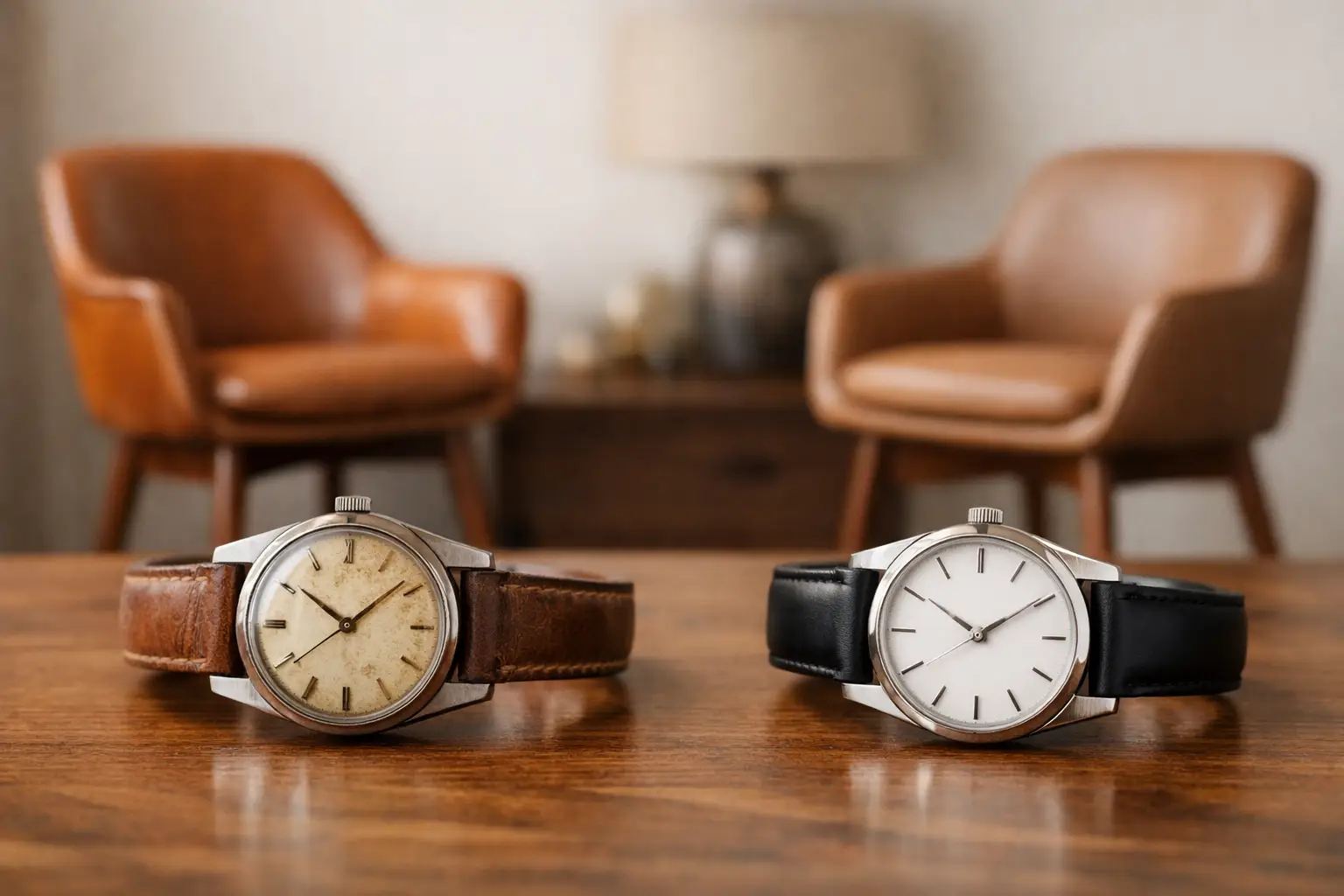
Vintage buyers often speak about patina, but the word is sometimes reduced to a flattering description of wear. In the best pieces, patina is more precise than that. It is the finish created by time: brass that has softened rather than stayed bright, wood that has gained depth, leather that has become supple, glass that reflects light with the faint irregularity of handwork.
This does not mean every mark should be romanticized. Structural damage, unstable wiring, missing components, and poorly executed repairs deserve careful evaluation. A good vintage purchase is not an excuse to ignore condition. It is an informed choice to distinguish honest age from problems that compromise beauty, function, or value.
A careful restoration can preserve a piece while making it appropriate for contemporary use. Rewiring a vintage chandelier to modern safety standards, for example, protects the original design while allowing it to function in a new setting. What matters is that restoration respects the object rather than erasing the features that make it singular.
Original Materials Change the Experience
Reproductions frequently rely on substitutes designed for consistency, cost control, and ease of production. Veneers may replace solid wood, lightweight plated metals may stand in for heavier brass, molded glass may mimic hand-blown forms, and newly manufactured finishes may imitate age in a single uniform layer.
There is nothing inherently wrong with contemporary materials. Many current makers produce excellent work. The issue is that a reproduction often makes a visual promise that its construction cannot fully support. When a design depends on tactile richness, optical depth, or a precise balance of weight and scale, material shortcuts become apparent over time.
Original Murano glass offers a particularly clear example. Its color may shift slightly through the thickness of the glass; tiny variations can catch light differently from one angle to another. Those characteristics are not imperfections to be corrected. They are part of what makes each work feel alive. A factory-made version may reproduce the broad outline, but it rarely reproduces the same luminous complexity.
Vintage furniture also rewards close attention. The joinery, veneer selection, drawer construction, and hardware on a well-made period piece often reveal a seriousness that disappears in a surface-level copy. These are details that may not announce themselves in a photograph, but they shape the daily experience of using the object.
A Room Gains a Point of View
Interiors become generic when every object arrives new, perfectly matched, and visually expected. Vintage interrupts that effect. It introduces contrast, age, and a more personal rhythm.
This does not require furnishing an entire room in one period. In fact, the most persuasive interiors tend to avoid that kind of theatrical completeness. A pair of Italian glass sconces can bring refinement to a contemporary hallway. A sculptural 1970s mirror can sharpen a quiet neutral living room. An antique Sicilian object can add cultural specificity to a minimal dining space without turning the setting into a themed room.
Vintage works especially well because it creates tension between eras. A clean-lined sofa becomes more interesting beside a carved giltwood table. A modern kitchen acquires warmth with an aged pendant light. The goal is not nostalgia. It is composition.
For an interior designer, this distinction matters. A reproduction may fill a stylistic gap, but an original can become the element clients remember. It gives the room a center of gravity, something that feels chosen rather than sourced from a predictable visual formula.
Rarity Creates Meaning, Not Just Scarcity
A vintage piece may be rare because few were produced, because many did not survive, or because a particular colorway, maker, or condition is hard to find. Rarity alone does not guarantee quality. However, when it meets strong design and good provenance, it gives an object a different kind of value.
You are not purchasing an item that will be restocked indefinitely. You are choosing a piece with a finite presence in the market. That can make the search more demanding, but also more rewarding. The acquisition becomes part of the story.
Provenance matters here. A maker’s mark, an attributed designer, an original label, or a documented origin can help place a piece in context. Not every beautiful vintage object will come with complete documentation, and not every purchase needs to be museum-level collecting. Still, asking informed questions helps buyers understand what they are choosing and supports more confident decisions.
At Sound Of Vintage Italy, the value of a curated selection lies in this act of discernment: bringing together pieces whose form, origin, and decorative relevance justify attention beyond a passing trend.
Vintage Can Be a More Considered Choice
Buying an existing object extends its useful life and avoids the material demand of making another version from scratch. That is a meaningful advantage, particularly for furniture and lighting designed to remain in use for decades.
Still, sustainability should not be treated as an automatic virtue. Shipping a heavy object across long distances, restoring a severely compromised piece, or buying vintage solely because it is fashionable can complicate the equation. The most responsible choice is usually the one you intend to keep, maintain, and live with for a long time.
Vintage encourages that longer relationship. A well-chosen cabinet can move from one home to another. A quality lamp can be serviced rather than discarded. A silk scarf, a jewelry case, or a decorative vase can become part of a personal collection instead of a short-lived purchase.
When a Reproduction May Be the Better Choice
The case for vintage is strong, but it is not absolute. Reproductions can be sensible when you need exact dimensions, large quantities, current electrical certifications without restoration, or an object intended for hard daily use in a demanding setting. A family with young children may reasonably choose a new dining table over a fragile original with a delicate veneer. A hospitality project may need matching fixtures in numbers that the vintage market cannot supply.
There are also excellent contemporary designs that should be valued on their own terms rather than judged against the past. The issue is not old versus new. It is whether an object has integrity. A newly made piece with original design, good materials, and skilled construction can be more compelling than a poorly made imitation of an iconic chair or lamp.
Before buying vintage, assess four essentials:
- Condition: Look for structural stability, sound surfaces, and repairs that have been professionally handled.
- Authenticity: Check marks, labels, construction details, attribution, and any available provenance.
- Function: Confirm dimensions, electrical requirements, installation needs, and the practical realities of daily use.
- Relevance: Choose the piece for its lasting relationship to your space, not because it happens to be fashionable now.
The most satisfying vintage purchase is rarely the loudest object in a room. Often, it is the piece whose character becomes clearer over time: the lamp that gives evening light a warmer texture, the mirror that makes an entry feel collected, or the small Murano vase that changes color with the day. Choose the object that keeps offering a reason to look again.