
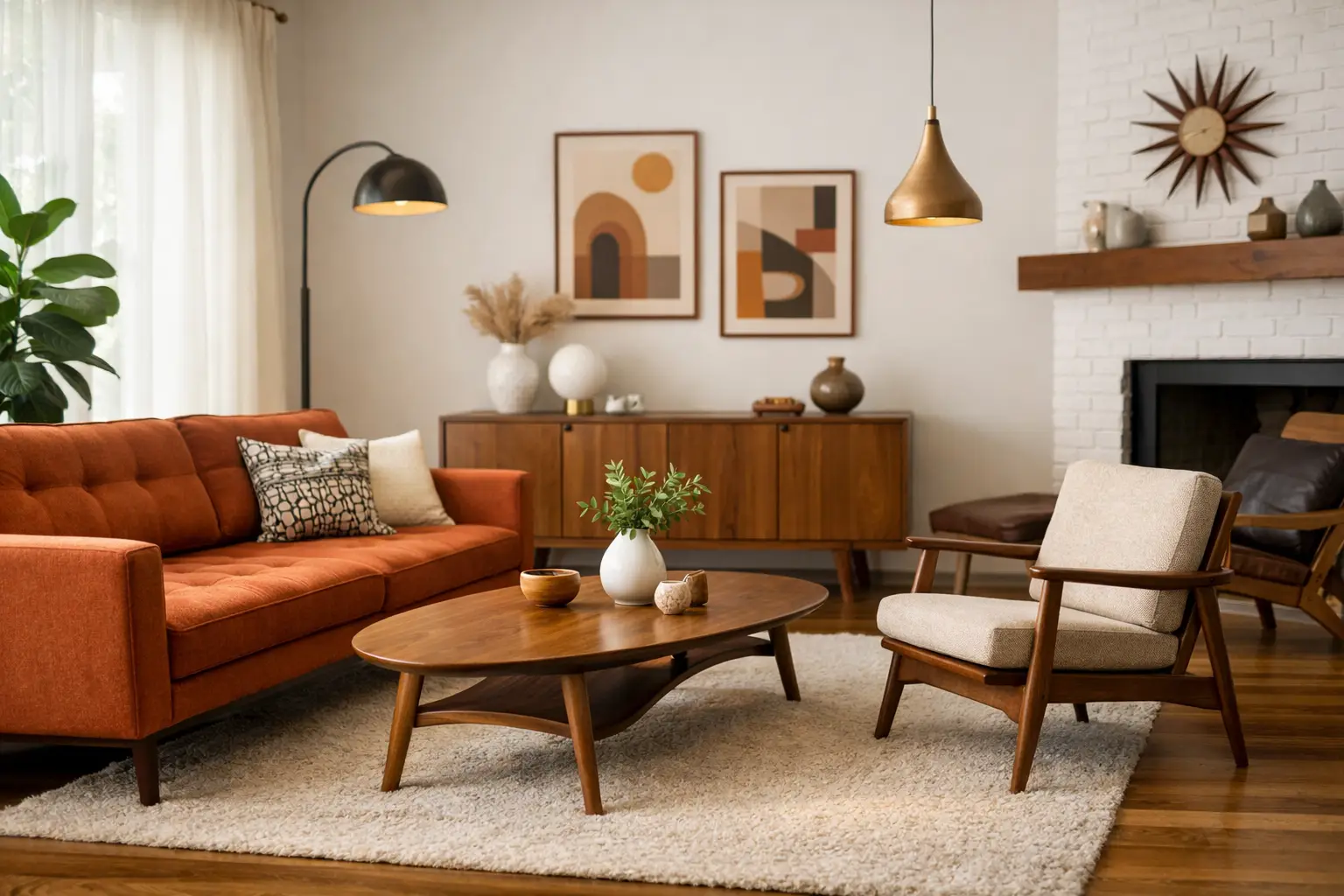
A convincing mid-century modern living room rarely begins with a sofa. It begins with restraint. The rooms that feel most persuasive are not crowded with references to the 1950s and 1960s – they are edited, balanced, and built around a few pieces with real visual authority. If you are wondering how to create a mid century modern living room, the answer is less about buying a set and more about composing a room with line, material, and character.
Mid-century modern is often misunderstood as a formula of tapered legs, walnut, and a starburst clock. Those elements can belong, but they are not the whole language. At its best, this style is architectural and calm. It favors proportion over ornament, quality over quantity, and objects that still look current because they were designed with clarity in mind.
How to create a mid century modern living room that feels authentic
The first decision is not what to add, but what to remove. Mid-century interiors depend on visual breathing room. If the space is overfilled, even beautiful pieces lose their presence. Start by looking at the room as a composition of horizontal lines, open floor area, and a deliberate mix of wood, fabric, metal, and glass.
A mid-century modern living room should feel collected, not staged. That means leaving space around important pieces and allowing one category to lead. In some rooms, the anchor is a low-profile sofa. In others, it is a sculptural Italian floor lamp, a Murano glass chandelier, or a rosewood cabinet with strong proportions. Once the lead piece is established, the rest of the room can support it rather than compete with it.
This is also where authenticity matters. A room filled entirely with recent reproductions can look flat, even when the silhouettes are correct. One or two vintage or vintage-inspired pieces with patina, age, and material depth usually create a more credible result than a complete matching scheme.
Start with the right furniture profile
Mid-century modern furniture is defined by clean geometry, controlled curves, and a relatively low visual weight. Sofas tend to sit lower than traditional models, with straight lines or gently rounded arms. Coffee tables are often elongated, slim, and finished in warm woods or glass. Sideboards and consoles introduce rhythm through sliding doors, exposed grain, and thoughtful joinery.
Walnut remains one of the most persuasive finishes for this look, but teak, oak, and rosewood can all work beautifully depending on the room. The key is to avoid bulky forms. Even substantial pieces should appear light on their feet, often with tapered or sculptural legs that lift them from the floor.
It also helps to avoid buying furniture as a suite. Mid-century rooms benefit from variation. A Danish-style sofa, an Italian armchair, and a brass-and-glass side table can coexist very comfortably if their scale is coherent. The room becomes more personal when the pieces relate by proportion and tone rather than by being identical.
Let lighting shape the atmosphere
If furniture gives the room structure, lighting gives it identity. In many mid-century interiors, the lighting is what transforms a competent space into a memorable one. Sculptural floor lamps, wall sconces, table lamps in ceramic or brass, and statement chandeliers all belong naturally in this vocabulary.
The most successful choices do more than illuminate. They introduce silhouette, material contrast, and a layer of decorative intelligence. A pair of brass sconces can sharpen an otherwise quiet wall. A Murano glass chandelier can soften the room with reflection and depth. A dome floor lamp can add a distinctly architectural note.
This is one of the easiest places to introduce Italian character into a mid-century modern room. Italian lighting from the period often carries more sensuality than stricter Scandinavian examples, with richer finishes and more expressive forms. For a room that feels refined rather than generic, that balance can be especially effective.
Choose materials with warmth, not heaviness
A common mistake is making a mid-century room too brown, too hard, or too severe. Wood should be present, but it should not dominate every surface. Mid-century modern interiors work best when warm timber is balanced with upholstery, glass, metal, and occasional stone or lacquer.
Textiles matter more than many people expect. Boucle, wool, velvet, and textured weaves can all support the style, especially in muted or earthy tones. Think olive, rust, ochre, camel, tobacco, cream, charcoal, and deep moss. These shades give the room historical resonance without making it feel themed.
Leather can also be excellent here, particularly on lounge chairs or accent seating. But it depends on the room. In a smaller space, too much leather may read heavy. In a brighter, more open room, it can add exactly the right note of sophistication.
Glass is useful because it keeps the composition open. A glass coffee table, smoked glass lamp, or decorative Murano vessel can prevent the room from becoming visually dense. Brass and chrome, used selectively, add the crispness that wood alone cannot provide.
How to create a mid century modern living room without making it look staged
The difference between a stylish room and a showroom is usually decoration. Mid-century modern does not ask for many accessories, but it does ask for the right ones. Decorative objects should feel chosen, not scattered.
A large ceramic vase, a compact stack of art books, an ashtray in amber glass, a faceted mirror, or a single sculptural object on a console can be enough. The goal is to punctuate the room, not fill every surface. Empty space is part of the style.
Art should follow the same logic. Abstract works, graphic prints, black-and-white photography, and textured compositions often sit naturally within a mid-century setting. Oversized art can work particularly well because it reinforces the confidence of the room. What usually feels less convincing is overly literal retro imagery. The room should nod to the period, not perform it.
Plants are another classic element, and for good reason. Broad-leaf greenery softens the geometry and brings life into rooms centered on wood and metal. One substantial plant often works better than several small ones.
Get the layout right before you finish the room
Mid-century modern rooms are conversational. Furniture should not cling to the walls unless the space absolutely requires it. Pulling the seating inward, even slightly, often improves the room immediately. It creates intimacy and lets individual pieces read more clearly.
Rugs help organize this arrangement. Look for designs that ground the room without overwhelming it. Geometric patterns can work, but so can solid or subtly textured rugs in wool or natural fibers. If the furniture is visually strong, the rug can be quieter. If the room is very restrained, a patterned rug may add necessary movement.
Scale is critical. A small rug under a large seating group will make the room feel accidental. A coffee table that is too tiny or too tall breaks the rhythm. Mid-century modern depends on proportion, so measure carefully and think in terms of relationships between pieces rather than isolated purchases.
Mix eras carefully for a richer result
One of the most sophisticated ways to approach this style is not to treat it as a strict period room. Mid-century modern lives very well with selected Art Deco references, postwar Italian lighting, contemporary upholstery, and even a few older decorative accents if they are visually disciplined.
This is where a curated eye matters. A room with only textbook mid-century pieces can feel predictable. A room with a 1960s sideboard, a contemporary cream sofa, a pair of vintage brass sconces, and one remarkable glass object tends to feel more cultivated. The common thread should be elegance of form, not historical purity.
For collectors and design-conscious homeowners, this approach also leaves more room for individual taste. A living room should reveal sensibility, not adherence to a checklist. That is often the difference between trend-following and lasting style.
What to avoid when building the look
There are a few recurring errors worth sidestepping. The first is over-decorating with clichés. Too many obvious retro signs, novelty prints, or inexpensive imitations drain the room of credibility. The second is ignoring craftsmanship. Mid-century modern is simple in appearance, which means poor materials become visible very quickly.
Another issue is overcommitting to one wood tone or one fabric texture. Variation gives depth. A final mistake is treating lighting as an afterthought. In a style built on silhouette and atmosphere, lighting deserves as much attention as the seating.
For those looking for pieces with stronger identity, a boutique curatorial approach often produces a more distinctive room than broad retail sourcing. A well-chosen Italian lamp, a Murano accent, or a singular vintage object can shift the entire composition with very little effort.
A mid-century modern living room should feel composed, warm, and unmistakably personal. Once the room has the right structure, the most valuable additions are the ones that carry presence without noise. That is usually where the room begins to feel less decorated and more collected.