

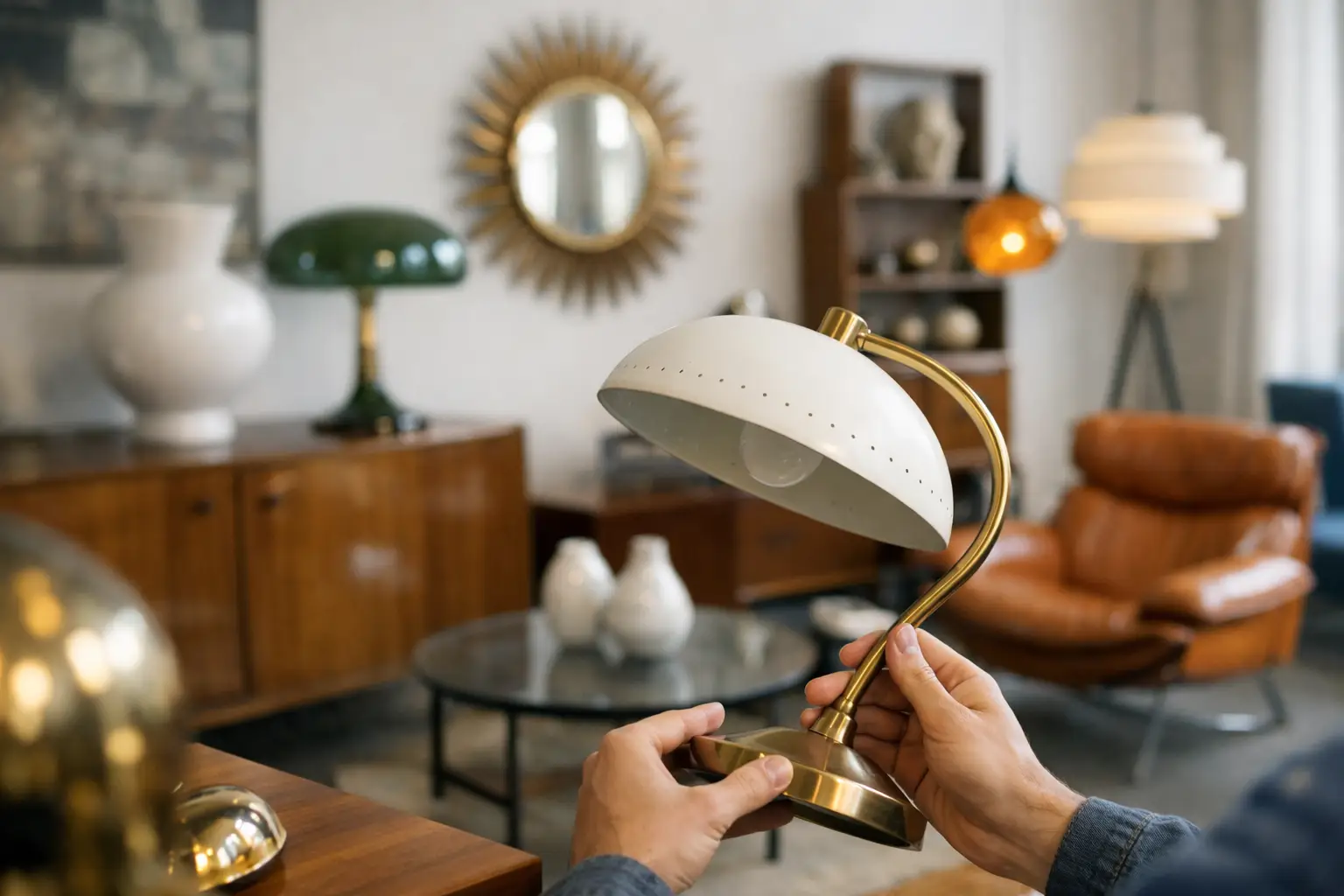
Some pieces announce themselves immediately. A Murano glass lamp with the right weight and glow, a sculptural brass mirror that changes a room, a 1950s sideboard with proportions contemporary furniture rarely gets right. When asking where to buy modernariato, the real question is not simply where to shop. It is where taste, authenticity, and selection still matter.
Modernariato is often translated too loosely as vintage design. In practice, it refers to a more specific universe of 20th-century furniture, lighting, decorative objects, and collectible design with historical character and visual authority. It sits between pure antique dealing and generic vintage resale. That distinction matters, because the best places to buy modernariato are not just sellers of old objects. They are editors of style.
Where to buy modernariato today
The market has widened. That is good news for buyers who want access to Italian lighting, Mid-Century furniture, Art Deco accents, or one-of-a-kind decorative pieces without spending months sourcing in person. It also means quality varies dramatically.
You can buy modernariato from online boutiques, antiques dealers, design galleries, fairs, private pickers, and broad marketplace platforms. Each channel serves a different kind of buyer. If you are furnishing a home with intention, or sourcing statement pieces for a project, the best option is usually a specialized online boutique or dealer with a strong point of view.
Why? Because curation saves time, but it also protects the overall result. A carefully selected inventory tells you something before you even read a description. It tells you the seller understands scale, period, materials, and decorative relevance. That is far more useful than scrolling through thousands of loosely labeled listings where a reproduction sits next to a genuine period piece.
A good modernariato source should make its taste legible. You should be able to see coherence across categories, whether the focus is lighting, Murano, mirrors, seating, or decorative accessories. The object matters, but so does the eye behind the selection.
The best places to buy modernariato, depending on what you want
If you are buying for immediate decorative impact, specialized boutiques are often the most efficient route. Lighting, mirrors, Murano glass, and small furniture are categories where curation makes an enormous difference. These are also the categories where condition, authenticity, and proportion are easiest to misread in a generic marketplace.
For investment-oriented buying, established dealers and galleries can be a strong choice, especially when you are looking for attributed pieces or highly collectible makers. The trade-off is that prices are usually firmer, and the selection can be narrower or more academic in tone.
Fairs and physical markets remain valuable if you enjoy sourcing in person and have a trained eye. They offer the thrill of discovery, but they demand time, patience, and confidence in evaluating wear, repairs, and originality. For many buyers, especially those furnishing from a distance, that model is less practical than it sounds.
Large online marketplaces are useful for broad comparison, but they are rarely the best answer to where to buy modernariato well. They reward volume more than discernment. You may find excellent pieces there, but you also assume more responsibility for filtering quality, verifying provenance, and judging whether restoration has been done properly or simply hidden in flattering photos.
What separates a good modernariato seller from a risky one
The first sign is specificity. Serious sellers do not describe everything as iconic, rare, or Mid-Century. They identify materials, likely decade, stylistic references, dimensions, and visible condition with clarity. A Murano fixture should not be presented in vague decorative language alone. A brass wall light should not be reduced to “vintage style” if it is actually a later reproduction.
The second sign is visual discipline. Product photography should show more than atmosphere. It should reveal surfaces, patina, hardware, wiring, edges, and scale. Beautiful styling is welcome, but not as a substitute for useful detail.
The third sign is editorial coherence. Sellers who specialize in modernariato tend to build a recognizable visual world around their inventory. Furniture, lighting, and objects speak to one another. That does not mean every piece looks the same. It means the selection has standards.
Finally, there is the matter of trust. A refined seller understands that buyers in this category are not only purchasing utility. They are buying distinction. That requires transparency on condition, origin, and decorative value. If descriptions feel evasive, the problem is rarely just the wording.
How to evaluate authenticity and condition
Authenticity in modernariato is not always a simple yes or no. Some pieces are clearly attributed and documented. Others are period works without maker labels but with strong stylistic consistency and material integrity. Both can be worthwhile, depending on your goal.
If you are buying for collection value, attribution and provenance matter more. If you are buying for interiors, the object can still be highly desirable without a signature, provided it is genuinely of the period and has the right formal quality.
Condition requires similar nuance. A well-restored lamp or cabinet is often more practical and desirable than an untouched example with serious issues. On the other hand, over-restoration can strip a piece of character. Fresh polish, replaced elements, or poorly matched repairs can flatten the surface quality that gives modernariato its presence.
Patina is not damage. Wear consistent with age is often part of the appeal. What matters is whether the wear is stable, visually honest, and appropriate for the object’s use. A small mark on a 1960s mirror frame is one thing. Structural weakness in a chair is another.
Where to buy modernariato for interiors, not just collecting
Many buyers are not building a museum-grade collection. They are shaping rooms. That changes the criteria.
For interiors, buy from sources that understand decorative composition as much as historical category. A dramatic chandelier, a pair of wall sconces, a sculptural coffee table, or a Murano vase should feel like part of a larger visual language. The seller should help you recognize how a piece lives in a space, not just what decade it belongs to.
This is where boutique curation becomes especially valuable. A well-composed selection allows you to move across categories with confidence, combining furniture, lighting, and accessories without losing coherence. The best modernariato buying is not only about finding a beautiful object. It is about finding an object that gives the room authority.
For this reason, buyers often benefit from shopping with specialists who treat decorative arts, vintage design, and personal style as connected worlds. That approach feels closer to how people actually live. A brass lamp, an Art Deco mirror, a Sicilian decorative piece, and a vintage fashion accessory may belong to different categories, yet speak the same language of character and rarity.
Why online boutiques have become central
A decade ago, asking where to buy modernariato might have pointed you first to fairs, local dealers, or sourcing trips in Italy. Those channels still matter, but curated online boutiques now offer something equally valuable: immediate access to a filtered inventory shaped by a clear aesthetic position.
That is not a minor convenience. It changes the buying experience. Instead of searching endlessly through mixed-quality stock, buyers can begin with a seller whose standards align with their own. The object is already preselected for visual relevance, historical texture, and decorative strength.
For an audience with a developed eye, that form of selection is part of the value. It reduces noise. It narrows the field to pieces worth considering. And it makes international buying feel less anonymous.
In that sense, a strong boutique such as Sound Of Vintage Italy does more than sell vintage objects. It presents modernariato as a coherent lifestyle language – rooted in Italian design culture, but flexible enough for contemporary interiors across markets.
What to avoid when buying modernariato
The most common mistake is buying by label instead of by object. Terms like Italian, Mid-Century, Murano, or Art Deco attract attention, but they do not guarantee quality. Poor proportions, heavy restoration, or decorative emptiness remain poor choices no matter how searchable the label.
Another mistake is treating price as the only signal of value. Cheap listings can become expensive once restoration, rewiring, shipping, or disappointment enter the picture. At the same time, high price alone does not prove merit. A serious buyer looks at the total equation: authenticity, presence, condition, rarity, and how well the piece fits its intended setting.
It is also worth avoiding sources that feel visually chaotic. If a seller presents everything at once, without category clarity or aesthetic discipline, the burden shifts entirely to the buyer. That can work for seasoned dealers. For most private collectors and design-led buyers, it is simply inefficient.
The right place to buy modernariato is rarely the loudest one. It is the one that shows restraint, expertise, and a point of view you recognize as your own.
A good piece of modernariato should keep revealing itself after the purchase – in the way light catches the glass, in the line of a frame, in the quiet confidence it gives a room. Buy where that kind of quality is still visible from the first glance.
Sorry, the comment form is closed at this time.