
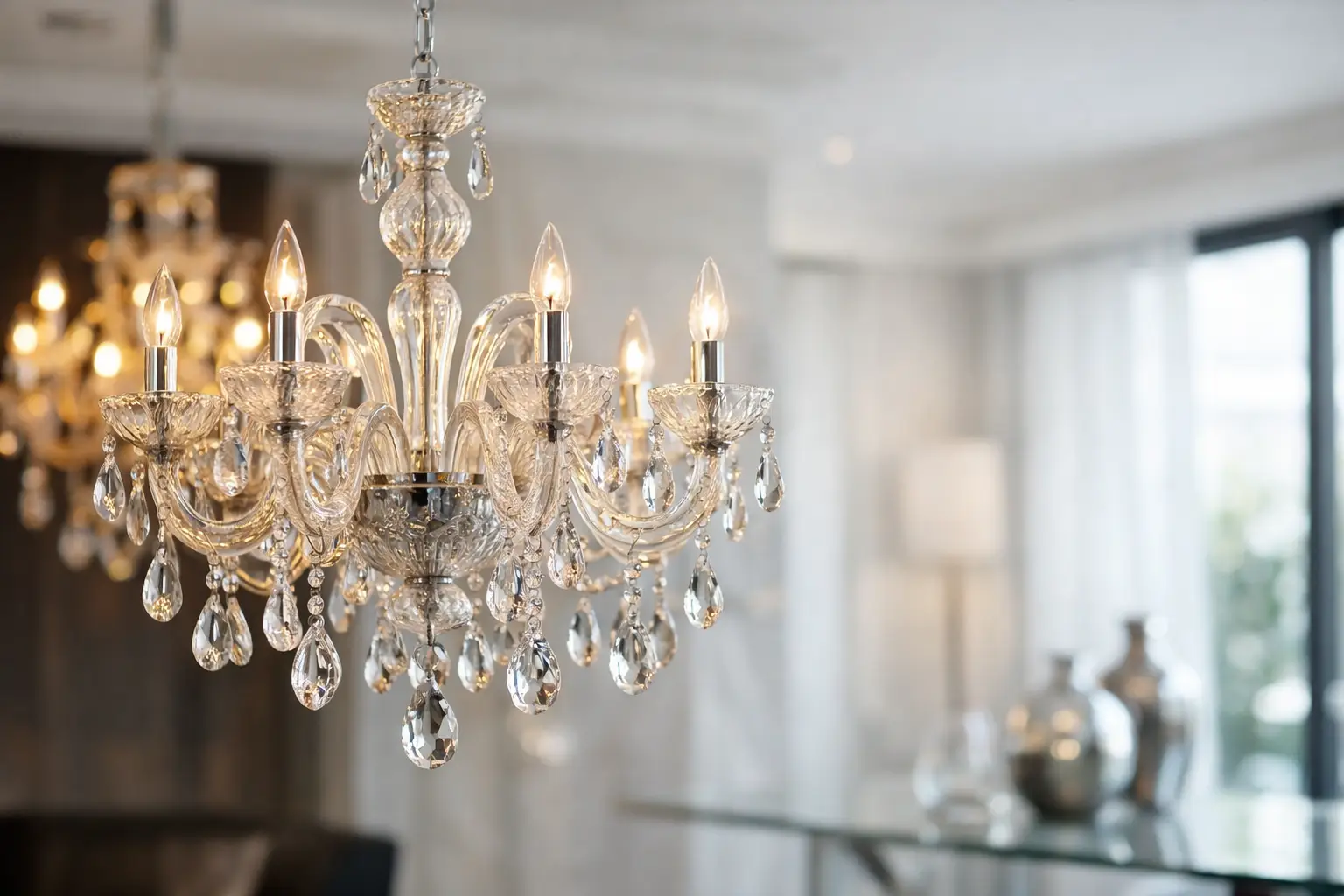
A Murano chandelier can define a room in a way few objects can. It is lighting, certainly, but it is also sculpture, Venetian glassmaking, and interior identity condensed into a single suspended form. Any serious Murano chandelier buyer guide should start here: you are not choosing only a fixture, you are choosing proportion, atmosphere, craftsmanship, and a certain level of permanence.
That is why buying one well matters. The right piece can anchor a dining room, sharpen a minimalist entry, or bring tension and softness into a more architectural space. The wrong one can feel oversized, underpowered, poorly restored, or simply generic – especially in a market where “Murano style” is often presented as if it were the same thing as Murano.
What makes a Murano chandelier worth buying
The value of a Murano chandelier begins with authorship of material rather than signature alone. Murano glass is not a decorative finish applied at the end of production. Its character is formed in the making – through blown elements, hand-shaped leaves, twists, cups, arms, flowers, or prisms that carry slight variations, density, and depth. Those nuances are often the first signal that a chandelier has real presence.
Age matters, but not in a simplistic way. A mid-century Murano chandelier may appeal for its clean rhythm and balanced geometry, while an earlier floral model may attract buyers looking for a more theatrical silhouette. Neither is automatically better. It depends on the room, the collection, and whether you are buying for daily living, a design project, or long-term collecting.
Condition matters just as much as style. A chandelier with original glass but compromised wiring, missing decorative elements, or replacements that do not match the original tone can lose visual integrity quickly. Some restoration is expected and often necessary. Good restoration supports the object. Poor restoration flattens it.
Murano chandelier buyer guide: authenticity before aesthetics
Many buyers begin with color and silhouette. That is understandable, but authenticity should come first. Not every chandelier made with Italian glass is Murano, and not every chandelier described as Venetian has meaningful collectible value.
A genuine Murano chandelier often reveals itself through consistency of craftsmanship. The glass components should feel resolved as a family – not similar, but coherent. Arms, bobeches, drops, and decorative flourishes should speak the same design language. Handmade does not mean irregular in a careless sense. It means each element carries a human precision rather than factory uniformity.
Labels, stickers, or etched marks can help, but they are not the whole story. Many older pieces have lost labels over time. Others may carry labels that tell you less than the object itself. A serious seller should be able to discuss provenance, period, construction, condition, and any later interventions with clarity.
It is also worth distinguishing between “attributed to,” “in the style of,” and “manufactured in Murano.” These are not interchangeable descriptions. For collectors and design-conscious buyers, this distinction affects both price and long-term relevance.
Signs to examine closely
Glass quality is the first detail to study. Murano glass tends to hold light with complexity. Whether clear, smoked, opaline, amber, or infused with gold flecks, it should show depth rather than a flat decorative effect. Surface wear can be acceptable with age, but cloudiness from neglect or harsh cleaning is less desirable.
Metal structure deserves equal attention. Look at the frame, canopy, central stem, and armature. Oxidation may be natural and even attractive, but deformation, unstable assembly, or crude replacement hardware should prompt questions. The chandelier must remain both visually faithful and structurally dependable.
Ask whether all parts are original to the piece. A chandelier assembled from period components can still be beautiful, but it should be presented honestly. For a buyer furnishing a refined interior, transparency is part of value.
Choosing the right style for the room
A Murano chandelier succeeds when it enters into dialogue with the architecture around it. In a room with ornate moldings and parquet floors, a floral or multicolored composition may feel natural. In a cleaner contemporary interior, a transparent triedri chandelier or a more sculptural mid-century form can create contrast without excess.
Scale is not simply about ceiling height. It is about visual weight. A chandelier with clear glass and open spacing can read lighter than a smaller but denser fixture in amber or smoked tones. The diameter, drop, and shape all affect how the piece occupies the room.
Dining rooms tend to accept stronger gestures because the chandelier can center the table and create ritual around the space. Entry halls benefit from verticality and presence. Bedrooms usually ask for restraint unless the architecture can support a more dramatic statement. In living rooms, it depends on whether the chandelier is the focal point or part of a broader composition that includes art, mirrors, and vintage furniture.
Color, finish, and atmosphere
Clear Murano glass is often the most versatile choice. It interacts with daylight elegantly and adapts across periods, from Art Deco-inspired rooms to more minimal interiors. Amber and pink tones add softness and warmth. Smoked glass introduces a more graphic, sophisticated mood. White opaline glass can feel especially polished in interiors that favor calm surfaces and measured contrast.
The key is not to match everything. A Murano chandelier usually performs best when it introduces a note of tension – between lightness and ornament, history and restraint, craftsmanship and architecture.
Size, ceiling height, and practical fit
This is the part buyers sometimes rush, then regret. Measurements should be treated as seriously as style. Record the chandelier’s height, width, and approximate visual spread. Then compare that with ceiling height, table size if relevant, and circulation around the fixture.
For lower ceilings, a flush or semi-flush Murano form may be a better choice than a chandelier with deep drop. In rooms with generous height, a longer profile can become an asset rather than an obstacle. If the piece hangs above a dining table, the relationship between the lower edge of the chandelier and the tabletop should feel intimate but not intrusive.
Weight also matters. Murano chandeliers can be surprisingly substantial, especially when composed of many individual glass elements. Ceiling support and professional installation are not optional details. They are part of responsible buying.
Wiring, restoration, and what “ready to install” should mean
A beautiful chandelier that is not properly rewired is an incomplete purchase. Electrical components should be checked for compatibility with US standards if the piece is coming from Europe. Socket type, bulb format, grounding, and canopy configuration all deserve attention before purchase, not after arrival.
Restoration should be discussed in plain terms. Has the chandelier been rewired? Were any glass elements replaced? Has the metal frame been polished, stabilized, or refinished? There is no single perfect answer. Some buyers prefer a cleaner presentation, others value original patina. What matters is quality and disclosure.
If a seller describes a chandelier as ready to install, that should imply more than visual cleaning. It should suggest a piece that has been evaluated as an object of use, not just display.
Murano chandelier buyer guide: price, rarity, and value
Price in this category is shaped by more than age. Design quality, scale, maker attribution, rarity of color, complexity of construction, and condition all influence value. Large multicomponent chandeliers with strong decorative rhythm tend to sit differently in the market than simpler examples, even when both are authentic.
There is also a difference between price and worth. Some pieces are expensive because they are fashionable. Others are valuable because they remain visually convincing over time. Buyers with a developed eye usually benefit from favoring the latter.
When assessing value, consider how distinctive the chandelier feels within its category. Does it have a memorable profile? Does the glass show refinement? Is the composition balanced from every angle? Would it still hold attention in a room with significant furniture and art? Those are better questions than whether it looks “luxurious” in isolation.
For many buyers, especially those furnishing layered interiors, a carefully selected vintage Murano chandelier offers stronger character than a new luxury fixture at a similar budget. That is part of its enduring appeal.
Buying from a curated source
The best buying experience is one that reduces ambiguity. Detailed photography, accurate dimensions, clear condition notes, and informed dating are not extras in this category. They are the basis of trust.
A curated specialist is also more likely to recognize the difference between a decorative object and a collectible design piece. That distinction matters when the chandelier is intended to live among other considered objects. For buyers who value originality and decorative authority, a selective eye is often as important as inventory.
This is where a boutique approach has real strength. A platform such as Sound Of Vintage Italy is compelling not because it offers everything, but because it filters for objects with stylistic identity and decorative seriousness.
A Murano chandelier rewards patience. The right one will not simply fill the ceiling. It will alter the room’s temperature, rhythm, and memory the moment the light comes on.