
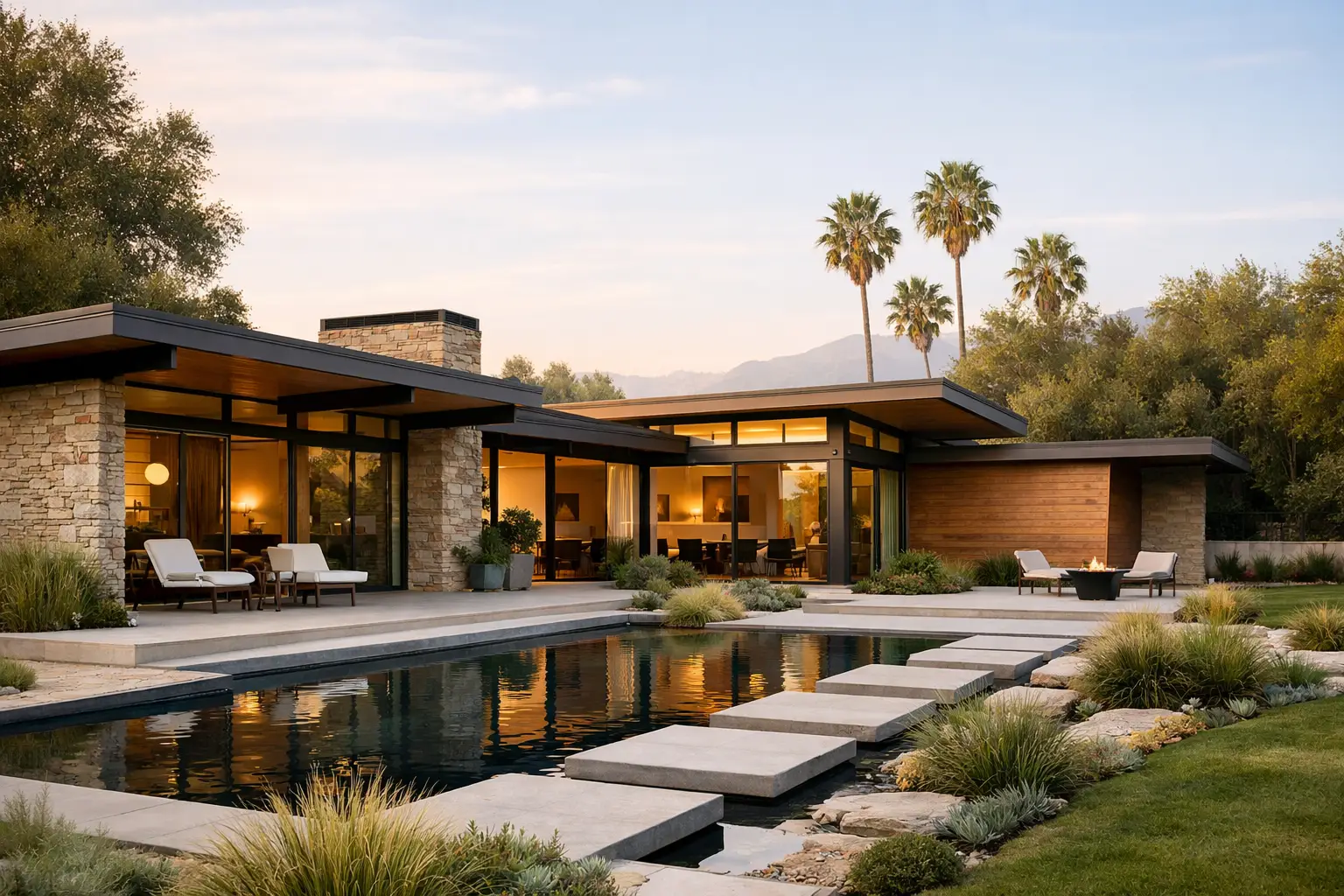
A true mid-century interior never feels overworked. The room is resolved in a few confident moves – a low profile sofa, a sculptural lamp, warm walnut, a pane of glass catching afternoon light. That is why mid century modern house design ideas continue to hold their place: they offer clarity, proportion, and character without visual noise.
For collectors, design professionals, and homeowners with a trained eye, the appeal is not nostalgia alone. Mid-century modern remains relevant because it understands restraint. It leaves space for architecture, values material honesty, and rewards the presence of one exceptional object. In practice, that means a house should not look staged into a period set. It should feel edited, layered, and alive.
What defines mid century modern house design ideas
The phrase is often used loosely, but the strongest mid-century interiors share a recognizable discipline. Furniture sits low and horizontal. Lines are clean, but not cold. Woods such as teak, walnut, and rosewood introduce warmth. Metal, glass, ceramic, and stone add contrast. Lighting is never an afterthought – it acts almost as sculpture.
The architectural side matters just as much. Open layouts, broad windows, indoor-outdoor continuity, and a sense of flow from one zone to another are central to the style. But there is a difference between honoring these principles and reproducing them literally. In an older house, or in a contemporary apartment, the goal is often translation rather than reenactment.
That is where selection becomes decisive. A well-chosen Italian floor lamp, a Murano glass chandelier, or a sharply profiled sideboard can shift an entire room into focus more effectively than a full suite of matching furniture.
Start with architecture, not decoration
Many interiors fail because they begin with accessories. Mid-century rooms work best when the envelope is considered first. Look at the wall planes, the light, the ceiling height, the floor tone, and the sightlines between spaces. If the architecture is quiet, the furnishings can speak more clearly.
This does not mean every house needs structural renovation. Sometimes the simplest corrections carry the most weight. Replacing heavy drapery with cleaner window treatments can restore the visual relationship between interior and exterior. Refinishing dark floors in a more natural tone can bring back the lightness associated with mid-century spaces. Even adjusting furniture placement to emphasize openness rather than perimeter clutter can make a room feel more period-aware.
There is, however, a trade-off. A purist approach can become too spare for daily life. Families often need storage, softness, and acoustic comfort. The best solution is to preserve the architecture’s clarity while introducing pieces that solve practical needs with visual discipline.
Let wood be the anchor
Among the most reliable mid century modern house design ideas, wood remains the one element that grounds everything else. Walnut and teak are especially effective because they carry depth without heaviness. They also pair beautifully with brass, smoked glass, leather, and textured upholstery.
A room does not need wood everywhere. In fact, it is usually stronger when concentrated in a few substantial pieces – a credenza, a dining table, a wall unit, or a pair of bedside cabinets. This creates rhythm instead of uniformity. Too much matching wood can flatten the room and push it toward showroom territory.
Look for grain, profile, and proportion. Mid-century case goods tend to be elevated on tapered legs or shaped plinths, which gives them presence without bulk. That visual lift is part of what keeps the style elegant rather than dense.
Use lighting as a statement, not background
If there is one category that defines the emotional temperature of a mid-century interior, it is lighting. A chandelier, wall sconce, or table lamp from the right period does more than illuminate – it establishes the room’s point of view.
Italian lighting is particularly persuasive in these interiors because it combines rigor and sensuality. Brass structures, opaline diffusers, smoked glass, and Murano elements introduce a refined softness that balances the cleaner geometry of mid-century furniture. A sculptural pendant above a dining table or a pair of wall lights framing a mirror can add the exact layer of tension a room needs.
Scale matters. Oversized lighting can be brilliant in an open plan living area, but in a smaller room it may read as theatrical rather than composed. The opposite problem is just as common: choosing fixtures that disappear. Mid-century interiors benefit from lighting with silhouette and identity.
Keep the palette restrained, then add one rich accent
The strongest color stories in mid-century homes are usually built on neutrals with selective saturation. Think warm white, oatmeal, tobacco, walnut, charcoal, and black as the base. Then introduce one or two more expressive tones – olive, rust, cognac, mustard, deep blue, or aubergine.
This balance keeps the house visually calm while giving individual rooms a sense of distinction. It also allows collectible pieces to hold attention. Murano glass, ceramic vases, lacquer details, or vintage art all benefit from a background that does not compete.
Bright color is not off-limits, but it depends on how it is used. A single upholstered chair in burnt orange can feel exact and sophisticated. An entire room in competing retro shades can quickly turn costume-like.
Mix organic shapes with disciplined lines
Mid-century modern is often described as linear, but that only tells half the story. Its best interiors always soften strict geometry with rounded forms and tactile materials. A curved lounge chair beside a rectilinear sofa, a circular mirror above a long console, or a bulbous ceramic lamp on a crisp sideboard creates the contrast that keeps the room from feeling rigid.
This is especially useful in homes with hard architectural edges. If the space has a lot of glass, concrete, or angular millwork, organic silhouettes bring relief. Conversely, in a softer traditional shell, strong linear furniture can sharpen the room.
The point is not to decorate by formula. It is to create tension between precision and ease.
Choose fewer pieces, but better ones
One of the most overlooked mid century modern house design ideas is subtraction. Mid-century interiors are often admired because they appear effortless, but that effect comes from editing. Too many side tables, too many small objects, too many decorative layers, and the room loses definition.
A house with three excellent pieces will usually feel more convincing than a house filled with generic references to the period. This is where vintage selection matters. An original mirror with a sculptural brass frame, a substantial credenza, or a distinct floor lamp can carry far more atmosphere than a dozen trend-driven accessories.
For buyers with a collector’s sensibility, this is also the more intelligent path. It builds a home with depth rather than temporary styling.
Make room for glass, reflection, and transparency
Glass belongs naturally in the mid-century language. It lightens composition, extends sightlines, and introduces a certain elegance without visual weight. Coffee tables with glass tops, mirrored surfaces, smoked glass shelving, and handblown decorative elements all work well when the room needs brightness.
Reflection also has a strategic role. A vintage mirror can amplify daylight and reinforce the sense of openness that mid-century architecture favors. In smaller urban homes, this can be more effective than adding extra furniture in an attempt to enrich the room.
The caution is simple: too much reflective material can feel brittle. Glass is strongest when balanced with wood, woven textures, and upholstered forms.
Bring in craft, not clutter
A convincing interior from this design family should feel curated, not stripped. Ceramics, art glass, woven pieces, and select decorative objects add the human note that keeps modernism from becoming impersonal.
This is where Italian sensibility can be especially compelling. A Murano vase, a hand-finished mirror, or a distinctive decorative object with visible craftsmanship introduces cultural depth and material richness. At Sound Of Vintage Italy, this kind of selection is precisely what gives a room its final layer of identity.
Still, restraint matters. Decorative pieces should punctuate the space, not fill every surface. Leave negative space around them. The eye needs pause as much as it needs interest.
How to adapt the style room by room
In the living room, focus first on seating, lighting, and one substantial anchor piece such as a credenza or coffee table. In the dining room, prioritize the table’s shape and the fixture above it. In bedrooms, keep the composition quiet – low storage, warm lighting, and textiles with texture rather than busy pattern.
Kitchens and bathrooms are more dependent on budget. Full renovation is not always necessary. Cabinet hardware, globe lighting, mirrors, wood accents, and carefully chosen stools can move these rooms closer to the spirit of the period without forcing a total rebuild.
The key is consistency of attitude, not perfect historical replication.
A memorable mid-century home does not announce itself with clichés. It reveals itself in proportion, in material honesty, and in the confidence of a few exceptional choices. If the room feels lighter, warmer, and more precise after each decision, you are moving in the right direction.