
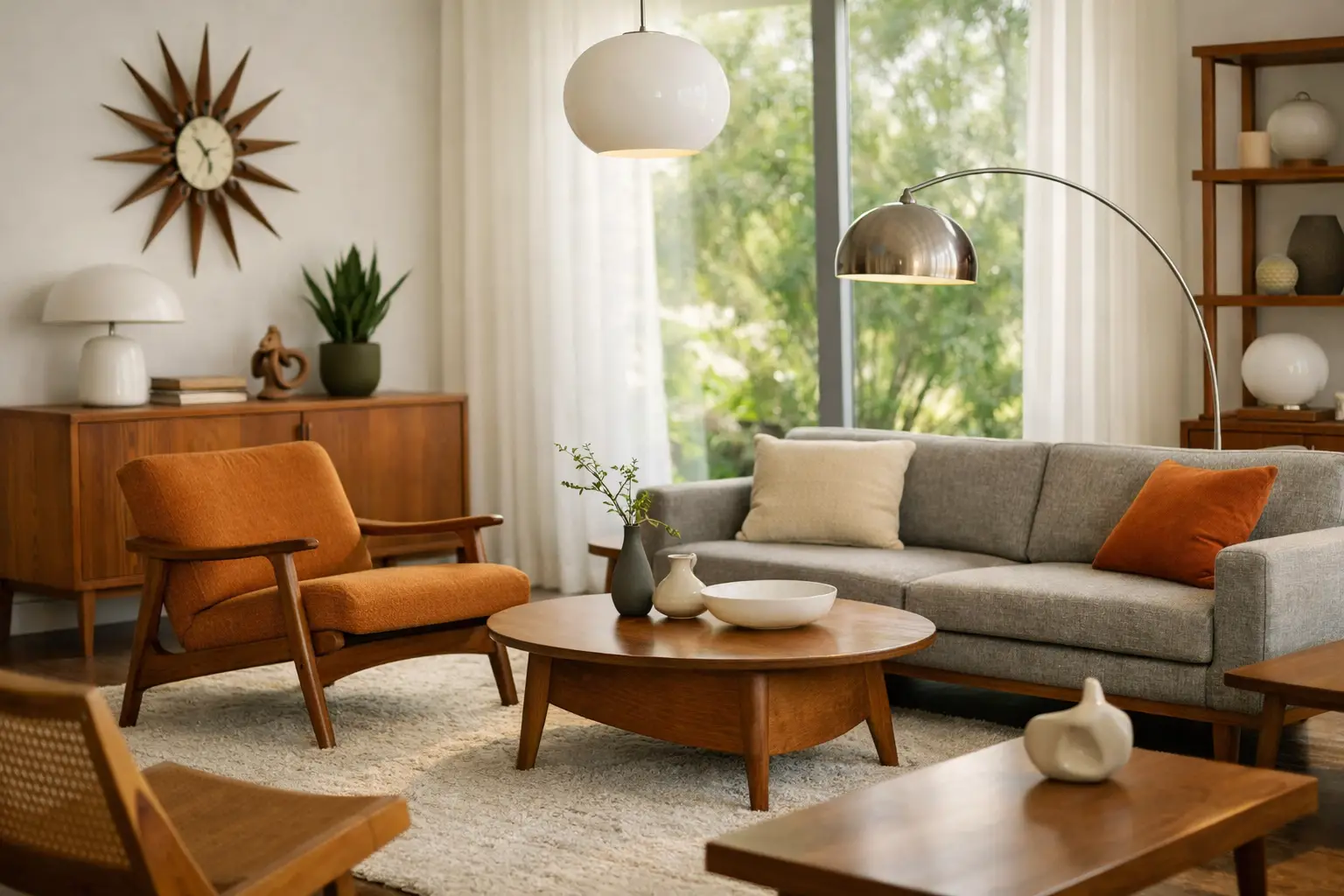
A room with a low walnut sideboard, a sculptural lounge chair, and a brass floor lamp often gets labeled mid-century modern. Sometimes the label fits. Sometimes it is just a convenient shorthand for anything vaguely retro. So what is mid century modern interior design, really? It is not simply furniture from the 1950s. It is a design language built on clarity, proportion, practicality, and a very specific idea of modern living.
Mid-century modern emerged roughly from the mid-1940s through the late 1960s, shaped by postwar optimism, industrial innovation, and a growing interest in homes that felt open, efficient, and visually calm. Interiors from this period favored clean lines over ornament, but they were never cold in the best examples. Wood brought warmth. Curved silhouettes softened geometry. Glass, metal, ceramic, and textiles added rhythm without clutter.
What Is Mid Century Modern Interior Design in Practice?
In practical terms, mid-century modern interior design is an approach that values form and function in equal measure. Furniture is meant to be useful, but also elegant from every angle. Rooms are organized with intention. Decoration exists, but it is selective rather than excessive.
This is why authentic mid-century modern spaces still feel current. They do not rely on trend effects. They rely on balance. A tapered-leg console, a compact armchair, a smoked glass pendant, or a ceramic table lamp can all carry the vocabulary of the style, but only when the overall composition remains disciplined.
That distinction matters. A single vintage chair does not automatically create a mid-century interior. Nor does a room full of reproductions. The style comes through in proportion, spacing, materials, and restraint.
The Core Visual Codes
The most recognizable feature is line. Mid-century furniture tends to sit lightly in a room, often elevated on slim legs, with profiles that appear streamlined rather than heavy. Cabinets, sideboards, desks, and seating are usually designed with visual economy. Nothing is overworked.
Organic form is equally important. While many people focus on straight lines, the style also embraces soft curves, molded shapes, and rounded edges. This tension between structure and fluidity gives mid-century rooms their ease. They feel composed, but never rigid.
Open space is another defining principle. Mid-century interiors are rarely crowded. Pieces are chosen to perform clearly, and circulation is part of the aesthetic. A room should breathe. Negative space is not emptiness here. It is part of the design.
Color works in the same measured way. Classic palettes often begin with neutrals, then build through earthy tones, muted greens, ochres, rust, teal, black, and occasional saturated accents. The result can be understated or graphic depending on the mix. In a more refined setting, color often appears through upholstery, art, ceramics, or lighting rather than everywhere at once.
Materials That Define the Style
If there is one material that instantly anchors a mid-century interior, it is wood. Teak, walnut, rosewood, and oak are especially associated with the period. Their grain adds visual richness to otherwise simple forms, which is why a minimal sideboard can still feel deeply decorative.
Wood, however, is only part of the picture. Mid-century modern interiors often combine natural and industrial materials with great confidence. Brass, chrome, steel, glass, leather, wool, and ceramic all appear regularly. The best interiors from the period understand contrast: matte against polished, warm against cool, handcrafted against machine-made.
This is one reason the style remains so compatible with collectible objects. Murano glass, for example, can sit beautifully within a mid-century modern room because it introduces luminosity and artisanal character without fighting the architecture of the space. The same can be said for a well-chosen mirror, a ceramic vessel, or a distinctive lighting piece with sculptural presence.
Furniture: Why It Still Feels Relevant
Mid-century modern furniture is often admired because it solves problems elegantly. Storage is integrated without bulk. Dining chairs are compact but expressive. Coffee tables remain light in profile. Desks are often modest in scale, which makes them surprisingly useful for contemporary homes.
The style also understands the value of silhouette. A credenza is not just a storage unit. It becomes an architectural line across the room. A lounge chair is not just seating. It becomes a focal point through contour and material. This is why original pieces continue to attract collectors and why high-quality vintage examples still outperform many newer alternatives aesthetically.
That said, authenticity is not only about age. Condition, provenance, craftsmanship, and design integrity matter. Some original pieces are extraordinary. Others are ordinary. A later piece inspired by the period can work beautifully if it respects scale and materiality. The question is less about purity and more about coherence.
Lighting in Mid-Century Modern Interiors
Lighting deserves its own place because it is central to the atmosphere of the style. Mid-century lighting is rarely incidental. It often acts as sculpture, especially in floor lamps, wall lights, and pendants with opaline glass, brass details, perforated metal, or geometric shades.
What makes this lighting so enduring is its dual role. It illuminates, but it also edits the room visually. A well-placed table lamp on a sideboard can sharpen the composition. A chandelier with clean branching arms can define a dining area without overwhelming it. Wall sconces can introduce symmetry or soft rhythm.
There is also a subtle theatrical quality to mid-century lighting. It creates pools of warmth rather than flat brightness. That matters if the goal is not just to reference a style, but to build a room with depth.
What Mid-Century Modern Is Not
One of the easiest mistakes is to confuse mid-century modern with any vintage interior from the 1950s, 60s, or 70s. These decades overlap, but they are not interchangeable. Mid-century modern is more restrained than many late-1960s and 1970s interiors, which often lean more eclectic, more saturated, or more dramatic in finish.
It is also not synonymous with Scandinavian design, even though the two frequently intersect. Both appreciate simplicity, craftsmanship, and natural materials, but Scandinavian interiors generally feel lighter and softer, while mid-century modern can be more architectural and more varied in its use of contrast.
And despite the word modern, the style should not be interpreted as sterile minimalism. A successful room has warmth, tactility, and personality. If everything feels too polished, too generic, or too staged, something has likely been lost.
How to Recognize a Good Mid-Century Modern Room
A good mid-century modern interior does not announce itself too loudly. It feels settled. The furniture has shape, but not noise. The materials have character, but not excess. Decorative objects are present, yet edited.
Look for visual hierarchy. Usually one or two pieces lead the room – perhaps a sideboard, a pair of lounge chairs, or a notable lamp – while supporting elements remain controlled. This is where many imitations fail. They stack recognizable motifs without understanding composition.
Scale is another clue. Mid-century rooms are often very good at proportion. Furniture tends to sit lower, lines remain horizontal, and objects are placed with intention. Even when the space includes a striking piece, the room does not collapse around it.
Why the Style Endures
The endurance of mid-century modern interior design is not only about nostalgia. It is about usability. These interiors suit contemporary life because they favor flexible layouts, efficient furniture, and pieces that can coexist with architecture old or new.
There is also a collector’s logic to the style. Mid-century modern invites curation. A room can begin with one cabinet, one lamp, one mirror, then evolve gradually. It rewards a trained eye. It leaves room for singularity.
For that reason, the most compelling interiors rarely look assembled in a weekend. They look selected. They carry a sense of authorship. This is where a boutique perspective matters. A curated environment built around pieces with identity will always feel more convincing than a room assembled from formulas. That is also why collections such as those presented by Sound Of Vintage Italy resonate with design-aware buyers looking for distinction rather than repetition.
What Is Mid Century Modern Interior Design Today?
Today, the style is less about strict historical reconstruction and more about intelligent interpretation. A contemporary interior can absolutely use mid-century principles without becoming a period set. In fact, that is often the stronger approach.
A walnut console may sit beside contemporary art. A pair of Italian sconces may sharpen a minimal hallway. A Murano lamp may add softness to an otherwise disciplined living room. When the eye is selective, mid-century modern becomes not a costume, but a framework.
That is probably the most useful way to understand it. Mid-century modern interior design is a language of proportion, material, and atmosphere. It values objects that are clear in purpose and distinctive in form. And when chosen well, it still offers something many interiors lack: calm with character.