
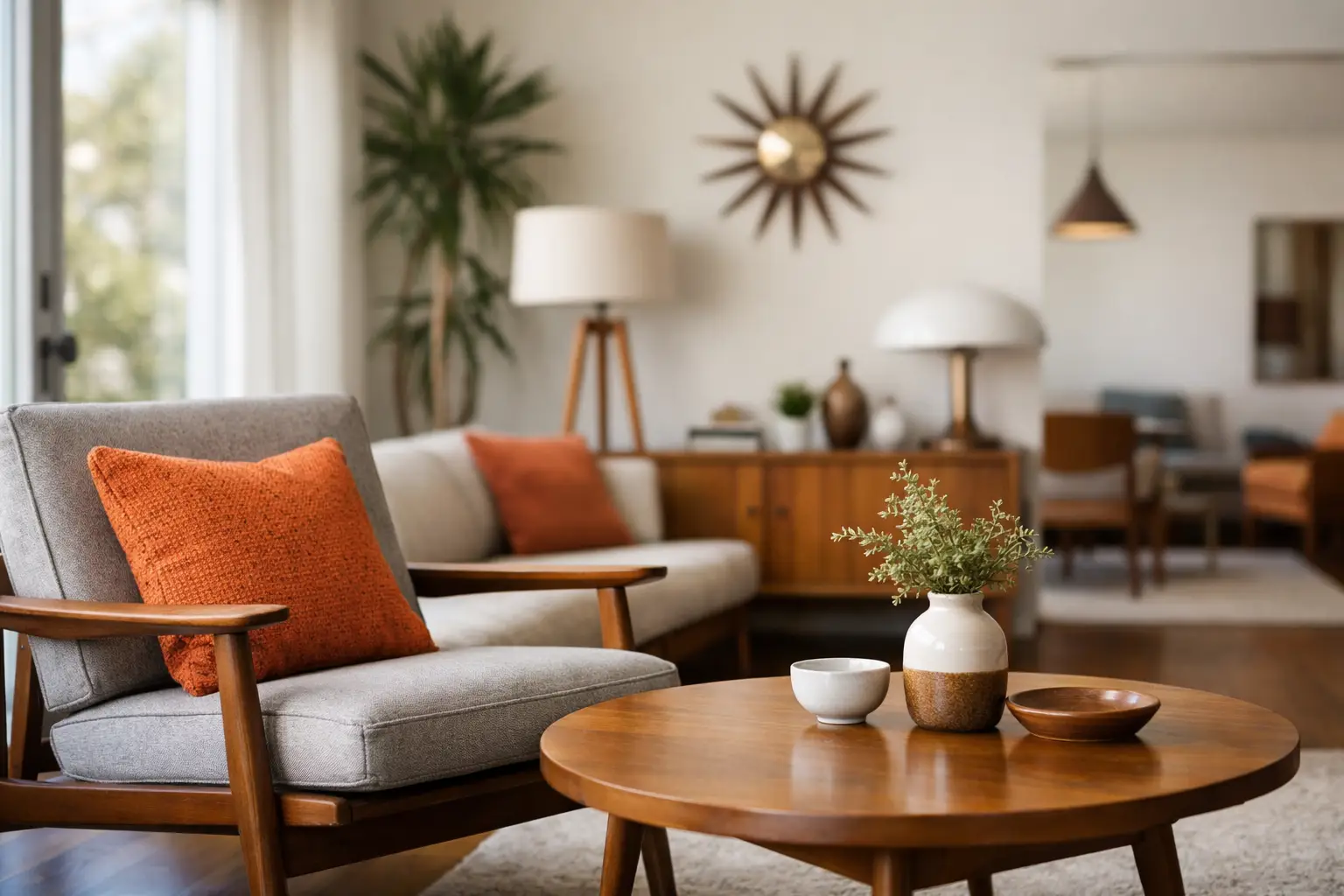
Some styles never really leave the room. They simply change context, move from architect-designed homes to city apartments, from collector interiors to carefully edited family spaces. That is one reason why is mid century modern so popular remains such a persistent question. The style feels familiar without feeling tired, refined without appearing rigid, and curated without losing comfort.
Mid-century modern has done something very few design languages achieve. It has become widely recognizable while still retaining real aesthetic authority. For collectors, designers, and homeowners with a trained eye, its appeal is not a mystery of trend. It is the result of proportion, material honesty, and objects that still look resolved decades after they were made.
Why is mid century modern so popular in interiors?
The short answer is balance. Mid-century modern sits at a rare intersection where beauty, function, and clarity all support one another. A teak sideboard, a sculptural floor lamp, a Murano glass pendant, or a clean-lined lounge chair can hold visual presence without overwhelming a room.
That balance matters in contemporary interiors, where people want spaces to feel personal but not cluttered, elevated but not theatrical. Mid-century modern offers strong silhouettes, thoughtful materials, and enough restraint to let a room breathe. Even a single vintage piece can establish order and character at once.
There is also a practical reason for its staying power. The style adapts easily. It works in period homes, minimalist lofts, layered European apartments, and commercial spaces that need identity without excess. Very few historical styles move this easily across architecture, geography, and lifestyle.
The design language is simple, but not plain
One of the most misunderstood qualities of mid-century modern is its simplicity. People often read clean lines as easy design. In reality, simplicity is difficult. It requires proportion, discipline, and confidence.
The best mid-century pieces are reduced, but never empty. A walnut cabinet is not interesting because it is plain. It is interesting because the line is controlled, the joinery is intelligent, and the wood carries the visual depth. A table lamp from the period does not rely on ornament to justify itself. Its form, material, and scale do the work.
This is a major reason the style remains popular. It gives interiors visual calm while still rewarding close attention. It speaks clearly, but it is not simplistic.
Form follows use, and people still respond to that
Mid-century modern developed in an era deeply interested in how people lived. Furniture became more responsive to daily routines, smaller footprints, changing family structures, and a growing appreciation for informal comfort. That human-centered thinking still feels current.
A dining chair that is elegant yet genuinely comfortable, a modular storage unit that solves a spatial problem, or a low-profile sofa that opens a room visually all reflect design decisions people still value. The objects are attractive, but they are also usable in a real way. That matters more than ever in homes expected to serve multiple functions.
It feels warm where many modern styles feel cold
Modern design can sometimes become sterile in the wrong hands. Mid-century modern usually avoids that problem because it relies on warmth as much as precision. Wood, glass, brass, leather, ceramic, and textured textiles soften the geometry.
This is where the style separates itself from generic contemporary interiors. The lines may be crisp, but the atmosphere is often inviting. Rich woods add depth. Hand-blown glass introduces irregularity and reflection. Aged metal surfaces bring nuance. The result is disciplined design with a human temperature.
For this reason, mid-century modern often attracts buyers who want sophistication without severity. They may admire minimalist spaces, but they do not want to live in a room that feels emotionally flat. Vintage mid-century pieces offer structure with soul.
Why is mid century modern so popular with collectors?
Because it is one of the few categories where design history, decorative impact, and collectibility regularly overlap. A well-chosen mid-century object can function on several levels at once. It can solve a furnishing need, elevate a room, and hold cultural value.
Collectors are drawn to pieces that reflect a clear design moment and a recognizable philosophy. Mid-century modern does that extremely well. It carries the optimism of postwar design, the refinement of industrial and artisanal production, and a broad international vocabulary that includes Italy, Scandinavia, France, and the United States.
Italian mid-century design holds special authority within this field. The period produced lighting, furniture, mirrors, and decorative objects that combined architectural rigor with material richness. Murano glass, in particular, gave the era a dimension of luminosity and sculptural sophistication that still feels compelling in contemporary interiors. These are not objects chosen only for nostalgia. They are chosen because they still command space beautifully.
Original pieces carry presence that reproductions rarely match
Part of the popularity of mid-century modern comes from its visibility, but visibility has also created a market full of diluted imitations. This is where experienced buyers become more selective.
An original or well-attributed vintage piece usually has a density, finish, and proportion that reproductions often miss. The wood has matured. The patina is real. The construction feels grounded. Even when the design is restrained, the object has authority.
That difference is especially noticeable in lighting and case goods. A true vintage brass sconce, a Murano table lamp, or a finely made credenza tends to shape a room differently than a contemporary lookalike. It introduces not just style, but character.
The style photographs well, but that is not the whole story
It would be naive to ignore the role of visual culture. Mid-century modern performs exceptionally well in magazines, film sets, social media, and real estate imagery. Its silhouettes are legible. Its palettes are attractive. Its rooms appear edited and intelligent on camera.
But if popularity were only about photogenic design, the style would have faded by now. Instead, it has remained desirable because it also performs well in lived space. A room with thoughtfully chosen mid-century elements tends to feel organized, open, and calm. The eye moves easily through it.
That ease is not accidental. The style often favors raised furniture, cleaner sightlines, moderate scale, and compositions that do not overcrowd the floor plan. In smaller homes or apartments, these qualities are more than aesthetic. They are spatial advantages.
It invites mixing rather than strict historical fidelity
Another reason for its durability is flexibility. Mid-century modern is remarkably good at conversation. It can sit beside Art Deco mirrors, antique ceramics, contemporary art, or Sicilian decorative pieces without collapsing into confusion.
This makes it especially attractive to buyers who do not want a room to look staged in one decade. A single mid-century chandelier can sharpen a traditional interior. A vintage lounge chair can soften a very contemporary room. A sculptural glass piece can connect architecture, lighting, and collecting in one gesture.
That said, the style works best when it is edited. Too many pieces from the same vocabulary can make a space feel predictable. The most compelling interiors usually treat mid-century modern as a strong chapter, not the entire book.
There is comfort in timelessness, but also risk in overuse
The popularity of mid-century modern has created a paradox. On one hand, it is timeless because its fundamentals are sound. On the other, its most famous shapes have been reproduced so often that they can feel generic when used without discernment.
This is where curation matters. Not every tapered leg or low-profile chair deserves the label in any meaningful sense. The distinction lies in quality, origin, material, and composition. Buyers with a developed eye tend to move beyond the obvious icons and look for pieces with stronger individuality – a less common light fixture, a particular Italian mirror, a cabinet with unusual detailing, a glass object with sculptural tension.
Popularity, then, is both strength and warning. The style remains relevant, but the rooms that stay memorable are the ones built with selectivity.
Mid-century modern aligns with how people want to live now
There is also a broader cultural reason for its appeal. People increasingly want homes that feel intentional. Not crowded, not trend-driven, not disposable. Mid-century modern supports that desire because it is rooted in lasting forms and materials that age with dignity.
It also suits a more conscious approach to buying. Choosing vintage often means choosing objects that have already proved their longevity. For many buyers, that carries both aesthetic and ethical value. A well-made lamp or cabinet from the 1950s or 1960s does not need to justify itself through novelty. Its survival is part of its argument.
This is why the category continues to resonate with sophisticated buyers and designers. It offers clarity in a crowded market. It allows a room to feel designed without feeling overdesigned.
For those who care about interiors with memory, line, and presence, mid-century modern remains popular for a very simple reason: it still makes spaces look better, feel better, and say something more interesting about the people who live in them.