

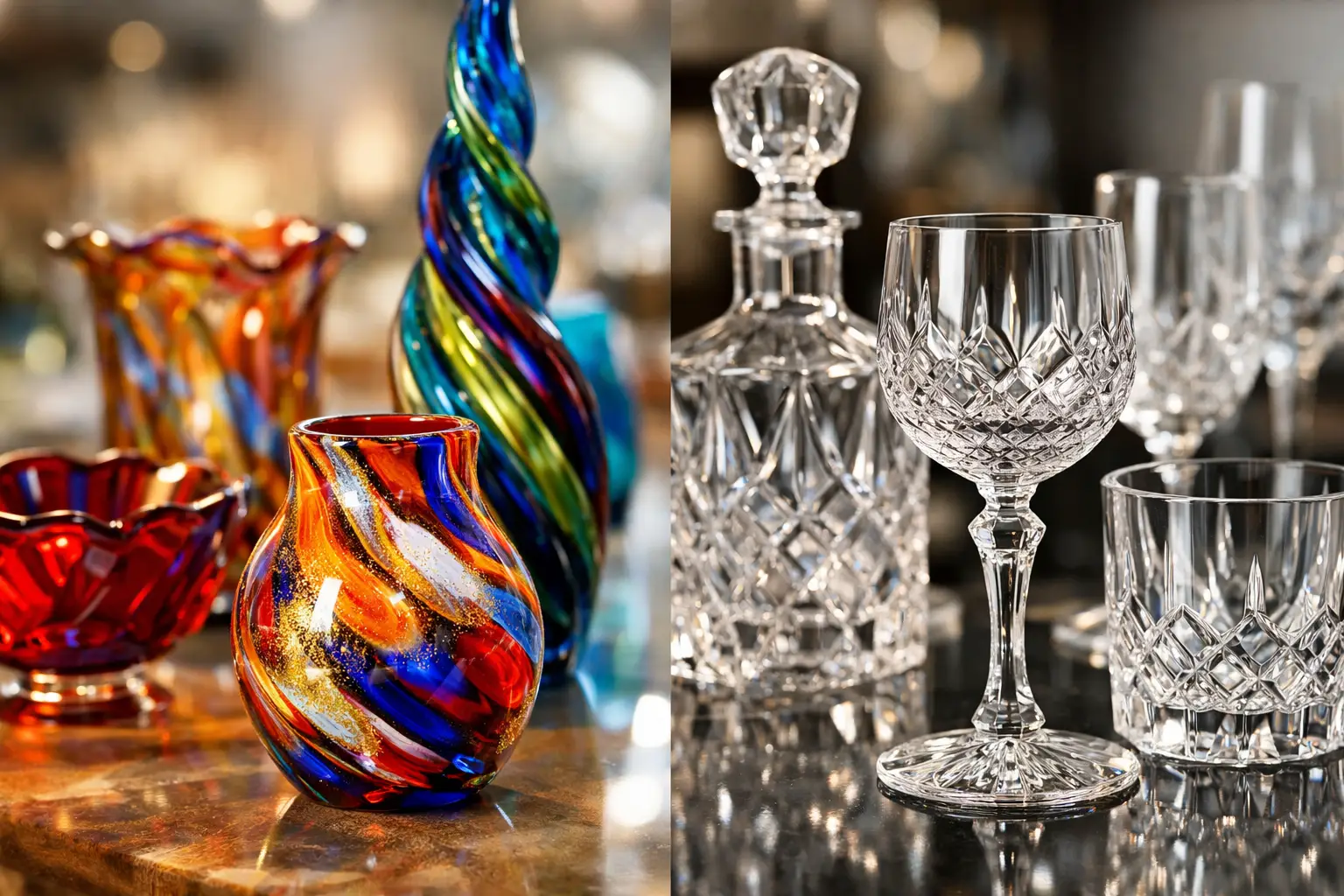
A chandelier can sparkle from across the room and still tell two very different stories. In the conversation around Murano glass vs crystal, the distinction is not just about shine. It is about origin, technique, visual character, and the kind of presence an object brings into an interior.
For collectors, designers, and anyone furnishing with intention, these materials should never be treated as interchangeable. Crystal often speaks the language of clarity, precision, and formal brilliance. Murano glass carries something else – gesture, atmosphere, and the unmistakable hand of Venetian glassmaking.
Murano glass vs crystal: what changes, exactly?
The simplest way to frame Murano glass vs crystal is this: Murano glass refers to art glass produced on the island of Murano, near Venice, using centuries-old techniques and a strong artisanal tradition. Crystal refers to a type of glass formulated for enhanced clarity, brightness, and refraction, often associated with cut tableware, decorative objects, and certain lighting forms.
That means the terms do not belong to the same category. Murano is primarily a place-based and craft-based identity. Crystal is primarily a material category, defined by composition and optical qualities. This is why confusion is so common. A Murano piece can be transparent, luminous, and refined, but it is not automatically crystal. Likewise, a crystal vase can be elegant and beautifully made without having any connection to Murano.
In practice, what changes is the visual result. Murano glass tends to emphasize artistic technique, sculptural form, color layering, texture, and movement. Crystal tends to emphasize transparency, sharp reflection, and a brighter, more prismatic kind of sparkle.
Origin matters as much as material
Murano glass is inseparable from its place of origin. Since the late 13th century, Murano has been associated with some of Italy’s most important glassmaking workshops. Over time, the island developed a distinct culture of production where techniques such as sommerso, filigrana, pulegoso, lattimo, aventurine, and controlled color application became part of a recognizable visual language.
That heritage matters because when people seek Murano, they are rarely seeking only a functional object. They are looking for a piece with authorship, tradition, and decorative identity. A Murano table lamp, bowl, vase, or chandelier often carries the value of artisanal interpretation. Even when the silhouette is clean and modern, the piece usually retains the evidence of handwork.
Crystal does not depend on one place in the same way. It has a broader manufacturing history across Europe and beyond, from Bohemian traditions to French and English production. Its value may come from brand, lead content or alternative formulas, cutting quality, age, rarity, and condition. But crystal as a category is not defined by geography in the way Murano glass is.
Material and composition
This is where the comparison becomes more technical. Crystal is usually formulated to achieve greater brilliance and a higher refractive index than standard glass. Traditional lead crystal includes lead oxide, which contributes to weight, clarity, and that familiar light-catching effect. Many contemporary crystal pieces are now made with lead-free formulas, but the goal remains similar: exceptional transparency and sparkle.
Murano glass is made using silica and other materials, then shaped and decorated through highly specialized furnace techniques. Its identity lies less in chemical composition and more in process. The emphasis is not necessarily on maximum refraction. Instead, the focus is often on color density, surface character, depth, and complex decorative effects achieved while the glass is still hot.
For that reason, if someone expects Murano to behave visually like cut crystal, they may miss the point of the object. A Murano piece often glows rather than flashes. It can be velvety, opaline, saturated, smoky, iridescent, or dramatically layered. Its beauty is often read through volume and tone rather than pure optical sharpness.
How they look in a room
In interiors, the difference is immediate.
Crystal tends to amplify light with a crisp, formal brilliance. In chandeliers and stemware especially, it creates sharp highlights and a sense of ceremony. It works beautifully in rooms where symmetry, reflection, and polished finishes are part of the composition. Think classic dining spaces, tailored entryways, or interiors where elegance is expressed through precision.
Murano glass is often more atmospheric. It introduces color, softness, and sculptural rhythm. In lighting, it can diffuse light in a way that feels richer and more nuanced. In decorative objects, it behaves almost like a small work of art – an accent that changes according to daylight, surrounding textures, and viewing angle.
Neither effect is inherently superior. It depends on what the room needs. If the space calls for brilliance and formal luminosity, crystal may be the right answer. If it needs personality, depth, and an unmistakably Italian decorative gesture, Murano glass has a different kind of authority.
Murano glass vs crystal in craftsmanship
Craftsmanship is central to both, but it takes different forms.
Murano craftsmanship is frequently visible in the body of the object itself. You notice the slight asymmetry that confirms hand formation, the layered canes, the trapped bubbles, the subtle transitions in color, the texture created by heat and timing. These are not flaws. In many cases, they are exactly what make the piece compelling.
Crystal craftsmanship is often revealed through cutting, polishing, balance, and precision. The appeal lies in control. Edges are cleaner, surfaces are sharper, and decorative patterning may rely on engraving or faceting rather than molten manipulation. The discipline is different, and so is the visual reward.
This is one reason seasoned buyers rarely ask only whether a piece is “beautiful.” They ask what kind of beauty it offers. Murano invites a more tactile and expressive reading. Crystal often rewards a more formal and optical one.
Weight, sound, and feel
People often try to identify material by touch, and that instinct is useful, though not foolproof.
Crystal is usually heavier for its size and can produce a bright ringing sound when lightly tapped. It often feels cool, dense, and highly polished. Murano glass may also have substance, especially in thick blown forms, but its weight varies considerably depending on technique and design. Some Murano pieces are surprisingly substantial, while others feel airy and delicate.
The surface can also guide the eye. Crystal often aims for pristine clarity and geometric regularity. Murano may present controlled irregularities, richer coloration, internal decoration, or a softer visual depth. These qualities are especially noticeable in vintage lighting and decorative vessels, where handmade character is part of the object’s charm.
Value and collectibility
Value depends on more than material alone.
Crystal can command significant prices when it comes from respected makers, historic houses, or exceptional periods of production. Antique and vintage crystal chandeliers, stemware, and decorative pieces remain highly collectible, particularly when cut quality, condition, and provenance align.
Murano glass occupies a different but equally important collecting space. Here, the strongest value often comes from workshop attribution, period, technique, rarity, and design relevance. Mid-century Murano lighting, sculptural vases, and colored art glass continue to attract serious interest because they sit at the crossroads of decorative art, Italian design history, and craftsmanship.
In other words, higher sparkle does not automatically mean higher value. A rare Murano piece with strong authorship and period character may be more desirable than a generic crystal object, even if the latter appears more brilliant at first glance.
Which should you choose?
If you are choosing for a home, a project, or a collection, the better question is not which material is better. It is which presence belongs in the space.
Choose crystal when you want clarity, symmetry, and sharper light reflection. It is particularly effective in formal settings, in layered tabletop arrangements, and in interiors where polished surfaces and classic elegance set the tone.
Choose Murano glass when you want individuality, color, and the expressive value of handmade Italian craftsmanship. It suits interiors that benefit from a focal point with more personality – especially vintage, eclectic, mid-century, or highly curated spaces where one object can shape the entire mood.
There is also a practical consideration. Murano often works beautifully as a statement piece because it carries visual substance even when used sparingly. A single lamp, vase, or chandelier can do a great deal of stylistic work. Crystal can be more dependent on repetition or context, especially in table settings or formal decorative schemes.
For buyers who care about distinction, Murano usually offers a stronger sense of singularity. That is part of why curated selections remain so important. A well-chosen Murano object does not just decorate a room. It establishes a point of view.
At Sound Of Vintage Italy, this distinction is not academic. It shapes how one reads an object before bringing it into a space. The best choice is the one that feels coherent with the room, the collection, and the life around it. When the material matches the mood, the piece stops being an accessory and becomes part of the architecture of taste.
Sorry, the comment form is closed at this time.