

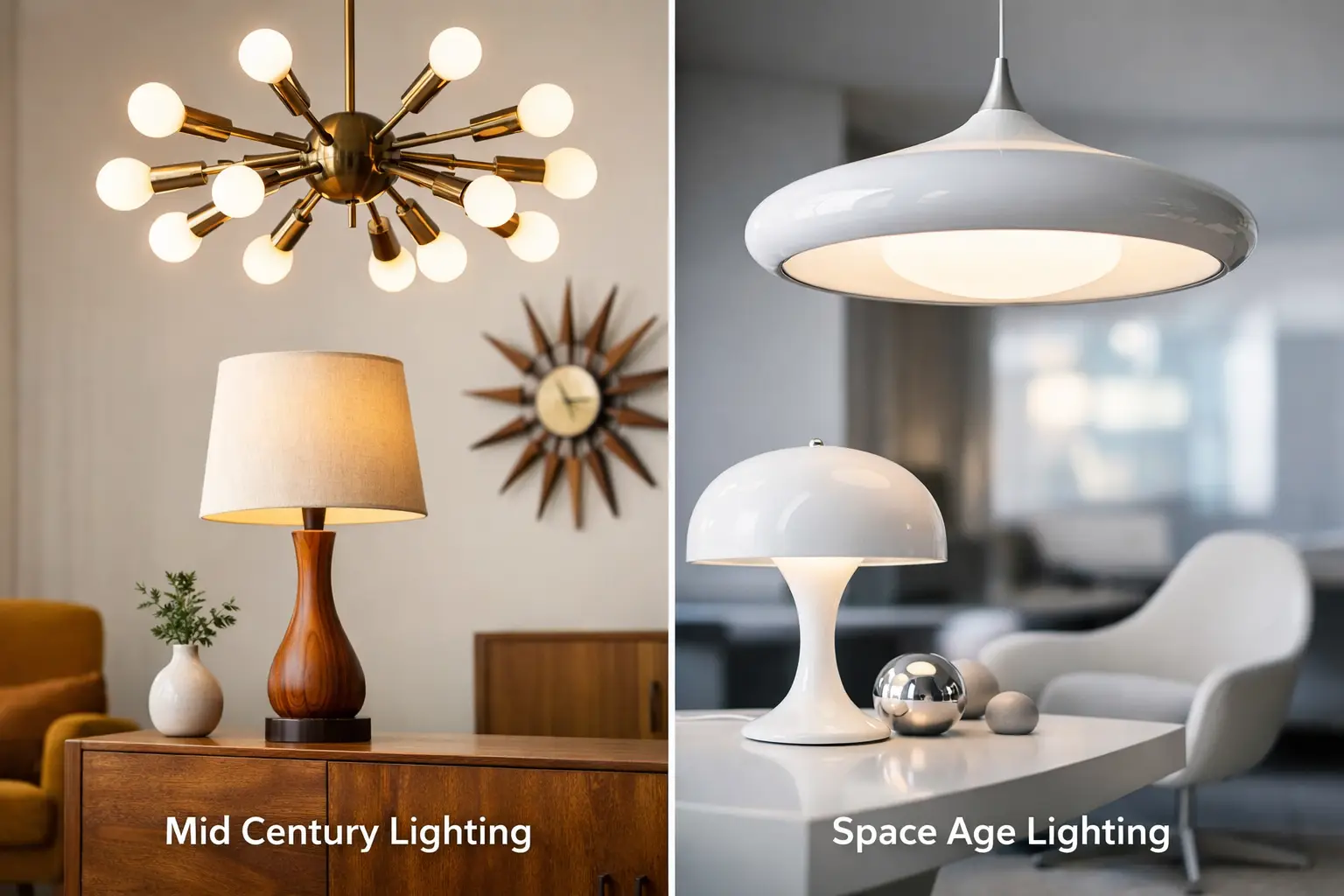
A brass floor lamp with a calm teak base and a chrome mushroom table lamp may both belong to the vintage universe, but they tell very different stories. That is exactly where the conversation around Mid Century lighting vs Space Age lighting becomes useful: these styles are often grouped together, yet they shape a room in radically different ways.
For collectors, decorators, and anyone building a home with intention, the distinction is not academic. Lighting is one of the fastest ways to define an interior. It sets rhythm, reflects materials, and reveals whether a room leans architectural, sculptural, restrained, or boldly futuristic. Mid-Century and Space Age pieces can coexist beautifully, but they should not be mistaken for one another.
Mid Century lighting vs Space Age lighting: the real difference
Mid-Century lighting is rooted in balance. Its forms tend to feel edited, functional, and quietly elegant. Think clean silhouettes, measured proportions, organic curves, brass details, wood accents, opaline glass, and a design language that supports daily living without unnecessary drama. Even when a piece is visually striking, it rarely feels theatrical for its own sake.
Space Age lighting shifts the center of gravity. It is more experimental, more synthetic, and often more sculptural. It embraces the optimism of the postwar future, especially from the late 1960s into the 1970s, when new plastics, chromed metals, and molded forms made designers imagine interiors as extensions of a modern, technological lifestyle. A Space Age lamp often looks like an object first and a lamp second, and that is part of its appeal.
The simplest way to understand the divide is this: Mid-Century lighting usually refines the room, while Space Age lighting transforms it.
What defines Mid-Century lighting
Mid-Century lighting belongs to a broader design culture shaped by clarity, proportion, and modern living. In practice, this means fixtures that feel intentional rather than ornamental. Pendant lamps, wall sconces, and floor lamps from the period often rely on geometric control softened by warm materials. Brass, walnut, teak, lacquered metal, frosted glass, and parchment shades all appear with regularity.
There is also a strong relationship between Mid-Century lighting and architecture. These fixtures were designed to sit naturally within interiors that valued open plans, low furniture, and visual coherence. A lamp was rarely an isolated gesture. It was part of a complete environment.
This is why Mid-Century pieces remain so adaptable. They have personality, but they do not dominate every conversation in the room. A pair of Italian wall sconces in brass and milk glass, for example, can add atmosphere without pulling attention away from art, wood furniture, or textiles. Their strength is often in their restraint.
The Mid-Century mood
The mood is warm, composed, and cultivated. Even when the lines are sharp, the effect is rarely cold. Light tends to be diffused or directed with purpose rather than staged as spectacle. In a dining room, living room, or study, Mid-Century lighting usually creates a sense of order and comfort.
For buyers who want vintage character without making the room feel themed, this style often offers the better entry point.
What defines Space Age lighting
Space Age lighting emerged from a different appetite. It reflects fascination with technology, aerospace imagery, pop culture, and new industrial possibilities. If Mid-Century design is about disciplined modernism, Space Age design is about motion, novelty, and a more liberated imagination.
This is where you find domed forms, globes, capsules, mushroom silhouettes, cantilevered arcs, mirrored surfaces, lacquer, acrylic, fiberglass, and chrome. Orange, white, silver, red, and smoke tones appear frequently. Shapes can feel aerodynamic, cellular, or almost extraterrestrial.
Italian, French, and German production from the period includes some of the most memorable examples. These pieces often carry a strong visual identity even when they are compact. A Space Age table lamp can act like a sculpture on a console. A large pendant can become the room’s main visual event.
The Space Age mood
The mood is more cinematic. It can be playful, sleek, and slightly provocative. Space Age lighting rarely disappears into the background. It is made for interiors that can support contrast, shine, and a stronger gesture.
That does not mean it is less refined. It simply works through impact rather than restraint. The best examples still have discipline in their proportions, but they are more willing to challenge convention.
Materials, finishes, and visual weight
One of the clearest distinctions in Mid Century lighting vs Space Age lighting appears in materials. Mid-Century pieces often favor a conversation between natural and industrial elements. Wood and brass soften painted metal. Opaline or etched glass diffuses light with elegance. The finish palette usually feels grounded.
Space Age lighting tends to push harder into industrial or synthetic expression. Chrome reflects everything around it. Acrylic and molded plastic create seamless curves. Lacquered surfaces make color feel intentional and graphic. Even when the lamp is white, silver, or black, the object often carries more visual tension.
Visual weight matters too. A Mid-Century chandelier may have multiple arms and still feel airy because its composition is balanced. A Space Age pendant may be physically small yet feel much more present because of its shine, opacity, or unusual silhouette.
This difference becomes especially important in layered interiors. If the room already contains bold art, patterned rugs, or statement seating, Mid-Century lighting may give you needed control. If the room feels too quiet or too safe, Space Age lighting can introduce contrast immediately.
How each style works in contemporary interiors
Neither style belongs only in period-perfect homes. Both can work exceptionally well in contemporary settings, but they ask for different supporting conditions.
Mid-Century lighting integrates easily with natural stone, linen, oak floors, plaster walls, and understated upholstery. It complements interiors that value texture, tonal depth, and a certain architectural calm. Designers often use it when they want vintage authenticity that still feels timeless rather than nostalgic.
Space Age lighting thrives in rooms with sharper editing. It can elevate minimalist spaces by adding shape and reflection, or it can intensify eclectic rooms where art, collectibles, and unconventional furniture already set the tone. It also performs well in monochrome interiors, where its sculptural quality becomes more pronounced.
There is, however, a trade-off. Mid-Century lighting generally ages more quietly in a room. Space Age lighting makes a stronger point of view, which can be exactly right or slightly overpowering depending on placement.
Which style is more collectible?
Collectibility depends on rarity, condition, designer attribution, and provenance, but the market often responds to these categories differently. Mid-Century lighting has broad, enduring demand because it is highly livable. Buyers know where to place it, and designers rely on it often. That keeps the category consistently relevant.
Space Age lighting can inspire more immediate desire among collectors who are drawn to iconic silhouettes and stronger stylistic signatures. Exceptional examples can feel more niche, but also more memorable. A rare Space Age lamp in excellent original condition may have a sharper emotional pull precisely because it is less neutral.
For a collector, the question is not simply which one is better investment-wise. It is which one still feels compelling after the first moment of attraction. The strongest vintage purchase is rarely the loudest one. It is the one that remains convincing in your space over time.
Mid Century lighting vs Space Age lighting: how to choose
Start with the room, not the trend. If your interior relies on warmth, wood tones, understated luxury, and a layered sense of permanence, Mid-Century lighting will usually feel more natural. It supports the room’s structure and adds distinction without pushing too hard.
If your space needs a focal point, or if you are building an interior with more graphic confidence, Space Age lighting may be the better decision. It works particularly well when you want one object to establish mood quickly.
Scale is equally important. Mid-Century pieces often succeed through proportion and repetition, such as a pair of sconces or a balanced pendant over a dining table. Space Age pieces can operate more independently, almost like autonomous sculptures. In smaller rooms, that can be an advantage, but only if the surrounding elements stay controlled.
There is also the question of personality. Some buyers are instinctively drawn to calm sophistication. Others want tension, shine, and surprise. Both instincts are valid. The best interiors are rarely assembled by category alone. They are shaped by conviction.
At Sound Of Vintage Italy, this is often the real value of a curated vintage lighting selection: not simply identifying the era, but recognizing the object that gives an interior its exact accent.
A well-chosen Mid-Century lamp can make a room feel settled. A well-chosen Space Age piece can make it feel awake. The right choice is the one that turns on the room even before the bulb is lit.
Sorry, the comment form is closed at this time.