
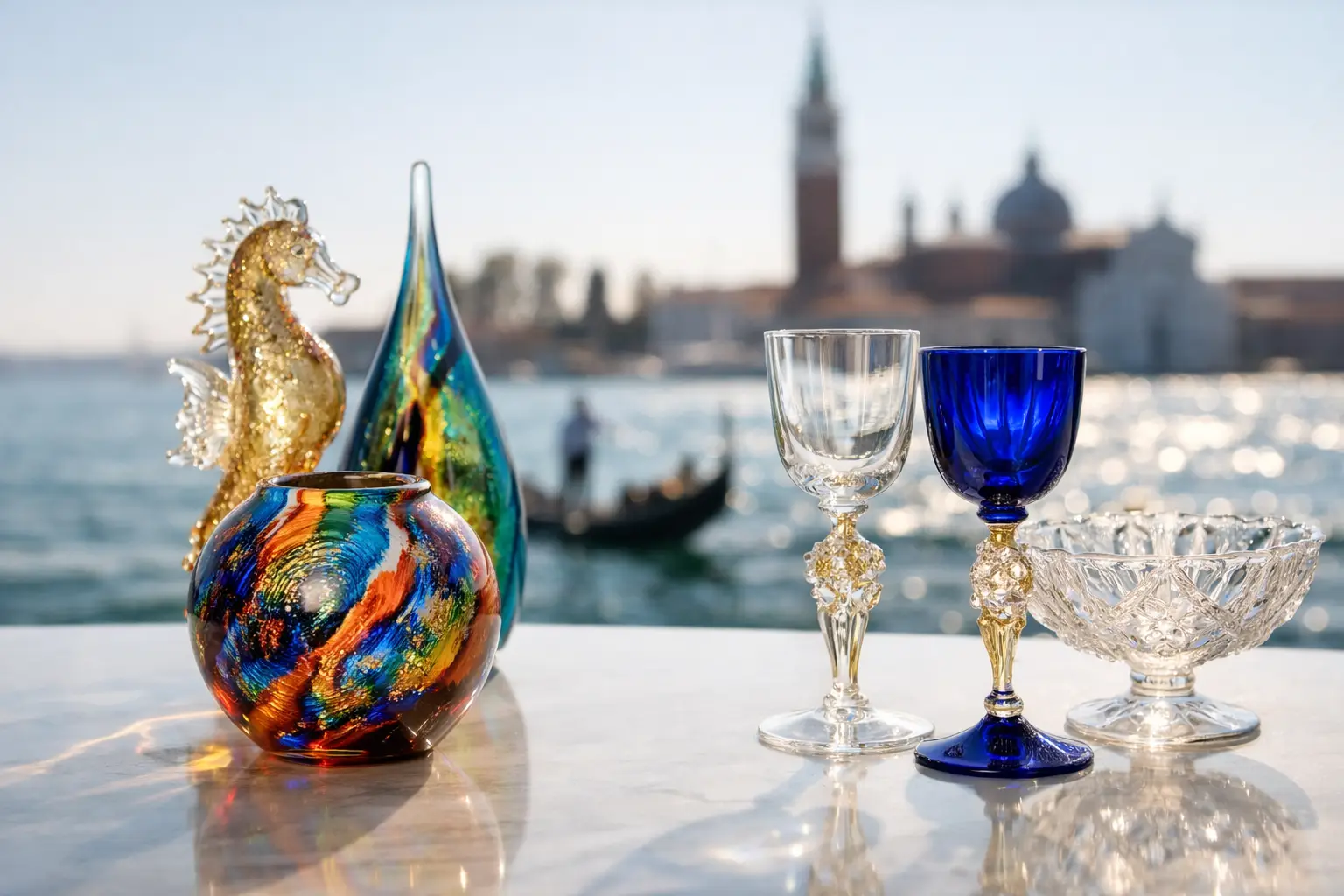
A hand-blown vase labeled “Venetian glass” can look every bit as seductive as one described as “Murano.” The colors shimmer, the surface catches light beautifully, and the form may feel unmistakably Italian. Yet when the question becomes Murano glass vs Venetian glass, the distinction is not cosmetic. It concerns origin, meaning, collectibility, and the level of precision behind the object in front of you.
For collectors, designers, and buyers furnishing rooms with intention, this difference matters. Not because one term is always right and the other always wrong, but because each points to a different kind of identity. One is geographic and specific. The other is broader, older, and often used with varying degrees of accuracy.
Murano glass vs Venetian glass: what is the real difference?
At its simplest, Murano glass refers to glass made on the island of Murano, in the Venetian lagoon, by workshops tied to that historic glassmaking district. Venetian glass is a wider term. It can refer to the glassmaking tradition of Venice more generally, including styles historically associated with the Republic of Venice, or it can be used in a looser commercial sense to evoke a Venetian look.
That is where confusion begins. Every authentic Murano piece is part of the Venetian glass tradition, but not every object sold as Venetian glass is necessarily made in Murano. In practice, Murano is the more exact term, especially when provenance and craftsmanship are central to value.
This distinction became especially relevant over the last century, as international demand for Italian decorative glass expanded. The phrase “Venetian glass” started to function not only as a historical descriptor but also as an aesthetic shortcut. It can suggest delicacy, gilding, colorful canes, lattimo milk glass, or ornate lighting inspired by Venetian forms. Useful, yes. Precise, not always.
Why Murano carries more specificity
Murano is not just a style reference. It is a place with a centuries-old manufacturing legacy. Since the late 13th century, glass furnaces were concentrated there, and over time Murano became synonymous with technical innovation and artisanal excellence. Techniques such as sommerso, filigree, aventurine, murrine, and pulegoso are deeply connected to this production culture.
When a piece is described as Murano, the expectation is stronger. Buyers reasonably assume an origin in Murano, or at minimum a direct connection to its workshops and makers. That expectation affects decorative prestige, market trust, and resale interest.
For a serious buyer, the word Murano signals more than beauty. It suggests lineage. A mid-century Murano chandelier or sculptural bowl carries the aura of a manufacturing ecosystem where design, furnace skill, and experimentation evolved together. That concentration of know-how is part of what makes Murano glass so enduring in both vintage interiors and collections.
Venetian glass as a historical term and a market term
The term Venetian glass is not inherently incorrect. In historical writing, it often refers to the celebrated glass tradition developed under Venice and exported across Europe. Many museum texts and academic sources use it legitimately, especially when speaking about earlier periods or broad stylistic families.
The problem appears in the marketplace, where Venetian glass may describe several different realities. It might refer to authentic Murano production. It might indicate a piece made elsewhere in Italy in a Venetian-inspired style. In less careful cases, it may be used for decorative glass with no meaningful link to Murano at all.
That does not make every non-Murano Venetian glass object uninteresting. Some later pieces have real decorative merit, particularly in interiors where form, scale, and light interaction take priority. But if your aim includes authenticity, period value, or investment-minded collecting, broad labels deserve scrutiny.
Murano glass vs Venetian glass in design value
From an interior perspective, both terms can point to visually compelling objects. A Venetian-style mirror with etched decoration, for example, may work beautifully in a room regardless of whether it was made in Murano. Likewise, a dramatic chandelier marketed as Venetian can still create the right atmosphere above a dining table or in a foyer.
Still, design value and collectible value are not always the same thing. Murano pieces tend to hold stronger appeal when the buyer wants originality anchored in place. This is especially true in vintage lighting, art glass, and signed studio production from the 20th century.
Collectors often gravitate toward Murano because authorship and workshop identity matter. Names such as Venini, Barovier, Seguso, Mazzega, Toso, and others are not interchangeable decorative references. They are part of a specific manufacturing history. A labeled Venetian glass lamp may be attractive; a documented Murano lamp can carry an entirely different cultural and market weight.
How to read the label without being misled
The safest approach is to treat terminology as a starting point, not proof. If an item is described as Murano, ask what supports that claim. Labels, signatures, archival references, original stickers, invoice history, and construction details all help. Age matters too, because stickers can be lost and attribution often relies on stylistic and technical analysis.
If an object is described only as Venetian glass, that does not automatically mean it lacks quality. It means the origin is less specific. Sometimes sellers use the wider term because attribution is uncertain. Sometimes they are being cautious, which is preferable to overclaiming. Sometimes, however, the vague wording masks a generic piece trading on the reputation of Venetian craftsmanship.
This is where an experienced eye becomes useful. Weight, finishing, balance, complexity of execution, and consistency of decorative technique often reveal more than a romantic label. Fine Murano work tends to show intentionality at every level, from the control of form to the sophistication of surface effects.
Signs that a piece deserves closer attention
No single feature authenticates glass on its own, but several clues can strengthen confidence. The quality of the blowing is one. Murano workshops, particularly the best-known ones, developed a remarkable command of proportion even in highly ornamental forms. The decoration should feel integrated, not applied as an afterthought.
Color is another clue. Murano glass often displays exceptional depth, whether transparent, opaline, smoky, or vividly saturated. In vintage examples, the color relationships can be subtle and deliberate, especially in pieces from the mid-century period when modern forms met traditional technique.
Then there is ambition. Murano makers have long excelled in pieces that are technically difficult – twisted stems, heavy sommerso layers, intricate cane work, complex chandeliers with dozens of coordinated elements. When an object looks easy, but clearly was not easy to make, that is often a good sign.
When the broader term is enough
Not every buyer needs the most exact attribution. If you are furnishing a room and fall in love with a Venetian glass mirror or a floral sconce because it brings lightness and personality to the space, the broader term may be perfectly adequate. Decorative success is not invalidated by a wider label.
The key is to match the terminology to the purpose of the purchase. For pure styling, visual presence may lead. For gifting, provenance may matter less than beauty. For collecting, insuring, or building a coherent vintage design narrative, specificity becomes far more important.
This is often the difference between buying an accessory and choosing an object with long-term significance. A room can benefit from both, but they should not be confused.
Why provenance matters more in vintage and collectible categories
In contemporary decorative retail, broad descriptors are common. In vintage and antique contexts, they carry more consequences. Origin affects not only price, but also historical placement, rarity, and the story the object contributes to an interior.
A genuine Murano piece can sit comfortably among important 20th-century furniture, Italian lighting, and curated decorative objects because it participates in that same design culture. It does not merely resemble it. For buyers who live with objects as expressions of taste rather than simple utility, this distinction is substantial.
That is why curated sourcing matters. A selective boutique such as Sound Of Vintage Italy does not treat Murano as a generic mood. It treats it as a category with its own standards, visual language, and collector expectations.
Choosing with confidence
If you are deciding between an object described as Murano and one described as Venetian glass, pause before comparing price alone. Ask what you are actually paying for. Is it just the look, or the look plus place, technique, and historical credibility?
Sometimes the answer will favor the Murano piece. Sometimes a broader Venetian glass object will still be exactly right for the room. Taste is rarely mechanical, and the best interiors are not built by labels alone. Still, names mean something in design, especially when they point to real craft traditions.
The most satisfying pieces tend to reward attention over time. The light they hold, the hand behind the form, the certainty of their origin – these are qualities that keep an object interesting long after the first impression has passed.