
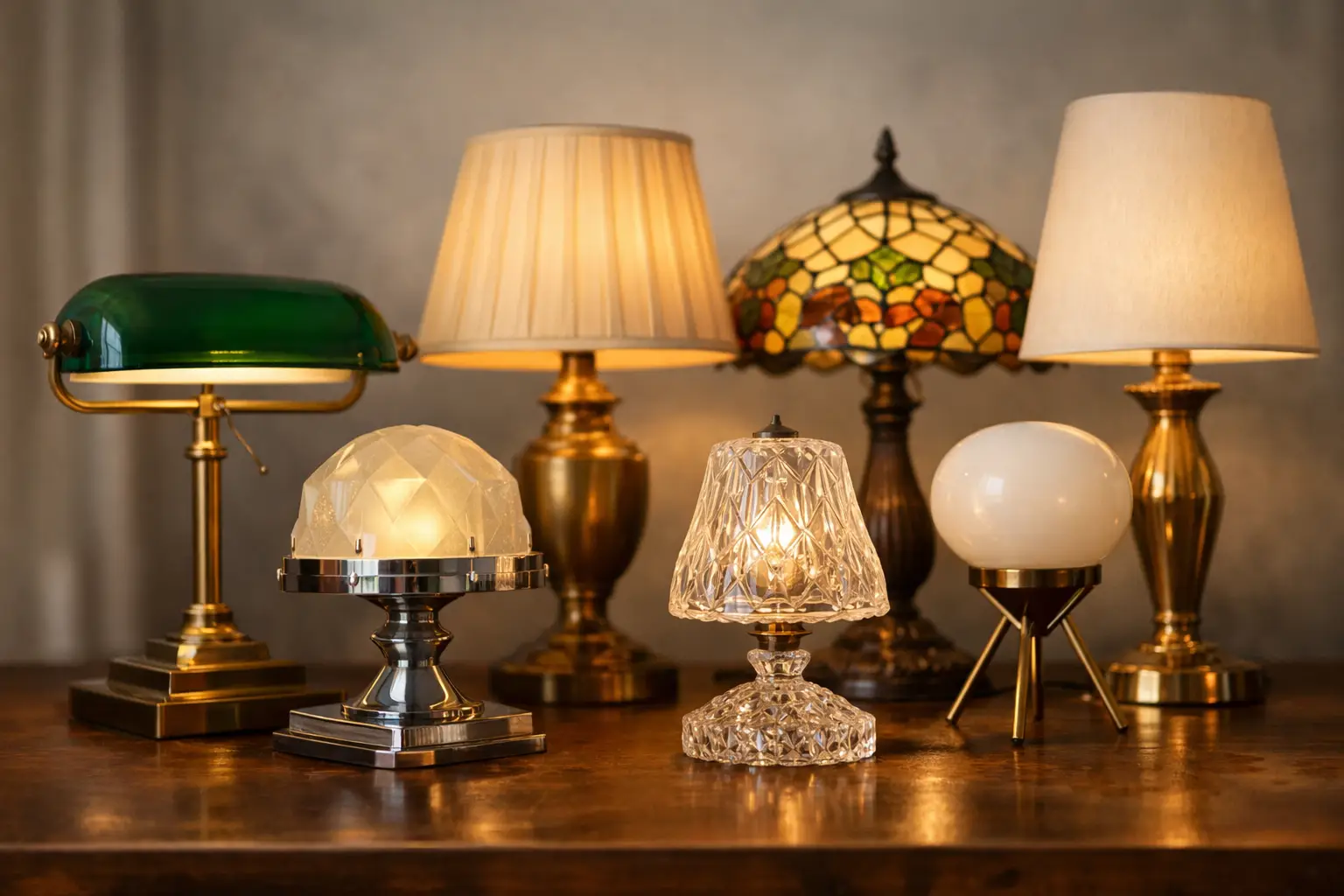
A table lamp rarely works as a minor detail. On a console, beside a sofa, or on a nightstand, it sets the visual temperature of a room before it casts a single pool of light. That is why the best vintage table lamps are not simply functional objects. They are sculptural presences, pieces of design history, and often the element that gives an interior its final point of character.
For collectors and design-led buyers, the appeal is clear. A vintage lamp carries proportion, material depth, and workmanship that are difficult to replicate convincingly. Brass ages with dignity. Murano glass holds light with a softness that feels alive. Lacquer, marble, chrome, parchment, and ceramic each bring a different kind of authority. The question is not only which lamp is beautiful, but which kind of beauty belongs in a particular room.
What makes the best vintage table lamps stand out
The strongest vintage lamps do three things at once. They illuminate, they anchor a surface, and they communicate a period sensibility with precision. A well-chosen lamp can make a contemporary room feel layered, or give a more traditional interior an unexpected edge.
Authenticity matters, but so does presence. Some pieces are valuable because they come from a notable maker or period. Others deserve attention because their silhouette is so resolved that they read as art, even without a famous attribution. In both cases, quality tends to reveal itself in the details – the weight of the base, the finish of the metalwork, the tension between shade and body, the balance of ornament and restraint.
There is also a practical dimension. Vintage lighting has to work in lived spaces, not only in photographs. Scale, wiring, shade compatibility, and light diffusion all affect whether a piece remains desirable after the initial attraction.
12 best vintage table lamps to consider
1. Murano glass lamps
Few categories feel as distinctly collectible as Murano. The glass can be clear, smoked, opaline, or richly colored, and the best pieces manipulate light with extraordinary finesse. Some are delicate and lyrical, others bold and architectural. For interiors that need luminosity without heaviness, Murano is often the right choice.
This style works especially well in refined bedrooms, formal living rooms, and spaces where reflective surfaces already play a role. It asks for enough visual room to be appreciated.
2. Mid-Century brass lamps
Mid-Century brass table lamps remain among the most versatile options. They can be slim and understated or substantial enough to command a sideboard. The appeal lies in their restraint – clean lines, warm metal, and silhouettes that integrate easily into both vintage and contemporary settings.
They are also forgiving pieces for first-time buyers. Brass tends to pair well with wood, marble, boucle, and leather, making it one of the easiest materials to place.
3. Ceramic lamps from the 1950s and 1960s
Textural ceramic bases bring a grounded, tactile quality that polished materials do not. Glazes vary from earthy neutrals to saturated greens, blues, and ochres. In the best examples, the form is simple enough to let the surface speak.
These lamps suit interiors that need warmth rather than shine. They can soften stricter architectural rooms and work beautifully with linen shades.
4. Art Deco lamps
Art Deco table lamps offer structure, geometry, and a sense of formal elegance. Chrome, glass, marble, and stepped forms define the category. They are ideal for rooms with strong symmetry or for buyers who appreciate period glamour without excess sentimentality.
The trade-off is that Deco can feel too emphatic in casual spaces. It rewards a more composed setting.
5. Italian modernist lamps
Italian modernist lighting has a distinct confidence. The proportions are often daring, the materials intelligently mixed, and the visual language cleaner than many decorative traditions. Think lacquered metal, sculptural brass, smoked glass, and forms that feel resolved from every angle.
For collectors with an eye for modernariato, this is one of the richest categories to explore.
6. Marble base lamps
Marble introduces mass and permanence. A marble-based vintage lamp feels settled, almost architectural, which makes it especially effective on substantial furniture. White Carrara, black marble, and veined varieties each shift the mood.
These lamps are less about delicacy and more about gravitas. In smaller rooms, that can be too much. On the right console, it is exactly enough.
7. Adjustable task lamps
Some of the best vintage table lamps are more functional than ornamental at first glance. Adjustable task lamps from the mid-century period, especially in metal, offer directional light and an industrial clarity that suits desks, reading corners, and studios.
Their advantage is precision. Their limitation is softness. If ambient glow matters more than focused light, another category may be better.
8. Hollywood Regency lamps
For interiors that welcome glamour, Hollywood Regency pieces bring polished brass, mirrored details, and dramatic silhouettes. They tend to perform best when treated as accents rather than repeated throughout a room.
Used well, they add wit and sparkle. Used excessively, they can tip into theatricality.
9. Parchment and stitched leather lamps
These pieces carry a quiet luxury. The surface is matte, refined, and slightly architectural, often associated with sophisticated 1970s interiors. They pair especially well with dark woods, travertine, and restrained palettes.
They are less immediately showy than Murano or brass, but often more nuanced in person.
10. Sculptural chrome lamps
Chrome reflects its surroundings sharply, making the lamp part of the room in a fluid way. Sculptural chrome designs from the 1960s and 1970s can feel futuristic, minimal, or distinctly space-age depending on the form.
They are strongest in interiors with confidence and restraint. Too many competing reflections nearby can dilute their effect.
11. Tole and painted metal lamps
Painted metal lamps, particularly floral or neoclassical tole examples, bring decoration in a more illustrative way. They work well in layered interiors where pattern, textiles, and collected objects already have a role.
These are not universal pieces, but in the right room they create charm that more severe modernist lamps cannot.
12. Stone and alabaster lamps
Alabaster and carved stone diffuse light with a distinctive softness and weight. They feel timeless, almost elemental. In luxury interiors, they often bridge the gap between decorative object and atmospheric light source.
The best examples have a strong silhouette even when switched off, which is always a good sign.
How to choose among the best vintage table lamps
The first decision is stylistic, but the second is architectural. A lamp has to relate to the surface it sits on and to the volume around it. A delicate Murano lamp on an oversized credenza can look lost. A heavy marble piece on a narrow nightstand can feel intrusive.
Height matters more than many buyers expect. On a bedside table, the lamp should support comfort and visual calm. On a console in an entry, it can be taller and more assertive. In a living room, the shade should usually sit low enough to create intimacy but high enough not to interrupt sightlines.
Material should also answer the room rather than dominate it. If a space already includes polished brass fixtures and warm woods, brass may extend that story naturally. If the room feels dense, glass can introduce relief. If everything is sleek, ceramic or parchment can restore texture.
Shade, wiring, and restoration
A vintage base and a later shade are often perfectly acceptable together, provided proportions are right. In fact, the right shade can make a period lamp feel current without erasing its identity. Natural linen, silk, parchment, or well-cut off-white shades usually keep the result elegant.
Wiring should always be assessed carefully. Rewired vintage lamps are often the most practical choice for daily use, especially for US buyers. Patina on the surface is usually desirable. Damage to structure or electrical components is another matter.
What to look for before buying
Condition is not a simple pass-or-fail issue. A small age mark on brass may add character. Minor irregularities in hand-worked glass may confirm authenticity. Chips, cracks, severe oxidation, unstable bases, or awkward repairs deserve closer scrutiny.
Provenance and attribution can influence value, but they are not the only markers of quality. Many excellent vintage lamps are prized because they embody a period beautifully, even when the designer is unknown. A curated selection matters here. The buyer is not only purchasing an object, but also the eye behind the edit.
For this reason, specialist vintage dealers and design-focused boutiques often offer a more coherent experience than broad marketplaces. A platform such as Sound Of Vintage Italy speaks to buyers who want the search already filtered through aesthetic judgment, material knowledge, and historical sensitivity.
Why vintage table lamps continue to matter
Lighting is one of the few categories where utility and collectibility meet without compromise. A chair may need reupholstery. A cabinet may ask for space. A table lamp can transform a room in a single gesture, while still being moved, layered, and lived with over time.
The best pieces stay relevant because they do not rely on trend alone. They hold their place through craftsmanship, proportion, and a certain visual intelligence. Whether the preference leans toward Murano radiance, Mid-Century brass, Art Deco geometry, or carved stone restraint, the right lamp does more than complete a room. It gives the room a point of view.
Choose one that still looks persuasive in daylight, still feels substantial up close, and still says something specific after the novelty fades. That is usually where lasting taste begins.